
Most dogs need a bath every 4 to 6 weeks. That is the standard schedule recommended by vets and groomers for a healthy adult dog with a normal coat — but it is a starting point, not a rule. Dogs with oily coats may need a bath every week, while short-haired indoor dogs can often go 8 weeks between baths. The right schedule depends on your dog’s coat, skin, lifestyle, and health.
Photo: Kjeldgaardcameron, Wikimedia Commons (CC BY-SA 4.0).
TL;DR — the short answer:
- Most dogs: every 4 to 6 weeks.
- Oily-coated breeds (Basset Hound, Cocker Spaniel): every 1 to 2 weeks.
- Short-haired indoor dogs (Beagle, Boxer, Weimaraner): every 6 to 8 weeks.
- Puppies: wait until 8 weeks old, then bathe only when dirty.
- Dogs with skin conditions: follow your vet’s schedule — medicated baths can be weekly or more often.
We compared guidance from the ASPCA, the American Kennel Club, and veterinary dermatologists, plus verified owner feedback, to build this schedule — no lab testing, just the consensus of people who bathe dogs for a living.
How often should you bathe your dog?
For a healthy adult dog, every 4 to 6 weeks is the schedule most vets and groomers recommend. The ASPCA advises bathing dogs as needed based on coat and activity, and notes that over-bathing strips the natural oils that keep skin and coat healthy. The American Kennel Club (AKC) gives the same range: a bath every month or so is right for most dogs, with adjustments for coat type and lifestyle.
Bathing too often is a real problem, not just wasted effort. A dog’s skin produces oils that protect against dryness and infection. Wash those oils away too frequently and you get the opposite of clean: dry, flaky skin, itching, and a dull coat. Dogs bathed weekly with ordinary shampoo often end up scratching more than dogs bathed monthly.
Bathing too rarely is also a problem. Dirt, pollen, and allergens build up in the coat, and a dirty coat traps moisture against the skin. Dogs that swim, roll in mud, or spend hours outdoors pick up smells and irritants that a monthly bath handles well. The 4-to-6-week window is the balance point for most dogs — clean enough to stay healthy, infrequent enough to protect the skin barrier.
The one-sentence rule: bathe your dog when it is dirty or smelly, or every 4 to 6 weeks — whichever comes first.
What changes the bathing schedule?
Coat type is the biggest factor. A Beagle’s short, smooth coat sheds dirt on its own and rarely smells; a Cocker Spaniel’s long, oily coat traps odor and needs washing far more often. Lifestyle is second: a dog that hikes, swims, or plays at the dog park daily gets dirty faster than a dog that mostly sleeps on the couch. Health is third: dogs with allergies or skin conditions may need medicated baths on a vet-prescribed schedule that overrides everything else.
Season matters too. Dogs that shed heavily in spring and fall benefit from a bath during shedding season — warm water and a good brushing session remove loose undercoat faster than brushing alone. In winter, stretch the interval a little: cold air dries skin out, and a wet dog in a cold house is miserable. Summer is the opposite: swimming, dust, and pollen justify more frequent baths.
Age changes things as well. Puppies under 8 weeks should not be bathed at all — they cannot regulate body temperature well, and a chill after a bath can make a young puppy sick. Senior dogs often need gentler, less frequent baths, especially if arthritis makes standing in a tub painful. For older dogs, a warm washcloth wipe-down between full baths keeps them clean without the stress of a tub.
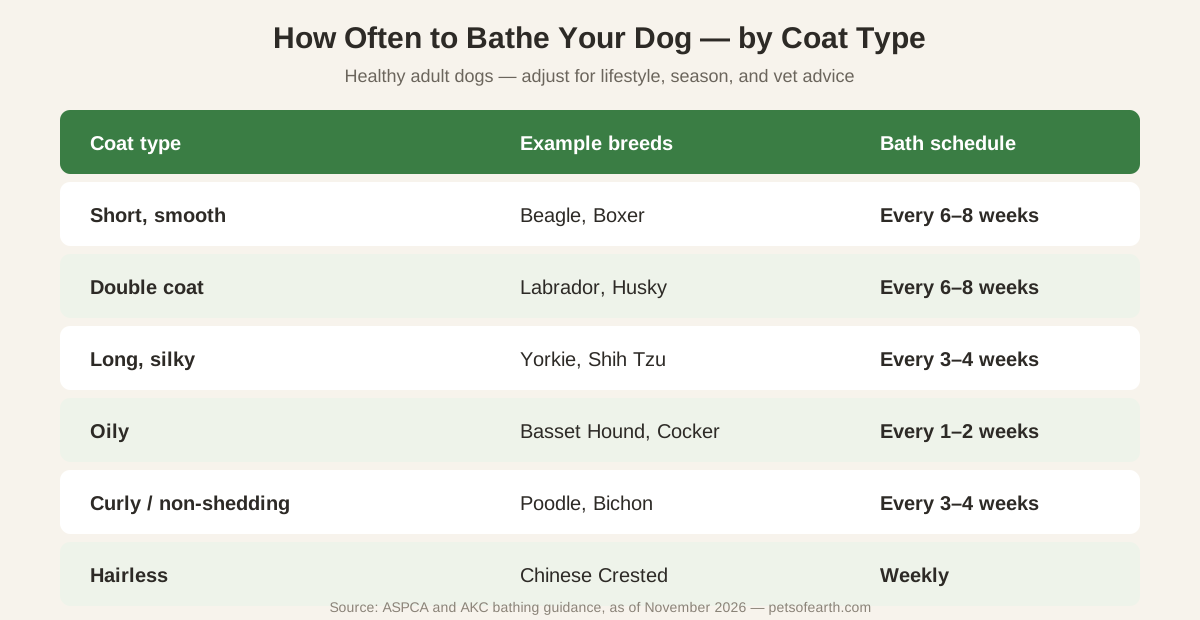
How does coat type change how often you bathe a dog?
| Coat type | Example breeds | Bathing schedule | Notes |
|---|---|---|---|
| Short, smooth | Beagle, Boxer, Weimaraner | Every 6 to 8 weeks | Sheds dirt easily; rarely smells |
| Double coat | Labrador, Husky, Golden Retriever | Every 6 to 8 weeks | Extra bath during shedding season; dry thoroughly |
| Long, silky | Yorkshire Terrier, Shih Tzu, Afghan Hound | Every 3 to 4 weeks | Mats form fast; brush before every bath |
| Oily | Basset Hound, Cocker Spaniel, Shar-Pei | Every 1 to 2 weeks | Oily skin traps odor; check skin folds |
| Curly / non-shedding | Poodle, Bichon Frise, Doodle mixes | Every 3 to 4 weeks | Needs brushing between baths to prevent mats |
| Hairless | Chinese Crested, Xoloitzcuintli | Weekly | Skin needs washing and moisturizing like human skin |
Double-coated breeds need a warning, not just a schedule. Huskies, Malamutes, and similar breeds have a dense undercoat that holds water for hours. A bath that is not followed by thorough drying can leave damp undercoat against the skin — a recipe for hot spots and fungal infections. If you bathe a double-coated dog, budget time for towel-drying plus a low-heat blow-dry, and never let the dog outside wet in cold weather.
Oily-coated breeds are the exception that proves the rule. Basset Hounds and Cocker Spaniels produce more skin oil than average, which is why they smell “doggy” faster. Bathing every 1 to 2 weeks is normal for these breeds and does not damage their skin the way weekly bathing would damage a short-coated dog’s skin. Use a gentle, dog-specific shampoo and the schedule is safe.
What happens if you bathe your dog too often?
Over-bathing strips natural oils from the skin and coat. The visible result is a dry, dull coat and flaky skin. The invisible result is a weakened skin barrier — the skin becomes more vulnerable to bacteria, yeast, and allergens. Dogs that are bathed too often commonly develop itchy skin, and owners often respond by bathing even more, which makes the problem worse.
Human shampoo makes over-bathing worse. Dog skin is less acidic than human skin — roughly pH 6.2 to 7.4, compared with about pH 5.5 for humans. Human shampoo, formulated for our more acidic skin, can irritate a dog’s skin and strip oils faster. Always use a shampoo made for dogs, and if your dog needs frequent baths, choose a gentle oatmeal or hypoallergenic formula.
Signs you are bathing too often: dry flakes on the coat, a dull or brittle coat, itching that started after you increased bath frequency, or red, irritated skin between baths. If you see these signs, stretch the interval by two weeks and switch to a moisturizing dog shampoo. If itching persists after you cut back, see your vet — itching has many causes beyond bathing, including allergies and parasites.
How do you bathe a dog properly?
A good bath takes 20 to 30 minutes and follows the same order every time. Rushing the rinse is the most common mistake — leftover shampoo residue irritates skin and attracts dirt.
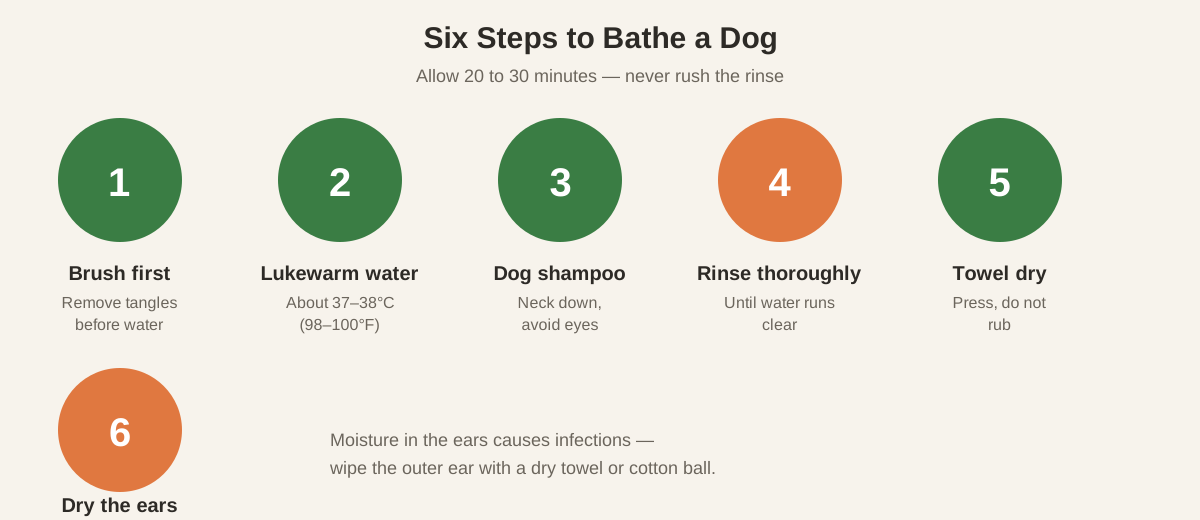
- Brush first. Remove tangles and loose fur before the dog gets wet — water tightens mats and makes them harder to remove.
- Use lukewarm water. Aim for about 37–38°C (98–100°F), roughly body temperature. Test it on your wrist the way you would for a baby.
- Wet the coat fully, then apply dog shampoo. Work from the neck down, avoiding the eyes and the inside of the ears. Massage the shampoo into the coat for a few minutes.
- Rinse thoroughly. Rinse until the water runs clear and the coat feels squeaky, not slippery. Residue is the number one cause of post-bath itching.
- Towel-dry. Press towels against the coat rather than rubbing, which tangles fur. Use two or three towels for a large dog.
- Dry the ears. Gently dry the outer ear with a towel or cotton ball. Trapped moisture in the ears is a common cause of ear infections after baths.
Never use a human hair dryer on high heat. If you blow-dry, use the lowest heat setting and keep the dryer moving. Many dogs tolerate a dryer better if you introduce it gradually over several baths rather than all at once.
What shampoo should you use for your dog?
Always use a shampoo made for dogs. The pH difference between human and dog skin is the reason — human shampoo is too acidic for dogs and can dry out their skin. Dog shampoos are formulated for a dog’s skin pH and coat needs.
Oatmeal shampoo is the safest default. It soothes mild itching and moisturizes dry skin, and it works for most coat types. Hypoallergenic, fragrance-free formulas are the best choice for dogs with sensitive skin or allergies.
Medicated shampoos are vet territory. Antifungal, antibacterial, and anti-itch medicated shampoos treat specific conditions and come with specific instructions — how long to leave the shampoo on, how often to repeat. Use them only on your vet’s advice, and follow the schedule exactly. A medicated bath that is rinsed off too early does nothing; one left on too long can irritate.
Skip the conditioner unless your dog needs it. Most dogs do fine without conditioner. Long-haired and curly-coated breeds benefit from a dog-specific conditioner that reduces tangles, but a short-coated dog gains nothing from it.
How do you dry a dog after a bath?
Towel-drying is enough for most dogs. Two or three large towels, pressed firmly against the coat, remove most of the water. Short-coated dogs air-dry in 30 minutes to an hour indoors. Long-haired and double-coated dogs take longer and benefit from a blow-dry on low heat.
Never put a wet dog outside in cold weather. A wet coat loses its insulating power, and a dog that is already cold can chill quickly. In winter, bathe indoors and keep the dog inside until fully dry. In summer, a damp dog in a warm room is fine.
Dry the ears every time. Moisture trapped in the ear canal is one of the most common causes of ear infections in dogs, especially floppy-eared breeds like Cocker Spaniels and Basset Hounds. A gentle wipe of the outer ear with a dry towel or cotton ball after every bath prevents most of these infections.
Frequently asked questions
How often should you bathe a puppy?
Puppies can be bathed from about 8 weeks old, and only when they are actually dirty — usually every 4 to 6 weeks at most. Use a puppy-specific shampoo and keep the puppy warm during and after the bath.
Can you bathe a dog too much?
Yes. Bathing more often than your dog’s coat needs strips natural oils, dries out the skin, and can cause itching and flaking. If your dog’s skin looks dry or itchy, stretch the interval and switch to a gentle oatmeal shampoo.
Is it OK to use human shampoo on a dog?
No. Human shampoo is formulated for skin with a pH around 5.5, while dog skin sits around pH 6.2 to 7.4. Human shampoo can irritate a dog’s skin and strip its coat. Always use a shampoo made for dogs.
How often should you bathe a dog that sleeps in your bed?
Every 3 to 4 weeks is a reasonable schedule for a dog that shares your bed, with a quick wipe-down of paws and belly after muddy walks. The goal is a clean coat without over-bathing — wash the paws often, bathe the whole dog less often.
Do dogs need a bath after swimming?
Yes, a rinse at minimum. Chlorine from pools and salt from the ocean dry out the coat, and lake or river water can carry bacteria. A quick rinse with fresh water after every swim, and a full bath with shampoo once a week during swim season, keeps the coat healthy.
What if my dog hates baths?
Introduce baths gradually: let the dog stand in an empty tub with treats, then add a little water over several sessions. Use a non-slip mat, keep your voice calm, and reward the dog after every bath. Most dogs that hate baths were rushed into a full bath on day one — patience works better than force.
The bottom line
Most dogs need a bath every 4 to 6 weeks, with oily-coated breeds on the shorter end and short-haired indoor dogs on the longer end. Use a dog-specific shampoo, rinse thoroughly, dry the ears, and let your dog’s coat and skin — not the calendar — tell you when the next bath is due. When in doubt, ask your vet: a quick question at a checkup beats guessing, and a schedule that fits your dog beats any schedule on the internet.
Sources: ASPCA pet-care guidance on dog bathing; American Kennel Club bathing-frequency guidance; American Veterinary Medical Association (AVMA) pet-owner resources. As of November 2026.