
Yes, dogs can eat bananas — in moderation, peeled, and in small slices. Bananas are not toxic to dogs, and the American Kennel Club (AKC) lists them as a safe fruit when served as an occasional treat. The catch is sugar: one medium banana carries about 14 grams of natural sugar, so a couple of slices is a treat, not a snack habit.
Photo: Pexels.
TL;DR — the short answer:
- Yes, dogs can eat bananas. Peeled, ripe banana flesh is safe and non-toxic.
- Keep portions small. A couple of slices for a small dog, up to half a banana for a large dog, a few times a week at most.
- Always remove the peel. Peels are not toxic but are hard to digest and can cause a blockage.
- Follow the 10% rule. All treats combined, banana included, should stay under 10% of your dog’s daily calories.
- Skip it for some dogs. Dogs with diabetes, kidney disease, or a weight problem need a vet’s go-ahead first.
We compared guidance from the American Kennel Club and the ASPCA, plus veterinary nutrition advice and verified owner feedback, to build this guide.
Are bananas safe for dogs?
Yes. Bananas are one of the safest fruits you can share with a dog. The AKC confirms that dogs can eat bananas, noting that they provide potassium, vitamin B6, vitamin C, fiber, and magnesium — and that the only real concern is the sugar content, which is why portions stay small. Bananas also do not appear on the ASPCA’s list of people foods to avoid feeding pets, a list that does include grapes, onions, garlic, macadamia nuts, and xylitol.
“Safe” does not mean “unlimited.” A banana is a treat, not a food group. Your dog’s complete and balanced dog food already covers its nutritional needs. The widely used veterinary rule is simple: treats of all kinds should make up no more than 10% of a dog’s daily calories. A medium banana has about 105 calories, so for a 20-pound dog eating roughly 400 calories a day, a whole banana would blow the entire daily treat budget more than twice over. If your dog has never had banana, start with a single small slice and watch for 24 hours — most dogs handle it fine, but a sensitive stomach can react to any new food with soft stools or gas.
What nutrients do bananas actually give a dog?
Bananas earn their reputation as a healthy treat honestly — low in fat and sodium, with several nutrients dogs genuinely use. The numbers below are for one medium banana (about 118 grams), from USDA FoodData Central, as of November 2026.
| Nutrient | Per medium banana | Why it matters for dogs |
|---|---|---|
| Calories | ~105 | The whole reason portions stay small |
| Potassium | 422 mg | Supports muscle function and nerve signals |
| Vitamin B6 | 0.43 mg | Helps the body make proteins and red blood cells |
| Vitamin C | 10.3 mg | An antioxidant; dogs also make their own vitamin C |
| Magnesium | 32 mg | Supports bone growth and vitamin absorption |
| Fiber | 3.1 g | Can help firm up loose stools in small amounts |
| Natural sugar | ~14 g | The downside — the reason banana is a treat, not a staple |
Potassium is the headline nutrient, but it is not a reason to overfeed. A healthy dog on a complete diet already gets enough potassium from its food, and unlike humans, dogs produce vitamin C in their own livers — so the banana’s vitamins are a bonus, not a supplement your dog is missing. Fiber cuts both ways. In small amounts it can help a dog with mild digestive trouble; in large amounts, that same fiber — plus the sugar — is exactly what causes the gas and soft stools owners report after overfeeding.
How much banana can a dog eat?
There is no official per-breed banana chart from any veterinary body, so every portion guide — including this one — is built on the 10% treat rule and the AKC’s guidance to keep servings small. The table below is a conservative starting point for healthy adult dogs, a few times a week at most, not daily.
| Dog size | Example breeds | Safe portion per treat | How often |
|---|---|---|---|
| Extra small (under 10 lb) | Chihuahua, Yorkshire Terrier | 1–2 thin slices | 1–2 times a week |
| Small (10–25 lb) | Beagle, Pug, French Bulldog | 2–3 slices | 1–2 times a week |
| Medium (25–50 lb) | Border Collie, Bulldog, Cocker Spaniel | Up to ¼ banana | 1–2 times a week |
| Large (50–90 lb) | Labrador, Golden Retriever, Boxer | Up to ⅓ banana | 2–3 times a week |
| Giant (over 90 lb) | Great Dane, Mastiff | Up to ½ banana | 2–3 times a week |
The 10% rule is the real limit, not the table. A slice is roughly a quarter-inch thick and carries about 10 calories. Two slices are about 5% of a small dog’s daily calories — right in the safe zone. Half a banana is about 50 calories, which fits inside a large dog’s treat budget but would be a quarter of a small dog’s entire day. When in doubt, feed less than the table says: no dog ever suffered from getting one slice instead of three.
Can dogs eat banana peels?
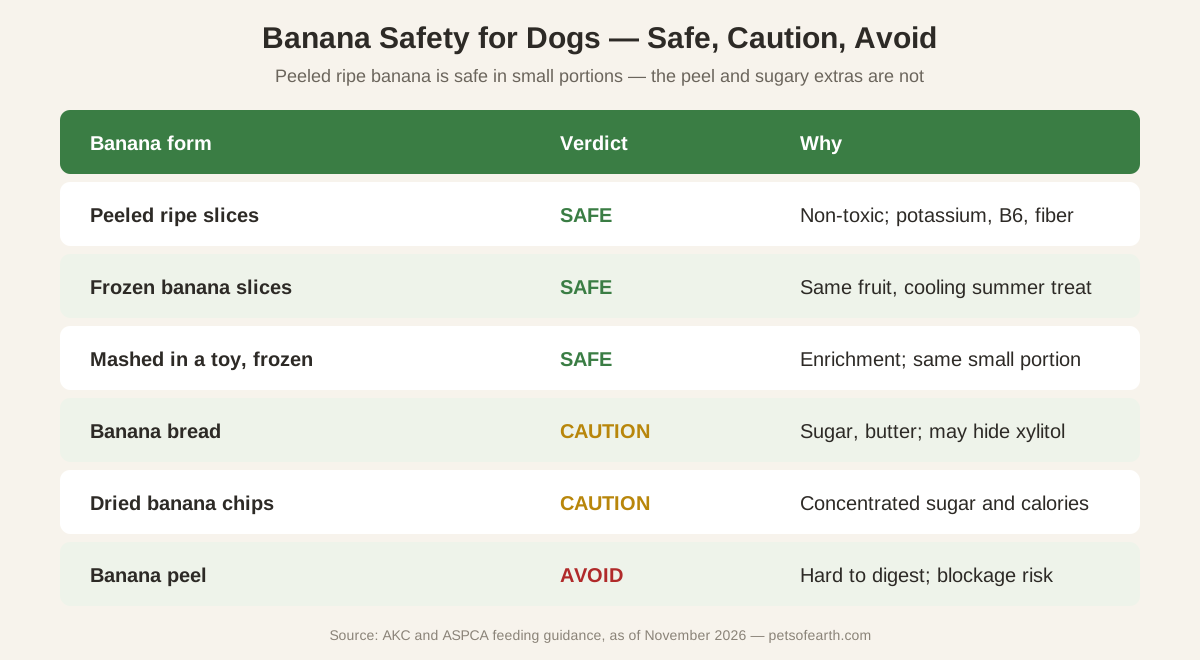
No — do not feed your dog a banana peel. The peel is not toxic, but that is the only good thing about it. Banana peels are tough, fibrous, and very hard for a dog’s stomach to break down. The AKC warns that eating a peel can cause stomach upset and, in the worst case, an intestinal blockage, especially if a dog swallows a large piece whole. A peel is also a choking hazard for small dogs and enthusiastic eaters who do not chew.
If your dog already ate a peel, do not panic — but do watch. A small piece of peel will usually pass through with mild stomach upset at most. Call your vet promptly if your dog ate a large piece, or if you see vomiting, straining to poop, loss of appetite, lethargy, or a swollen belly in the hours after. Those are the signs of a blockage, and a blockage is a veterinary emergency, not a wait-and-see situation. When you call, note how much peel your dog ate and when — the ASPCA’s poison-control line, (888) 426-4435, is also available if your vet is closed. The classic accident is a dog fishing a peel out of the trash or off a counter, so drop peels straight into a closed bin.
Can puppies eat bananas?
Yes, puppies can eat bananas in moderation, with smaller portions than an adult dog of the same breed. The AKC’s guidance applies to puppies too: a couple of small slices as an occasional treat is fine, and a puppy’s smaller stomach means the starting dose should be a single thin slice, with 24 hours of watching before offering more.
Puppies under 8 weeks should not get treats at all. Very young puppies are still on their mother’s milk or a puppy formula, and their digestive systems are not ready for solid extras. Once a puppy is weaned and eating solid puppy food — usually from about 8 weeks — a tiny taste of banana is safe. Keep it to a rare treat: a growing puppy’s calories should go toward a complete puppy food, not fruit. Because most dogs love the sweet taste, a thin slice cut into pea-sized bits also makes a soft, easy training reward — just count those bits toward the 10% treat budget.
Which dogs should skip bananas?
Most healthy dogs can enjoy banana, but three groups need a vet’s approval first.
Dogs with diabetes should generally avoid bananas. A medium banana’s 14 grams of sugar is a meaningful blood-sugar spike for a diabetic dog. Some vets allow a very small piece as a rare treat, but this is a decision for your dog’s vet, who knows its insulin routine.
Dogs with kidney disease need caution around potassium. Bananas are high in potassium, and dogs with advanced kidney disease often need to limit it — ask your vet before offering banana at all.
Overweight dogs and dogs on a weight-loss plan should skip it. Banana is not a low-calorie treat — at roughly 105 calories per fruit, it is one of the more calorific fruits you can offer, and a dog that needs to lose weight has no spare calories for it.
Dogs with sensitive stomachs can go either way. A small amount of banana fiber may help some dogs with loose stools, but the same fruit can trigger gas and soft stools in others — introduce it with a single thin slice and wait a day before deciding it agrees with them.
How should you serve bananas to a dog?
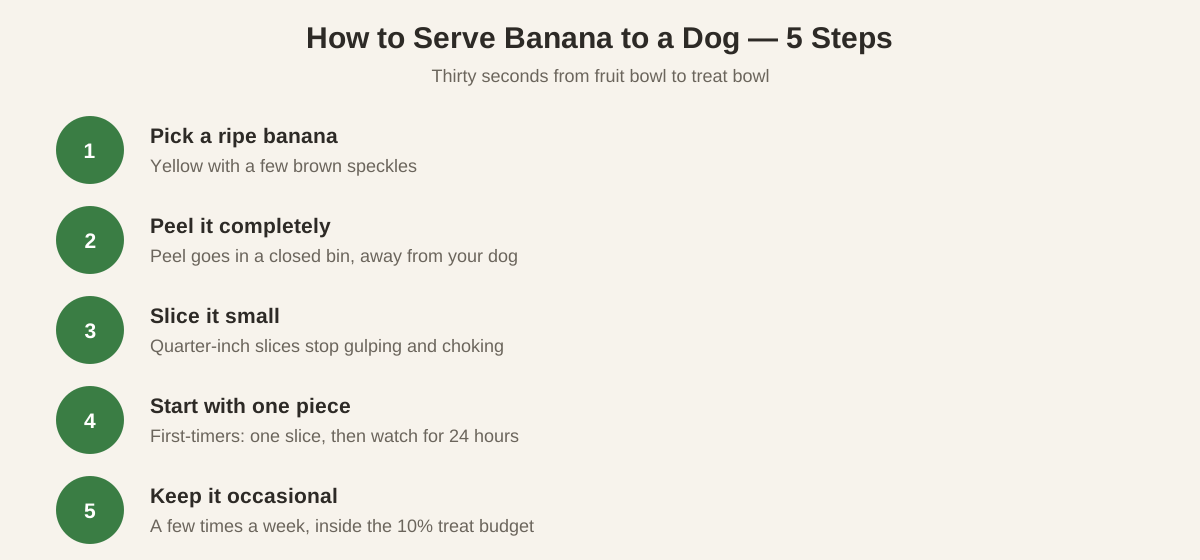
Serving banana safely takes about thirty seconds, and every step exists to remove one specific risk.
- Pick a ripe banana. Yellow with a few brown speckles is ideal. Green bananas are starchy and harder to digest.
- Peel it completely. Remove the whole peel and throw it in a closed bin, away from your dog.
- Slice it small. Cut quarter-inch slices. Small pieces prevent gulping and choking, especially in small breeds and puppies.
- Start with one piece. For a first-timer, one slice is the whole serving. Watch for 24 hours before offering a normal portion.
- Serve it plain. No chocolate, no banana bread. If you add peanut butter, check the label for xylitol first — it is toxic to dogs.
- Keep it occasional. A few times a week at most, inside the 10% treat budget.
Frozen banana is a summer upgrade, not a different food. Freeze peeled slices and offer them as a cooling chew on hot days — the same portions apply, and the frozen texture slows down gulpers. Mashed banana also works well smeared inside a stuffable toy and frozen, which turns a 10-calorie slice into ten minutes of enrichment.
What happens if a dog eats too much banana?
Too much banana causes digestive trouble, not poisoning. The most common signs are soft stools or diarrhea, gas, and a stomach that gurgles audibly — all from the combination of sugar and fiber in a large dose. These symptoms usually pass within a day.
The serious risks are the peel and the sugar, not the fruit itself. A swallowed peel can cause a blockage, which shows up as repeated vomiting, straining without producing stool, a painful or swollen belly, and refusal to eat. That is an emergency: call your vet immediately, or the ASPCA Animal Poison Control Center at (888) 426-4435. Repeated overfeeding over weeks is the slower problem — steady weight gain and, in a diabetic dog, blood-sugar trouble. Neither happens from one banana; both happen from a habit. When in doubt, call your vet — a two-minute call beats a night of worrying.
Frequently asked questions
Can dogs eat bananas every day?
No — bananas should stay an occasional treat, a few times a week at most, because their sugar adds up fast and daily feeding eats into the 10% treat budget.
Can dogs eat banana bread?
No. Most recipes contain sugar, butter, and often xylitol, chocolate chips, or nutmeg, any of which can be harmful, and a slice carries far more calories than plain banana.
Can dogs eat dried banana chips?
It is best to skip them. Dried banana is far more concentrated in sugar and calories than fresh banana, and many commercial chips add sweeteners or preservatives.
Can dogs eat frozen bananas?
Yes, frozen banana slices are safe as long as they are peeled and cut to a size your dog can chew safely. They make a good cooling treat in warm weather.
Are bananas good for dogs with sensitive stomachs?
Sometimes — the fiber in a small amount of banana may help firm up loose stools, but too much can cause gas and diarrhea, so start with a single thin slice and watch for 24 hours.
What should I do if my dog ate a banana peel?
Watch for vomiting, straining to poop, loss of appetite, or lethargy, and call your vet promptly if you see any of those signs, since peels can cause an intestinal blockage.
Sources
- American Kennel Club, “Can Dogs Eat Bananas?” (updated September 1, 2026): akc.org/expert-advice/nutrition/can-dogs-eat-bananas
- ASPCA, “People Foods to Avoid Feeding Your Pets” (bananas are not on the ASPCA’s avoid list): aspca.org/pet-care/animal-poison-control/people-foods-avoid-feeding-your-pets
- USDA FoodData Central, raw banana nutrition values per 118 g medium banana, as of November 2026.
This article is general pet-care information, not veterinary advice. Every dog is different — talk to your veterinarian before changing your dog’s diet, especially if your dog has diabetes, kidney disease, or a weight problem.