
Introduce a puppy to an older dog on neutral ground, on leashes, for a short 10 to 15 minute meeting, then separate them and repeat daily with gradually longer sessions. Most dogs settle into a comfortable routine within 1 to 2 weeks when introductions are slow, supervised, and built around the older dog’s space, food, and rest.
A new puppy is exciting for the family, but for the dog already living in the house, a small stranger who steals toys and has no manners can feel like an invasion. Most older dogs accept a puppy just fine when the meeting is managed well: prepare the home first, meet outside the house, then build shared time in small steps over about a week.
How Long Does It Take to Introduce a Puppy to an Older Dog?
Most pairs reach a relaxed daily routine within 1 to 2 weeks, though the exact timeline depends on the older dog’s age, health, and temperament. A calm adult dog may accept a puppy in a few days, while a senior dog with sore joints may need 3 to 4 weeks before sharing space freely.
The first meeting itself should last only 10 to 15 minutes. Plan for 2 to 3 brief meetings per day during the first week, and keep the dogs separated between sessions so each one can rest.
Age matters on both sides. Puppies usually go home at 8 weeks old, and the American Kennel Club (AKC) notes that puppies benefit from staying with their litter until at least 8 weeks. An older dog that is 10 years or older, or one managing arthritis, will tire faster and need more breaks than a healthy 3-year-old.
What Should You Do Before the First Meeting?
A few small steps before the dogs ever see each other make the first meeting far easier.
Book a vet check for the puppy first. The puppy should be examined, started on vaccinations, and screened for parasites before meeting a resident dog. The American Veterinary Medical Association (AVMA) recommends a veterinary exam within the first few days of bringing a puppy home, and that visit is the right time to ask about safe socialization for your puppy’s vaccination stage.
Set up separate spaces. Each dog needs its own bed, food bowl, water bowl, and rest area. Put the puppy’s crate or pen in a room where the older dog does not usually sleep, so the resident dog keeps its favorite spots. A crate gives the puppy a safe den of its own, and our guide to the best dog crate for anxious dogs covers how to choose a size and set it up so a puppy actually wants to use it.
Swap scents before they meet. For 2 to 3 days before the introduction, trade a blanket or towel between the dogs so each one learns the other’s smell in a calm setting. Rub the cloth on the puppy’s cheeks and neck, then leave it near the older dog’s bed, and do the same in reverse.
Exercise the older dog beforehand. A tired dog is a tolerant dog. Give the older dog a good walk or play session an hour before the first meeting so it arrives relaxed rather than bursting with energy. Exercise needs vary a lot by breed: a Labrador needs far more daily activity than a small companion breed, and our guide on how much exercise does a Labrador need breaks down the right amount by age. Have two leashes, high-value treats, a water bowl, and a baby gate ready, and remove favorite bones and special toys from the meeting area so there is nothing worth guarding.
How Do You Introduce a Puppy to an Older Dog for the First Time?
Follow these seven steps in order. The first meeting is only step four.
1. Meet on neutral ground. Choose a quiet spot neither dog considers its own territory, such as a neighbor’s yard or a calm stretch of sidewalk. Do not introduce the dogs inside the house or in the yard the older dog guards. Neutral ground removes the biggest trigger for a territorial reaction.
2. Walk parallel at a distance. Start with the dogs about 10 to 15 feet apart, walking in the same direction with a handler each. If both dogs stay loose and relaxed, close the gap by a few feet every minute or so. If either dog stiffens, barks, or fixates, increase the distance again and wait for calm.
3. Let them sniff briefly, then move on. When the dogs are walking calmly side by side, allow a short 3 to 5 second sniff, then cheerfully call them forward and keep walking. Reward both dogs with a treat for staying calm.
4. Allow a short off-leash greeting only if both dogs are relaxed. In a fenced, neutral area, drop the leashes and let the dogs greet for about 10 minutes while you watch closely. Loose bodies, play bows, and curved approaches are good signs.
5. Walk home together. Walk the dogs back to the house side by side, with the older dog entering first. Letting the resident dog walk in first signals that its place in the household has not changed.
6. Keep the first indoor session short and supervised. Give the puppy a tour of one room while the older dog watches from a comfortable distance. Use a baby gate to create a safe zone the puppy can retreat behind, then separate them for a nap.
7. Repeat daily, adding a little more time each day. Increase shared time by 10 to 15 minutes per day as long as both dogs stay relaxed. Never leave a puppy and an older dog alone together unsupervised during the first 2 weeks.
What Does the First Week Together Look Like?
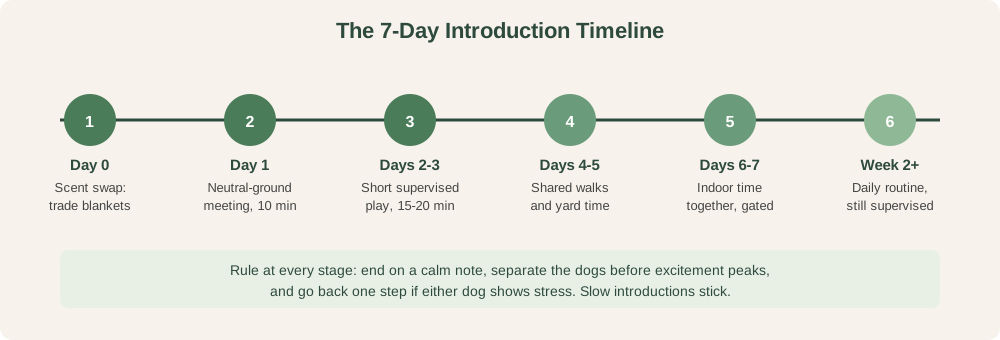
A slow, predictable schedule is the fastest route to a peaceful household. The table below shows a typical first week as of November 2026. If either dog shows stress, stay at the current step for an extra day.
| Day | Main activity | Shared time | What to watch for |
|---|---|---|---|
| Day 0 | Scent swap only; dogs do not meet | 0 minutes | Calm interest in the other’s blanket, no guarding of the scent item |
| Day 1 | Neutral-ground meeting and parallel walk | 10 to 15 minutes | Loose bodies, brief sniffs, easy disengagement |
| Days 2-3 | Short supervised play in a neutral or shared space | 15 to 20 minutes, 2 to 3 times a day | Play bows and turn-taking |
| Days 4-5 | Shared walks and yard time, feeding in separate spots | 30 to 45 minutes at a time | Both dogs eat calmly in their own areas; no food guarding |
| Days 6-7 | Gated indoor time together, puppy explores with supervision | 1 to 2 hours, with breaks | Older dog rests peacefully near the puppy; puppy settles for naps |
| Week 2+ | Normal household routine, still supervised when together | Full day with rest breaks | Gentle corrections; both dogs rest near each other |
How Can You Tell If the Introduction Is Going Well?
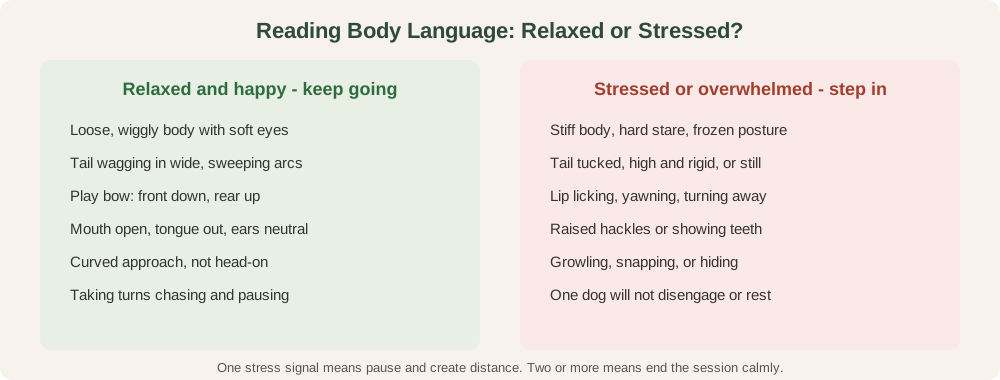
Watch the dogs, not the clock. A relaxed dog has a loose, wiggly body, soft eyes, and a tail that sweeps in wide arcs. Play bows, where the dog lowers its front end and raises its rear, are an invitation to play.
The older dog will probably correct the puppy at some point, and that is normal. A quick growl or a snap in the air that sends the puppy backing off is how adult dogs teach manners. The key difference between a correction and a problem is what happens next: after a fair correction, both dogs should relax and move on within seconds.
Puppies are clumsy social learners. Expect the puppy to ignore the older dog’s early warnings and get corrected more than once. If you see lip licking, yawning when not tired, turning away, or a tucked tail, those are stress signals: pause the session, create distance, and let both dogs calm down before trying again.
What If the Older Dog Growls or Snaps at the Puppy?
A growl is communication, not bad behavior, and it is one of the most misunderstood parts of dog introductions. The ASPCA advises owners never to punish a growl, because a dog that is punished for growling may skip the warning next time and go straight to a bite. When the older dog growls, calmly separate the dogs and try again later at a greater distance.
Context matters. A single growl when the puppy climbs on the older dog’s head is a fair correction. Repeated hard staring, stiff posturing, or snapping that makes contact means the introduction is moving too fast. Go back one step in the plan, shorten the sessions, and increase the distance between the dogs.
If the older dog’s reactions are intense from the very first meeting, or the aggression does not improve after a week of slow introductions, call in a certified professional dog trainer or a veterinary behaviorist. This is especially important for senior dogs in pain, dogs with a history of biting, or households where the size difference between the animals is large. The AVMA recommends asking your veterinarian for a referral to a qualified behavior professional.
What Mistakes Should You Avoid When Introducing a Puppy to an Older Dog?
Most introduction failures come from a few avoidable mistakes.
Do not force them to share everything at once. Food bowls, beds, and favorite toys should stay separate for the first few weeks. Resource guarding is one of the most common causes of fights between a new puppy and a resident dog.
Do not leave them alone together too soon. Even friendly pairs need supervision until the relationship is proven over weeks, not days. A puppy’s rude behavior can push a tolerant older dog past its limit when no one is watching. Use crates, gates, and separate rooms whenever you leave the house.
Do not ignore the older dog. Give the older dog its usual walks, attention, and treats first, especially in the first week. Greeting, feeding, and petting the resident dog before the puppy reassures it that nothing important has been lost.
Do not bathe the puppy right before the meeting. A wet, stressed puppy smells strange and behaves oddly, which can make the older dog suspicious. If bath time is due after outdoor introductions, check our guide on how often should you bathe a dog so you do not over-bathe young skin.
Do not rush because of a deadline. There is no prize for finishing introductions in a weekend. Dogs that are introduced slowly in the first two weeks are far more likely to become genuine companions than dogs pushed together too fast. Slow introductions are the shortcut.
Frequently Asked Questions
Should I introduce a puppy to an older dog inside or outside the house?
Outside, on neutral ground. A first meeting inside the house puts the puppy in the older dog’s territory, which raises the chance of a defensive reaction, while a quiet sidewalk or neighbor’s yard lets both dogs meet without anything to guard.
How long should the first meeting between a puppy and an older dog last?
The first meeting should last 10 to 15 minutes. Short meetings end while both dogs are still happy, and repeating them daily builds a positive association faster than one long session that ends in stress or exhaustion.
Is it normal for an older dog to growl at a new puppy?
Yes, an occasional growl is normal communication. Adult dogs use growls to teach puppies manners, and a brief growl followed by both dogs relaxing is a healthy correction.
When can a puppy and an older dog be left alone together?
Most pairs can be left alone together after 2 to 4 weeks of calm, supervised time together. Wait until both dogs rest peacefully in the same room and have shown no guarding or chasing, and start with very short absences first.
What if my older dog ignores the new puppy completely?
Ignoring the puppy is usually fine and often a good sign. Many older dogs simply do not find puppies interesting at first, and indifference is far better than hostility; keep sessions short and pleasant, and the older dog will usually warm up over 1 to 2 weeks.
Should I get a puppy if my dog is very old or sick?
Talk to your veterinarian first. A puppy’s constant energy can stress a frail senior dog, and the AVMA notes that pain and illness can lower a dog’s tolerance for a new housemate.
A calm, well-managed introduction is the best gift you can give both dogs. Take it slow, watch their body language, and protect the older dog’s routine while the puppy learns the rules of the house. Within a few weeks, most families find the two dogs napping near each other and settling into a companionship that lasts for years.