
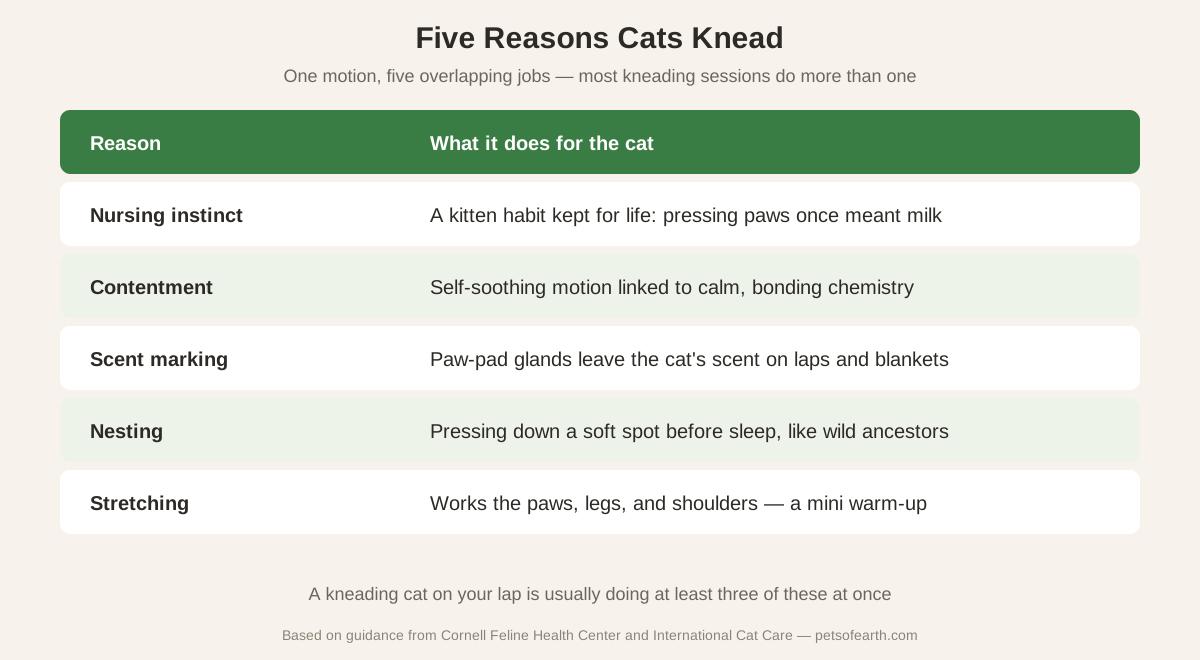
Cats knead because the motion starts in kittenhood: nursing kittens press their mother’s belly to stimulate milk flow, and the action becomes linked to warmth, food, and safety. Most adult cats keep kneading when they feel content, to mark a spot with scent from glands in their paw pads, or to settle a soft surface before sleep.
Photo: Pexels.
TL;DR — the short answer:
- Kneading starts as a nursing reflex. Kittens press their mother’s belly to help milk flow, and the motion becomes tied to comfort.
- Adult cats knead when they feel content — one of the clearest signs a cat feels safe with you.
- It also marks territory. Scent glands in the paw pads leave a cat’s scent on whatever it kneads.
- Kneading before sleep is nesting. Wild ancestors pressed down grass and leaves to make a resting spot.
- Claws-out kneading is normal, not aggressive. Trim the claws and keep a thick blanket on your lap.
- See a vet if kneading turns frantic or obsessive, or comes with other symptoms.
We compared guidance from the Cornell Feline Health Center, the ASPCA, and International Cat Care to build this guide.
What exactly is kneading?
Kneading is the rhythmic motion of a cat pushing its front paws alternately into a soft surface — one paw, then the other. Owners call it “making biscuits”: the motion looks like hands working bread dough. Most cats knead with claws sheathed, but some extend them — which is when laps start to hurt.
Kneading is a normal, healthy behavior in cats of all ages. Kittens do it from their first days of life, and many cats keep doing it. Some knead daily, some only before sleep, and some rarely or never do it at all — that whole range is normal. What matters is context: a relaxed cat with half-closed eyes tells a very different story from a tense cat kneading frantically for hours. A kneading cat often purrs and lets its body go loose — the body language of a cat that feels safe.
Where does kneading come from?
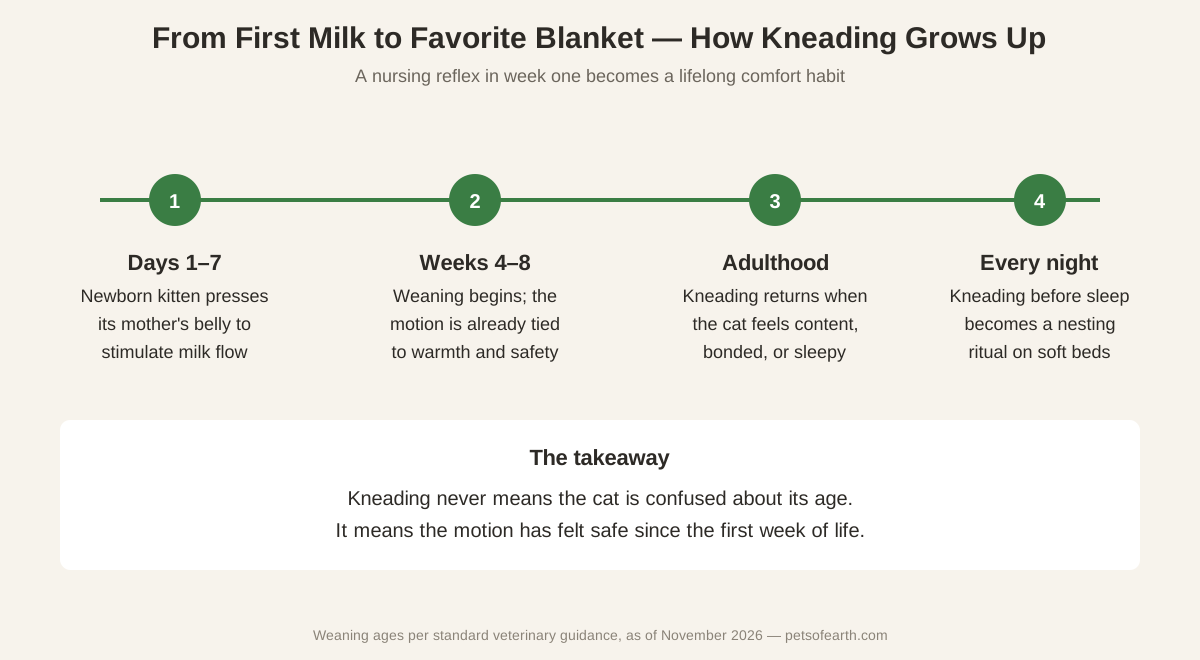
Kneading begins at the very start of a cat’s life. A newborn kitten cannot see or hear well, but it can find its mother’s belly and press its tiny paws to stimulate milk flow. The reward — food, warmth, and closeness — arrives within minutes, so the association forms fast.
That early link is why kneading survives into adulthood. The kitten grows up and the milk stops, but the motion stays wired to the same feelings. International Cat Care explains that cats who knead on a lap associate that person with a mother’s comfort.
Cats weaned very early sometimes knead more. Kittens are normally weaned gradually from around 4 weeks and fully by about 8 weeks, as of November 2026 — a kitten separated before then may hold on to kitten behaviors more strongly.
Why do adult cats knead when they feel happy?
Contentment is the most common reason an adult cat kneads. A cat that climbs onto your lap, starts kneading, and begins to purr is not asking for anything. Behaviorists describe kneading as self-soothing: the repetitive motion is calming, and it is linked to feel-good chemicals like oxytocin and endorphins.
Kneading is a cat’s way of saying it trusts you. Cats are careful about where they let their guard down. A cat that kneads on you has decided you are safe — safe enough to close its eyes and slip into the half-dreamy state that kneading brings.
Stress can also trigger kneading: a cat that has just come home from the vet, or that is settling into a new house, may knead a blanket as it calms down. Context tells you which one it is: a cat kneading on a sunny lap with slow blinks is content, while a cat kneading nonstop in a hiding spot is self-soothing.
Why does my cat knead me instead of the blanket?
Cats knead people for the same reasons they knead blankets — plus one more: you. A blanket is soft and warm. You are soft, warm, and you smell like home, which makes your lap the best kneading surface in the house.
Scent marking is the hidden reason cats knead their favorite people. Cats have scent glands in their paw pads, and every kneading session presses a small amount of scent onto the surface. The Cornell Feline Health Center notes that scratching deposits scent from special glands on a cat’s paws, and kneading works the same way — it quietly claims the spot as familiar territory.
That is also why cats knead some people and not others: the person who feeds the cat, plays with it, and sits still long enough to become a lap. If your cat kneads you and no one else, take it as a compliment.
Why do cats knead blankets and beds before sleeping?
Watch a cat get ready for a nap and you will often see a small ritual: circle, knead the blanket, then curl up and sleep. That sequence is ancient. Wild cats pressed down tall grass and leaves to flatten a resting spot before lying down. Your house cat does the same thing to a blanket, a cushion, or a pile of laundry.
Kneading before sleep is nesting, not restlessness. The cat is testing the surface, warming it, and shaping it. Soft, thick materials invite the most kneading, which is why cats gravitate to fleece blankets and freshly folded laundry.
What does kneading with purring, drooling, or closed eyes mean?
When kneading shows up alongside purring, slow blinks, and a relaxed body, the message is simple: this cat is deeply content. Both behaviors trace back to kittenhood, when kittens purr and knead while nursing — so they often arrive together in adulthood.
Drooling while kneading looks alarming but is usually harmless. Some cats drool when they slip into a deeply relaxed state. That said, drooling that starts suddenly, happens outside of kneading, or comes with bad breath or appetite loss is different — those are reasons to call a vet. Closed eyes and slow blinks are the clearest trust signal a cat gives: a cat that closes its eyes on your lap is choosing to be vulnerable with you.
How is kneading different from other comfort behaviors?
Kneading is one of several ways cats show contentment, mark territory, or soothe themselves. Here they are at a glance.
| Behavior | What it looks like | What it usually means | When to watch it |
|---|---|---|---|
| Kneading | Alternating front paws pressing a soft surface | Contentment, scent marking, nesting before sleep | If frantic, constant, or paired with distress |
| Purring | Low, continuous vibration, often with relaxed posture | Contentment — but also self-soothing when hurt or stressed | If constant, with hiding, less eating, or pain |
| Headbutting (bunting) | Cat presses head or cheek against you | Affection and scent marking from cheek glands | Rarely a concern; it is a friendly greeting |
| Slow blinking | Long, deliberate half-closes while looking at you | Trust and relaxation | No concern; it is one of the clearest calm signals |
| Wool sucking | Sucking or chewing fabric while kneading | Comfort-seeking, more common in cats weaned early | If the cat swallows fabric — risk of blockage |
The key difference is what the cat does with its paws. Purring, headbutting, and slow blinking are social signals. Kneading adds a territorial layer: the cat is marking the spot and preparing it. Wool sucking is the one behavior here that deserves closer attention, because a cat that chews and swallows fabric can develop a life-threatening intestinal blockage. The Cornell Feline Health Center notes swallowed fabric can cause serious gastrointestinal obstructions — if kneading turns into chewing and swallowing, that is a vet visit, not a quirk.
When should kneading worry you?
Kneading itself is not a problem. It becomes a reason to pay attention when the pattern changes — when a cat that never kneaded suddenly starts doing it constantly, when the motion turns frantic, or when it shows up alongside other symptoms.
See a vet promptly if kneading comes with any of these signs: sudden aggression or biting, kneading for hours without stopping, loss of appetite, hiding more than usual, vomiting or diarrhea, over-grooming to bald patches, or kneading aimed at a painful area. A sudden behavior change is always worth investigating, because cats hide pain well.
Excessive kneading can also signal stress rather than illness. A cat that kneads obsessively after a move, a new pet, or a change in routine may be coping with anxiety. The ASPCA’s guide to common cat behavior issues notes that stress-related behaviors often trace back to changes at home, and the fix starts with restoring routine: quiet hiding spots, consistent feeding times, and extra play. If it does not settle within a couple of weeks, a vet or feline behaviorist can help.
Some cats knead aggressively, claws fully extended, and bite if moved. That is usually overstimulation, not anger — and the answer is not punishment, which only teaches the cat to fear you. Place a thick blanket between the claws and your skin, or calmly lift the cat onto a cushion beside you. If the cat regularly becomes aggressive when touched, talk to your vet: pain, especially arthritis, can make a cat that once loved lap time suddenly lash out.
How can I live with a cat who kneads with claws out?
Claws-out kneading hurts, and it is the one part of the behavior most owners want to change. You can manage it without stopping the kneading itself, because kneading is a comfort behavior your cat needs.
Keep a thick blanket on your lap. A folded fleece blanket or thick cushion takes the claws before they reach your skin, and many cats prefer kneading something thick and soft anyway.
Trim the claws every two to three weeks. Short, blunt claws turn painful kneading into a gentle massage. Use cat nail clippers and trim only the sharp tip — never cut the pink quick inside the nail, which bleeds and hurts. If you are unsure where the quick is, ask your vet or a groomer to show you once.
Redirect, do not punish. If your cat starts kneading your bare arm, slide a blanket or cushion under its paws instead of pushing the cat away. Pushing, yelling, or squirting water teaches the cat that your lap is unsafe. The Cornell Feline Health Center is clear: cats do not respond well to punishment.
Never declaw a cat to stop kneading. Declawing is not a nail trim — it is the surgical amputation of the last bone of each toe. Cornell calls declawing an elective and highly controversial procedure that should be considered only as an absolute last resort, and it is banned or restricted in a growing number of US states and cities. Declawed cats can develop lasting pain, litter-box avoidance, and biting — so if claws are the problem, the answer is trimming and blankets, not surgery.
Frequently asked questions
Why does my cat knead me and not the blanket?
Because you are warm, soft, and smell like home — and kneading marks you with scent from your cat’s paw pads.
Does kneading hurt the cat?
No — it is a comfortable, self-soothing motion for the cat — but claws-out kneading can hurt you, which is why nail trims and a lap blanket help.
Is it normal for a cat to knead and drool at the same time?
Yes, some cats drool a little when they slip into a deeply relaxed state while kneading, but sudden drooling, bad breath, or appetite loss needs a vet visit.
Why does my cat knead only me and not other people?
Cats knead the person they trust most — usually the one who feeds them and sits still long enough to become a lap.
Should I stop my cat from kneading?
No — kneading is normal, but you can manage the claws with nail trims, a thick blanket, and gentle redirection.
Do all cats knead?
No — some do it daily, some only before sleep, and some never do it at all — and that whole range is normal.
Sources
- International Cat Care, “Why do cats..?” (kneading as a retained nursing behavior): icatcare.org/articles/why-do-cats
- Cornell Feline Health Center, “Feline Behavior Problems: Destructive Behavior” (scent glands in the paws, fabric chewing, declawing, and punishment): vet.cornell.edu/departments-centers-and-institutes/cornell-feline-health-center/health-information/feline-health-topics/feline-behavior-problems-destructive-behavior
- ASPCA, “Common Cat Behavior Issues” (stress-related behavior changes): aspca.org/pet-care/cat-care/common-cat-behavior-issues
This article is general pet-care information, not veterinary advice. Every cat is different — talk to your veterinarian before changing anything about your cat’s care, especially if your cat shows sudden behavior changes.