
Teach your dog that the doorbell predicts a treat for staying calm, not a reason to bark. Pair the sound with a reward on a mat away from the door, practice with a recorded ring first, and most dogs improve noticeably within 2 to 4 weeks of short daily sessions.
Why do dogs bark at the doorbell?
Dogs bark at the doorbell because the sound means something is about to happen, and barking has worked for them before. Every time the bell rings and a stranger appears, the dog’s brain links the two events — and the barking feels useful, so it repeats.
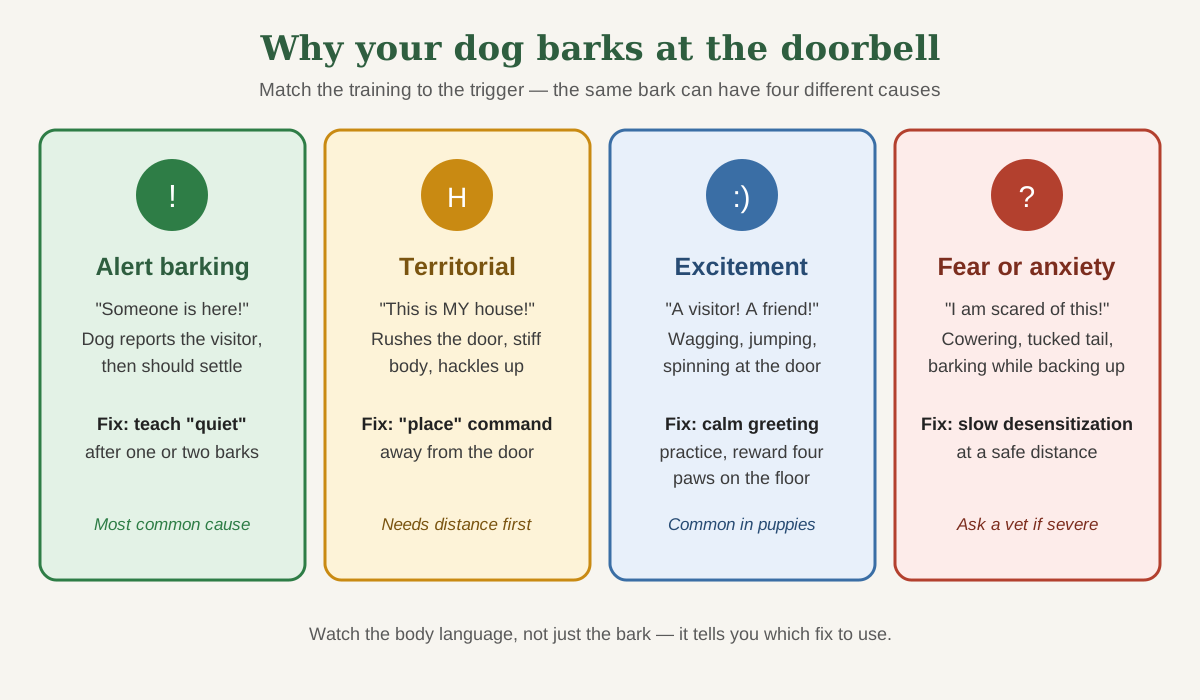
Most doorbell barking falls into one of four patterns. Alert barking is the most common: your dog hears the bell, barks to announce the visitor, and would settle if someone acknowledged it. Territorial barking is louder and stiffer, with the dog rushing the door. Excitement barking comes with a wagging tail, jumping, and spinning. Fear barking is different again: the dog barks while backing away, tail tucked, because the sound or the stranger worries it.
The distinction matters because the fix is different for each one. An excited puppy needs calm-greeting practice, a fearful dog needs slow desensitization at a distance, and a territorial dog needs a job to do instead — a “place” command on a mat across the room.
Above all, doorbell barking is usually a learned habit, not a personality trait. The dog barks, the door opens, the visitor appears, and the dog concludes that barking caused the door to open. This guide breaks that link by teaching a new one: bell means go to your mat, and calm behavior earns the reward.
What should you do first before you start training?
Before the first training session, change the setup so your dog cannot rehearse the bad habit — every uncontrolled barking episode at a real visitor strengthens the behavior you are trying to remove.
First, block the view of the door. A frosted window film on a sidelight or a baby gate across the hallway removes the visual trigger. Dogs that can see the visitor through glass bark longer and harder than dogs that only hear the bell. The American Kennel Club recommends removing the stimulus or blocking the dog’s view as a first step for nuisance barking.
Second, create a calm place. Pick a mat or dog bed away from the front door and make it the best spot in the house — chews, stuffed Kongs, and calm praise happen there. For anxious dogs, a crate in a quiet room can serve the same purpose; our guide to the best dog crate for anxious dogs explains how to choose one your dog will actually relax in.
Third, lower the dog’s overall arousal. A tired dog barks less, so a 30-minute walk in the morning takes the edge off most dogs. If you own a high-energy breed, check how much exercise it really needs — for example, how much exercise a Labrador needs.
Fourth, pick your training tools: high-value treats your dog loves and a treat pouch so the reward is instant, plus a recording of a doorbell sound on your phone, because the first week uses a fake bell you control. Ask everyone in the household to follow the same rule: nobody opens the door while the dog is barking, and nobody yells at the dog to be quiet.
Finally, set a schedule: three 5-minute sessions a day. Short sessions keep the dog calm enough to learn and keep you consistent. Agree on the same cue words now — this guide uses “place” for the mat and “quiet” for the stop-barking cue.
How do you teach a dog to stop barking at the doorbell?
The plan has seven steps, and the order matters — do not skip ahead to the real doorbell before the dog is calm with a recording, because rushing is the most common reason the training stalls.
Step 1: Teach “place” with no doorbell at all. Put the mat on the floor, lure the dog onto it with a treat, say “place,” and reward. Repeat until the dog runs to the mat when it hears the word. The mat must be a happy place before it becomes a job.
Step 2: Teach “quiet” during a barking moment. When your dog barks at something outside, wait for a natural pause, say “quiet” in a calm voice, and reward the silence immediately.
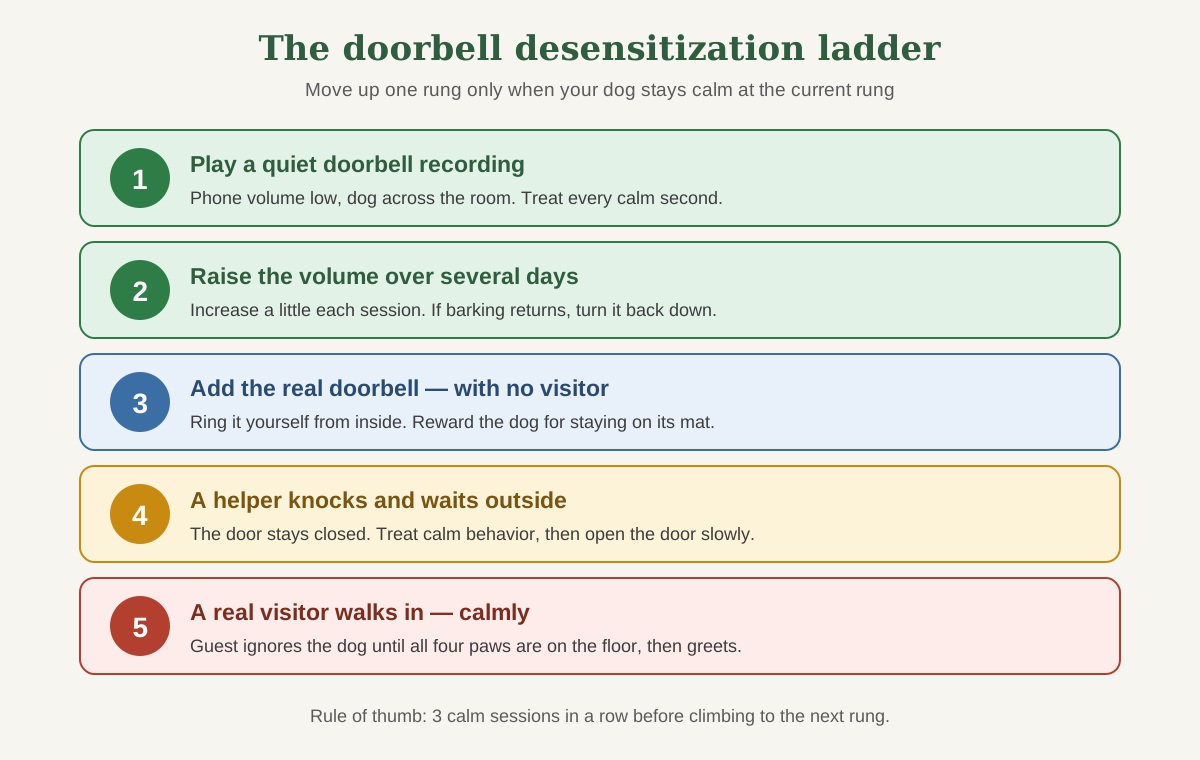
Step 3: Play a quiet doorbell recording. Sit with your dog across the room from the door. Play the recording at very low volume, and the instant it sounds, guide the dog to its mat and reward. Repeat five times, then stop. Keep the volume so low the dog barely reacts — trainers call this working under threshold. If the dog barks, turn it down and try again.
Step 4: Raise the volume over several days. Increase the recording volume a little each session. If the dog barks at the new volume, drop back to the previous level for another day. Three calm sessions in a row at one volume means the dog is ready for the next.
Step 5: Use the real doorbell with no visitor. Ring your own doorbell from inside, or have a family member ring it from outside while the door stays closed. Send the dog to its mat, reward the calm, and open the door only after the dog is quiet. This step connects the real sound to the trained behavior, and it is the step owners most often skip.
Step 6: Add a helper as a fake visitor. Ask a friend to ring the bell and wait outside. Keep the door closed, reward the dog for staying on its mat, then open the door a crack. If the dog stays calm, the helper steps in and ignores the dog until all four paws are on the floor. If the dog erupts, close the door calmly and try again in a minute.
Step 7: Practice with real visitors. Tell guests in advance: ring the bell, wait, and ignore the dog until it is calm. Put the dog on its mat before you open the door. As of November 2026, reward-based training remains the method veterinary behaviorists recommend first, and the AVMA notes that positive reinforcement is the preferred approach for barking problems.
The dog is learning a new chain — bell, mat, treat — and chains take repetition. Expect dozens of repetitions, not a handful.
How long does it take to stop doorbell barking?
Most dogs show real improvement in 2 to 4 weeks of daily practice, and reliable quiet behavior in 6 to 8 weeks. Puppies and food-motivated dogs often learn faster; territorial adults and dogs that have barked at the door for years usually need the full two months.
| Timeframe | What to expect | What to do |
|---|---|---|
| Days 1–3 | Dog learns “place” and “quiet” with no doorbell | Practice the two cues in a quiet room, 5 minutes, 3 times a day |
| Days 4–10 | Dog stays calm at a quiet doorbell recording | Raise the volume slowly; reward every calm response |
| Days 11–21 | Dog goes to its mat for the real doorbell with no visitor | Ring the real bell yourself; open the door only when the dog is quiet |
| Weeks 4–6 | Dog handles a helper visitor with brief barking, then settles | Practice with friends; keep the first real greetings short and calm |
| Weeks 6–8 | Dog goes to its mat automatically and barks once or not at all | Reduce treats gradually; reward with praise and occasional treats |
Progress is rarely a straight line. A dog that was perfect on Tuesday may bark on Wednesday because a delivery driver knocked loudly or the dog is tired. A bad day is not a failure — go back one step for a day and rebuild.
What mistakes make doorbell barking worse?
Most owners accidentally reward the barking they want to stop — the mistakes below are common, and every one of them is fixable.
| Mistake | Why it backfires | Do this instead |
|---|---|---|
| Yelling “quiet!” or “no!” | Your dog hears you barking along and barks louder | Speak softly, or say nothing and reward the silence |
| Opening the door while the dog barks | The dog learns barking opens doors | Wait for quiet, even two seconds, before opening |
| Letting the dog rush the door | Rushing is self-rewarding and builds arousal | Use a baby gate or leash so the dog must wait on its mat |
| Punishing the bark after the fact | The dog cannot connect a past bark to a present punishment | Reward the behavior you want in the moment it happens |
| Practicing only with real visitors | Real visitors are too exciting for a dog still learning | Practice with recordings and helpers first |
| Giving up after one bad week | Barking habits took months to form and need weeks to undo | Judge progress over two weeks, not two days |
The yelling mistake deserves emphasis because almost every owner makes it. When you shout over a barking dog, the dog hears a loud noise from its own pack member during an exciting event and interprets it as joining in. The ASPCA’s guidance on barking makes the same point: shouting usually increases barking rather than stopping it.
Should you use a bark collar for doorbell barking?
A bark collar should not be the first option for doorbell barking, and for many dogs it is not a good option at all. Collars that spray citronella, vibrate, or deliver a static shock can suppress barking in the moment, but they do not teach the dog what to do instead, and they do not address the cause — excitement, fear, or territorial arousal. The AVMA favors reward-based training first, noting that aversive tools can increase fear and anxiety; a fearful dog punished for barking may stop barking and start biting instead.
There are situations where a trainer might discuss a citronella or vibration collar as a short-term management tool — for example, a dog in an apartment facing a noise complaint while the owner works through the training plan. Even then, the collar is a temporary bridge, not the solution, and it should be used under the guidance of a certified professional dog trainer or veterinary behaviorist.
If you are considering any bark-control device, ask your vet first — some dogs bark because of pain, cognitive decline, or separation anxiety, and no collar fixes those causes.
When should you call a professional trainer or vet?
Call a certified professional dog trainer or a veterinary behaviorist if the barking comes with aggression — lunging, snapping, or biting at visitors — or if the dog panics at the doorbell with shaking, drooling, or trying to escape.
Also call a vet if the barking started suddenly in an adult or senior dog — a sudden change in behavior can signal pain, hearing loss, or cognitive decline, and training cannot fix a medical problem.
When you choose a trainer, look for certification from a recognized body such as the Certification Council for Professional Dog Trainers (CCPDT) or the International Association of Animal Behavior Consultants (IAABC), and confirm the trainer uses reward-based methods. As of November 2026, a typical private session with a certified trainer in the United States costs roughly $75 to $150 per hour.
Frequently asked questions
Can you stop a dog from barking at the doorbell completely?
Most dogs can learn to stay quiet or give one alert bark and then settle, but a completely silent dog is an unrealistic goal — barking is normal dog communication, and the aim is a short alert followed by calm.
How do I stop my dog barking at the doorbell when I live alone?
Use a doorbell recording on your phone and ask friends to be practice visitors once a week until the behavior is reliable.
Will a “quiet” command work if my dog barks at every sound, not just the doorbell?
Yes — practice “quiet” with easier sounds first, like a knock on the wall, then apply it to the real doorbell once the dog understands the cue.
Is it okay to give my dog a treat every time the doorbell rings?
Yes, especially in the first month. The treat builds the new association — bell means good things happen when I am calm. Phase treats out gradually after week six, replacing them with praise and an occasional reward.