
Golden Retrievers and Labrador Retrievers are the two most popular family dogs, and they look alike. Choose a Golden Retriever if you want a calmer, more sensitive companion that needs regular brushing, and choose a Labrador if you want a sturdier, more energetic dog that sheds heavily but needs less grooming. Both breeds are friendly, trainable, and great with children.
How are Golden Retrievers and Labradors different at a glance?
Both breeds belong to the American Kennel Club (AKC) Sporting Group, and both were bred to retrieve game for hunters. That shared job explains why they are so similar in temperament: friendly, eager to please, and happiest when they have something to carry in their mouths.
The table below summarizes the key differences. Every figure comes from the AKC breed standards and breed health data, current as of November 2026.
| Trait | Golden Retriever | Labrador Retriever |
|---|---|---|
| Height at shoulder | 21.5–24 inches | 22.5–24.5 inches |
| Weight | 55–75 pounds | 55–80 pounds |
| Lifespan | 10–12 years | 11–13 years |
| Coat | Long, feathered double coat in shades of gold | Short, dense double coat in black, yellow, or chocolate |
| Shedding | Heavy, year-round with seasonal peaks | Heavy, year-round with a big seasonal blow |
| Exercise needed | 1–2 hours of activity per day | 1–2 hours of activity per day |
| Trainability | Very high; sensitive and eager to please | Very high; famously food-motivated |
| Temperament | Calm, gentle, people-oriented | Boisterous, outgoing, endlessly enthusiastic |
| Good with children | Excellent, especially with patient supervision | Excellent, but young Labs can knock small kids over |
| Typical breeder price | $1,500–$3,000 as of November 2026 | $1,000–$2,500 as of November 2026 |
| AKC recognition | Recognized in 1925 | Recognized in 1917 |
The headline difference is simple: a Golden Retriever is the softer, slightly calmer version of the same idea, while a Labrador is the tougher, more high-energy version. Which one fits your family depends less on which breed is “better” and more on how much brushing, exercise, and chaos your household can happily absorb.
Which breed is bigger: Golden Retriever or Labrador?
Labradors are the slightly larger and heavier of the two, but the difference is small enough that most people cannot tell by looking. Adult male Labradors stand 22.5–24.5 inches at the shoulder and weigh 65–80 pounds, while adult male Golden Retrievers stand 23–24 inches and weigh 65–75 pounds.
What you notice more than the numbers is the build. Labradors are stockier, with a broad chest, thick otter tail, and a dense, almost waterproof-feeling coat. Golden Retrievers look longer and more elegant, with feathering on the legs, chest, and tail that gives them a flowing outline. A Golden’s coat makes the dog look bigger than it is; a Lab’s muscle makes the dog feel heavier than it looks.
Neither breed fits a home that wants a small dog. Both need a car with enough room, a crate sized for a large dog, and food bills to match — roughly 3–4 cups of quality kibble a day for an active adult.
Which breed is better with children?
Both breeds rank among the best family dogs in the world, and both are famously patient with children. The AKC describes the Golden Retriever as “intelligent, friendly, and devoted” and the Labrador as “friendly, active, and outgoing.”
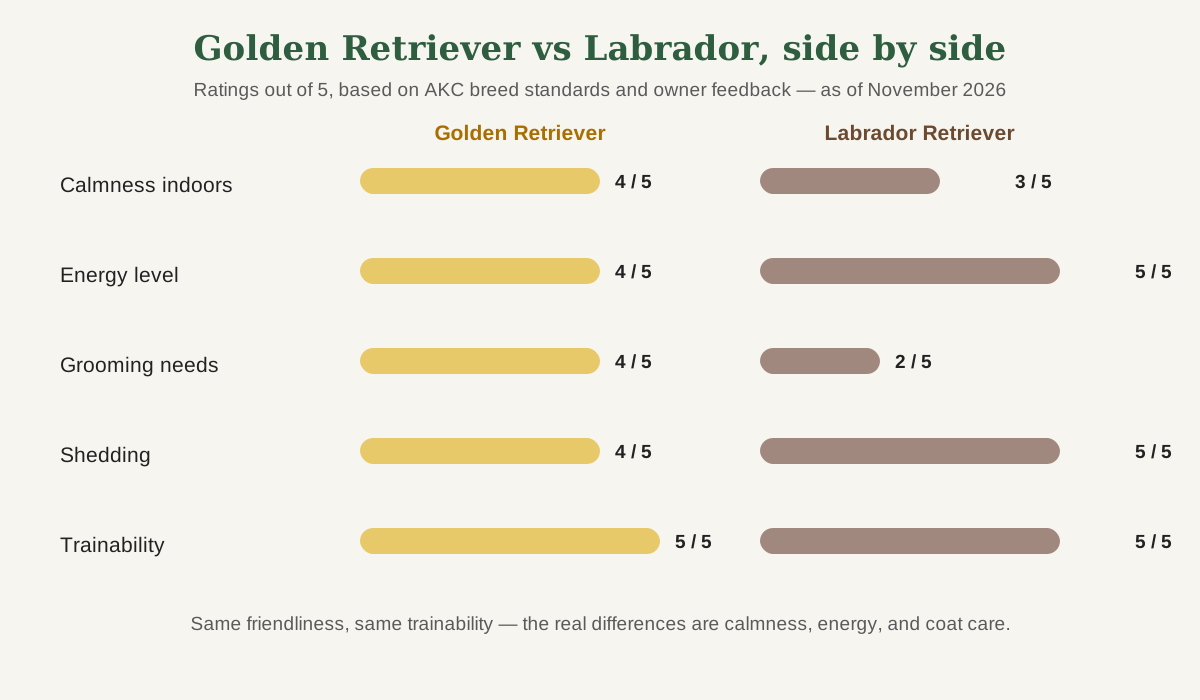
The difference is style. Golden Retrievers tend to be gentler and more tuned in to people’s moods. A Golden is more likely to settle quietly next to a child who is reading or upset. Labradors are more physically exuberant: a young Lab greets the world at full speed, and that enthusiasm is exactly why trainers warn that Labs can accidentally knock over toddlers — not from aggression, but from joy.
For families with children under five, a Golden Retriever is often the easier first choice, simply because the dog’s calmer default behavior leaves less to manage. For families with older children who want a dog to run, swim, and play fetch with for hours, a Labrador is hard to beat. Either way, no dog should be left unsupervised with a small child.
Which breed is easier to train?
Both breeds are among the easiest dogs in the world to train, and both are common choices for service and therapy work. The difference is what motivates them.
Golden Retrievers are eager to please in the classic sense: they watch your face, they care about your approval, and they respond best to gentle, consistent, praise-based training. Harsh corrections can shut a sensitive Golden down, so the best results come from patience and positive reinforcement.
Labrador Retrievers are famously food-motivated, which makes them extremely trainable — a treat in your hand will hold a Lab’s attention through almost anything. That same food drive is also their biggest training challenge: Labs counter-surf, steal food, and swallow things they should not. Teaching a reliable “leave it” and “drop it” is not optional with a Labrador, and treat portions should stay small — our guide on whether dogs can eat bananas explains safe serving sizes for a healthy training reward.
Based on breed standards and owner feedback, first-time owners do well with either breed, provided they commit to early socialization and basic obedience classes. A Golden may forgive a sloppy training session more gracefully; a Lab may forgive a missed walk less gracefully.
Which breed needs more exercise?
Both breeds need 1–2 hours of activity every day, and both will invent their own entertainment — usually destructive — if they do not get it. Neither breed is a couch dog.
Labradors tend to need more intense exercise. A Lab that gets a slow walk around the block will still have energy left to chew the furniture. Labs were bred to work all day in cold water, and they thrive on swimming, retrieving, and running. Our guide to how much exercise a Labrador needs breaks down daily activity by age, from puppy to senior. Golden Retrievers need the same amount of time, but they are usually content with a steadier pace: a long walk, a game of fetch, and some scent games.
Which breed sheds more — and which is easier to groom?
Both breeds shed heavily, so neither is a good choice for someone who wants a low-shedding dog. There is no meaningful winner here on shedding alone. The real difference is grooming time.
A Golden Retriever’s long, feathered coat needs brushing two to three times a week to prevent mats, especially behind the ears, under the legs, and around the tail. During the spring and fall shedding seasons, daily brushing helps. Plan on a bath every 4–6 weeks, or sooner if your Golden finds mud — which it will. Our guide on how often to bathe a dog explains how to set a bathing schedule without drying out the coat.
A Labrador’s short coat needs far less work: a quick brush once a week removes loose hair and keeps the coat glossy, and Labs rarely mat. They still shed just as much hair onto your floors and furniture, and their seasonal “blow” in spring can be dramatic, but the grooming itself takes minutes rather than half an hour.
If you hate brushing, the Labrador is the lower-maintenance choice. If you enjoy the grooming ritual, the Golden’s extra work is part of the pleasure.
Which breed lives longer and stays healthier?
Labradors live slightly longer on average — 11–13 years versus 10–12 years for Golden Retrievers, according to AKC breed data as of November 2026. That one-year gap is an average, not a promise: genetics, weight, and veterinary care matter more than breed alone.
Both breeds share the same main health risks, and both need screening from a responsible breeder. Hip and elbow dysplasia affect both breeds, so ask any breeder for Orthopedic Foundation for Animals (OFA) or PennHIP scores for both parents. Both breeds are also prone to certain eye conditions, including progressive retinal atrophy and cataracts, and to ear infections from their floppy ears.
The biggest health difference is cancer. Golden Retrievers have one of the highest cancer rates of any breed, and the Morris Animal Foundation’s Golden Retriever Lifetime Study has found that cancer is the leading cause of death in the breed. Labradors, meanwhile, are more prone to obesity: their famously strong food drive means they gain weight easily, and extra weight shortens a Lab’s life and worsens joint problems. The AVMA recommends keeping any dog at a healthy weight and discussing a diet plan with your veterinarian. If you notice symptoms such as limping, lumps, or sudden weight change, see a veterinarian promptly rather than trying to diagnose the problem yourself.
How much does a Golden Retriever or Labrador cost in 2026?
The purchase price is only the beginning, and the two breeds cost nearly the same to own. As of November 2026, a Golden Retriever puppy from a reputable breeder typically costs $1,500–$3,000, while a Labrador puppy typically costs $1,000–$2,500. Rescue organizations and breed-specific rescues often place adult dogs of either breed for $200–$600, which is the most affordable way to bring one home.
Ongoing costs are similar for both breeds:
| Cost | Golden Retriever | Labrador Retriever |
|---|---|---|
| Food per month | $60–$100 | $60–$100 |
| Routine vet care per year | $300–$600 | $300–$600 |
| Grooming per session | $60–$100 (longer coat, more time) | $40–$70 (short coat, quick bath and brush) |
| Pet insurance per month | $40–$70 | $40–$70 |
Over a 10–12 year lifespan, either breed costs roughly $15,000–$25,000 in total. Goldens cost a little more on grooming; Labs can cost a little more on food if their appetite runs unchecked.
Which breed fits your lifestyle?
Both breeds are wonderful, but they fit different households. Work through the questions below honestly, and the answer usually becomes obvious.
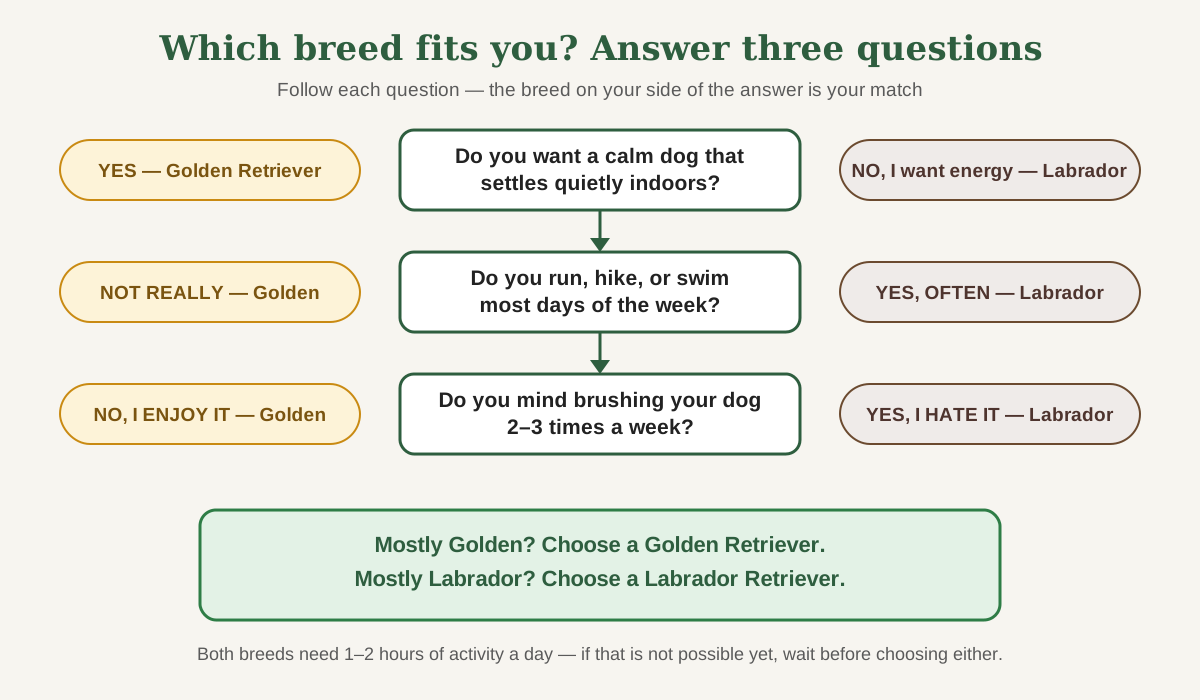
Choose a Golden Retriever if most of these describe you:
- You want a calm, gentle dog that settles quietly in the house.
- You enjoy brushing and grooming, or you do not mind doing it two to three times a week.
- You have very young children and want the gentlest possible temperament.
- You want a dog that is sensitive to your moods and sticks close to you.
- You prefer a dog that is slightly less boisterous when guests arrive.
Choose a Labrador Retriever if most of these describe you:
- You want a sturdy, high-energy partner for running, hiking, and swimming.
- You want the lowest-maintenance coat possible in a large dog.
- Your children are older and want a dog that plays hard.
- You want a dog that is famously food-motivated and easy to train with treats.
- You can laugh at a dog that greets life at full speed, every single day.
If you are still torn, consider your daily routine rather than your dream dog. A Golden Retriever fits a household that values calm and closeness; a Labrador fits a household that values energy and adventure. Both breeds need the same things — daily exercise, training, companionship, and a family that is home most of the day.
So, Golden Retriever or Labrador — which should you choose?
There is no wrong answer between these two breeds, only a better fit for your household. A Golden Retriever is the calmer, more sensitive companion with a beautiful coat that demands regular grooming. A Labrador is the sturdier, more energetic companion with a wash-and-go coat and an appetite for everything.
If your home is quiet and your children are small, choose the Golden Retriever. If your home is active and your children are older, choose the Labrador.
Frequently asked questions
Are Golden Retrievers and Labradors the same breed?
No. Golden Retrievers and Labrador Retrievers are two distinct breeds with separate breed standards, although both belong to the AKC Sporting Group and were bred as retrieving gun dogs.
Which breed is calmer, Golden Retriever or Labrador?
The Golden Retriever is generally calmer. Goldens tend to settle quietly indoors and are more sensitive to their owners’ moods, while Labradors stay puppy-like and high-energy for longer — often until age three or four.
Do Golden Retrievers shed more than Labradors?
Both breeds shed heavily year-round, so neither is low-shedding. Golden Retrievers shed longer hairs that are more visible on furniture and clothing, while Labradors shed shorter hairs in larger volume, especially during their spring coat blow.
Which breed is better for first-time dog owners?
Both breeds are excellent for first-time owners because they are friendly, intelligent, and eager to learn. A Golden Retriever is the safer pick if you want a naturally calmer dog, while a Labrador is the safer pick if you want a dog that is extremely food-motivated and quick to train.
How long do Golden Retrievers and Labradors live?
Golden Retrievers live 10–12 years on average, and Labrador Retrievers live 11–13 years on average, according to AKC breed data as of November 2026. Keeping your dog at a healthy weight, choosing a breeder who health-tests the parents, and scheduling regular veterinary checkups are the best ways to support a long life.