
To choose a doggy day care, tour at least two facilities in person, confirm vaccination and staff-to-dog ratio requirements, watch a live play group, and book a trial half-day before buying a package. A good facility charges about $25 to $50 per full day in most US markets, as of November 2026, and separates dogs by size and temperament.
Day care sounds simple: drop your dog off in the morning, pick up a happy, tired dog in the evening. In practice, facilities vary widely in supervision, cleanliness, grouping, and safety. This guide covers the whole decision in one weekend: research, tour, trial day, then decide. We compared published rates, facility checklists from veterinary organizations, and verified owner reviews. No facility paid for placement, and there are no affiliate links here.
What does a good doggy day care actually do all day?
A good day care is not a warehouse where dogs run loose for eight hours. It is a structured program with a schedule your dog can predict: morning settling, a supervised play session of 60 to 90 minutes, a midday rest in a quiet area, an afternoon play session, and a wind-down before pickup.
Ask for the written daily schedule. If the answer is “the dogs just play all day,” supervision is probably light. Puppies and seniors especially need enforced rest, since overstimulation is when scuffles start.
Is doggy day care right for your dog?
Day care works best for social, healthy adult dogs that enjoy other dogs and can settle after excitement. It is a poor fit for dogs that fear strangers, react badly to other dogs, are unvaccinated, or are recovering from illness or surgery.
Most facilities accept puppies only after their vaccination series is complete, usually around 16 weeks. Very old dogs can enjoy day care, but only in a calmer group with plenty of rest. If a 90-pound husky and a 6-pound chihuahua share one room, that is a warning sign.
Day care is also not a fix for separation anxiety or a substitute for training. If your dog panics when left alone, talk to your veterinarian or a certified trainer first.
How do you find doggy day care options near you?
Start with three to five facilities within a reasonable drive — a 45-minute commute each way turns day care into a chore within a month.
- Search maps and reviews together. Read the one-star and three-star reviews first; they usually describe specific incidents.
- Check licensing and insurance. A legitimate facility can show a business license, and most carry liability insurance. A facility that dodges the question is telling you something.
- Ask your veterinarian. Vets hear about bite incidents and kennel cough outbreaks before anyone else.
- Compare the basics on paper. Note hours, full-day and half-day rates, package discounts, holiday surcharges, and late pickup fees before you tour.
- Shortlist two or three to tour. Two thorough tours beat five rushed ones.
What should you ask on the tour?
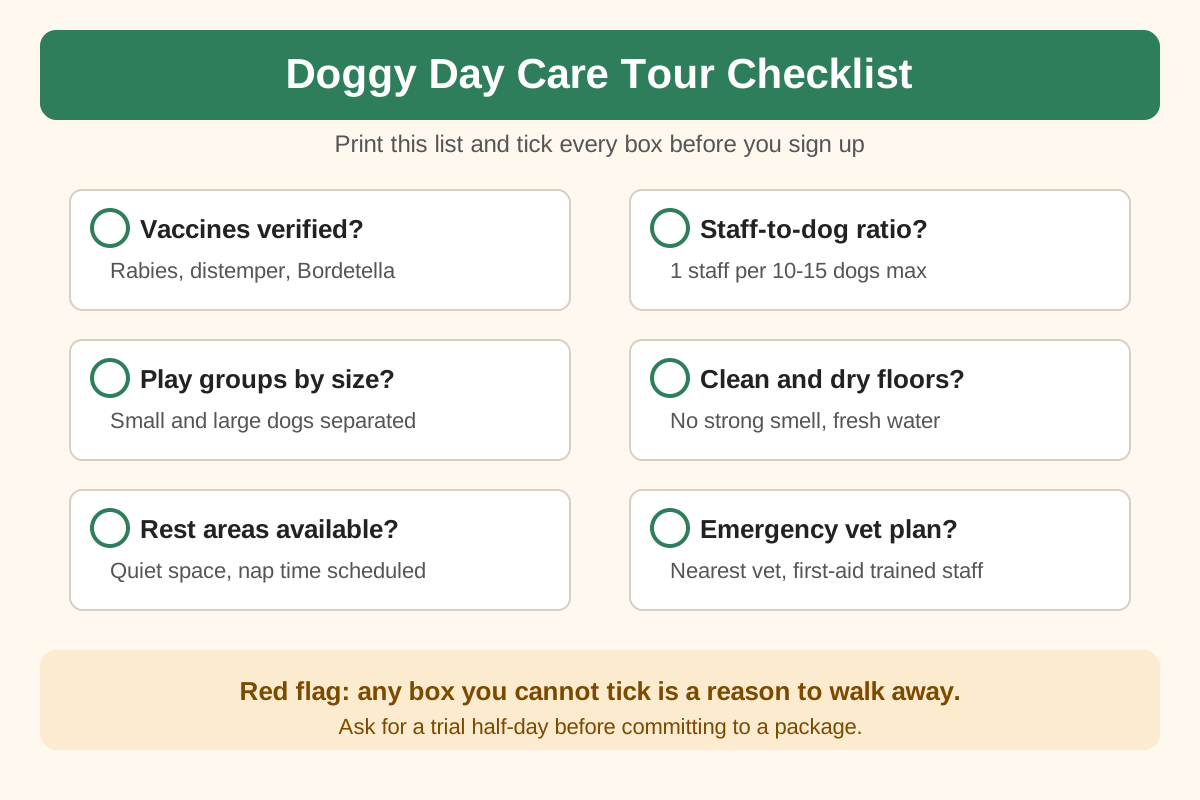
Tour during operating hours, watch a live play group for at least 15 minutes, and bring these questions:
- What vaccinations do you require? Expect rabies, distemper/parvo, and Bordetella (kennel cough) at minimum, with proof required before the first visit. The American Veterinary Medical Association (AVMA) notes that Bordetella vaccination is commonly recommended for dogs in group settings such as day care.
- What is your staff-to-dog ratio? Look for one trained staff member per 10 to 15 dogs. Ratios above 1-to-20 mean one person cannot watch every interaction.
- How are play groups organized? Dogs should be grouped by size, age, and play style. Small dogs and large dogs should never share one play area.
- What training do staff receive? Ask whether staff are trained in dog body language, safe play interruption, and pet first aid. “We all love dogs” is not training.
- What happens if my dog is injured? The facility should have a written emergency plan, a relationship with a nearby veterinarian, and a promise to call you immediately. The American Kennel Club (AKC) advises owners to know their vet’s emergency procedures before leaving a dog in someone else’s care.
- Where do dogs rest? Look for a quiet rest area with individual spaces, not just a corner of the playroom.
- How do you handle food and medication? Meals should be served individually, and medication administration should be logged. Some facilities charge $5 to $15 extra per day for medication.
- What is the cleaning routine? Floors should be cleaned and disinfected daily, water bowls refreshed, and waste removed promptly. Trust your nose: a strong urine or chemical smell is a red flag.
Watch the dogs, not just the room. Relaxed dogs have loose bodies, open mouths, and play bows. Good attendants move through the group, redirect rough play early, and know individual dogs by name.
What are the red flags at a doggy day care?
Walk away if you see any of these:
- No vaccination requirements. The ASPCA lists kennel cough and canine influenza among illnesses that spread quickly where dogs gather in groups.
- No temperament test. Reputable facilities evaluate every new dog before its first full day. A facility that accepts any dog, no questions asked, is accepting risk on your behalf.
- Overcrowded play areas. If dogs cannot move without bumping into each other, fights are a matter of time, not chance.
- No rest time. Dogs that play for eight straight hours are exhausted, not happy, and exhaustion leads to irritability and injuries.
- Staff on their phones. Supervision means watching dogs. An attendant scrolling a phone in the corner is not supervising.
- Dirty water, strong odors, or visible waste. Cleanliness is the cheapest safety measure a facility can provide.
- No cameras and no tours during operating hours. Transparency is easy for a good facility and impossible for a bad one.
- High-pressure package sales. A facility confident in its service lets a trial day sell itself.
How does a day care center compare with a sitter or a dog walker?
| Option | Typical cost per day (US, as of November 2026) | Best for | Main drawback |
|---|---|---|---|
| Commercial day care center | $25 to $50 full day, $20 to $40 half day | Social dogs needing exercise and play | Can overstimulate shy or senior dogs |
| In-home sitter day care | About $40 per day, per Rover data from September 2026 | Dogs preferring a calm home setting | Fewer formal safety protocols |
| Dog walker (midday visit) | $20 to $30 for a 30-minute walk | Dogs needing a bathroom break and walk | No socialization between visits |
| Staying home alone | No direct cost beyond setup | Independent dogs with no separation anxiety | Boredom and no one to notice an emergency |
A dog walker is often better for a senior dog or a dog that dislikes groups. Day care is better for a young, social dog with energy to burn. Many owners mix both.
How much does doggy day care cost in the US?
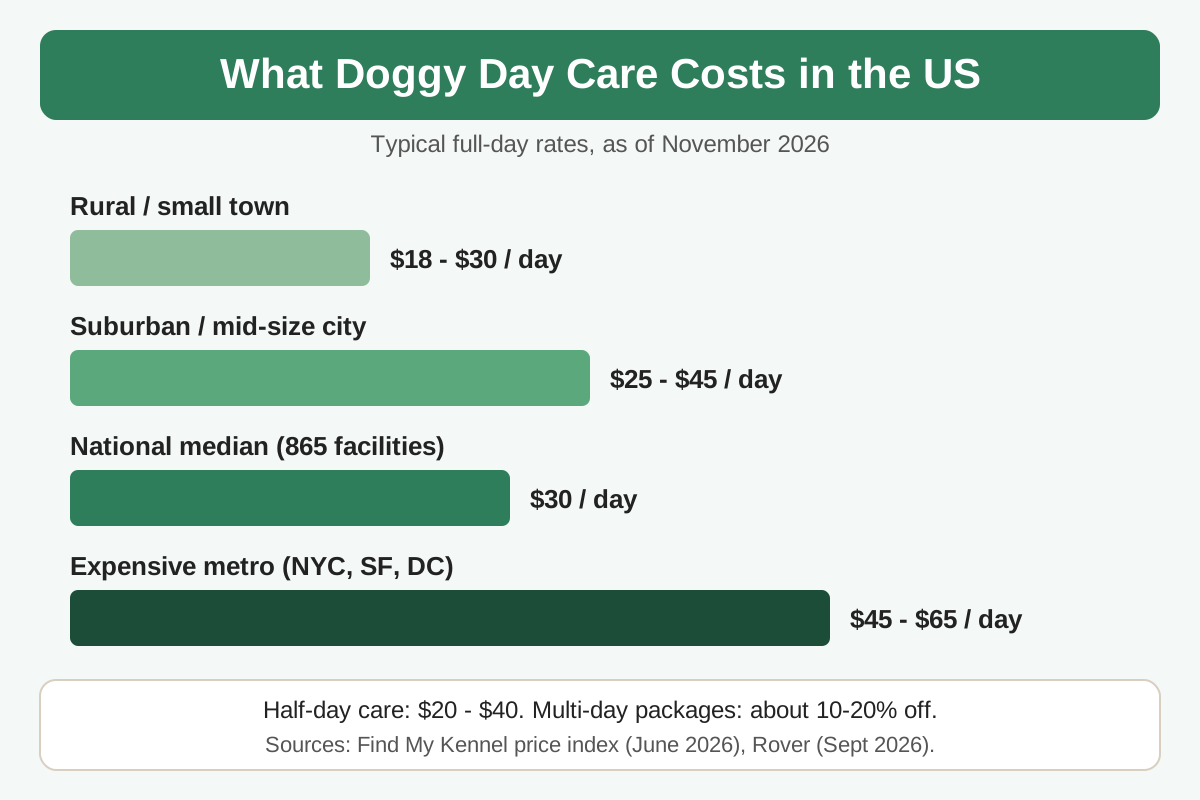
A full day typically costs $25 to $50 in the United States, as of November 2026. A June 2026 review of 865 US facilities put the national median at $30 per full day. Half-day care usually runs $20 to $40, and multi-day packages commonly cut the effective daily rate by about 10 to 20 percent.
Location drives most of the difference: state medians were about $20 per day in Alabama, $25 in Georgia, $30 in Texas and Florida, $36 in New York, and $40 in California and Washington. Premium facilities in Manhattan or San Francisco can reach $55 to $65 per day.
At the $30 national median, two days a week cost roughly $260 per month. Watch for add-ons: medication ($5 to $15 per day), baths or grooming ($20 to $50), and holiday surcharges of $10 to $20 per day around Thanksgiving, Christmas, and the Fourth of July.
How does the trial day work?
Never buy a package before a trial day. Here is how it usually goes:
- Paperwork and vaccine check. Bring vaccination records, your vet’s contact details, and an emergency contact.
- Temperament test. Staff introduce your dog to one calm dog first, then to a small group, watching body language throughout. This usually takes 30 to 60 minutes.
- A short first stay. Most facilities start with a half-day: play time, a rest period, and a chance to learn the routine without being overwhelmed.
- A report at pickup. Good facilities tell you how your dog did: who it played with, whether it rested, whether it ate, and anything that worried them.
- Your own debrief. Watch your dog that evening: a tired, content dog that eats normally and sleeps well had a good day. A limping or withdrawn dog needs a vet check before any second visit.
How do you prepare your dog for the first day?
Start a few days before, not the morning of. Make sure vaccinations are current and bring the records. If your dog needs a Bordetella booster, get it at least a week before day care.
Feed your dog at home before drop-off and pack its regular food if lunch is served. Never switch foods on a day care day. Exercise your dog lightly beforehand: a short walk takes the edge off excitement.
For puppies, the adjustment takes longer — see how to introduce a puppy to an older dog for gradual-introduction tips. If your dog comes home filthy, see how often you should bathe a dog.
What if your dog comes home tired, sore, or sick?
Some tiredness is normal, but limping, swelling, cuts, or reluctance to move need attention the same day. Ask the facility what happened, then call your veterinarian if the problem persists.
Illness after day care is usually minor but worth watching. Kennel cough spreads in group settings and typically causes a dry, honking cough. The ASPCA notes that most cases are mild, but a cough lasting more than a few days, or one that comes with lethargy and loss of appetite, deserves a vet visit. The same applies to vomiting, diarrhea, or a sudden change in energy. Never diagnose your dog yourself or start leftover medication from another pet. If your dog shows symptoms, contact your veterinarian promptly and tell the facility.
Two to three days a week is the sweet spot for most social dogs. Watch for signs of overdoing it: reluctance to enter the facility, sleeping far more than usual on rest days, or recurring minor injuries.
Frequently asked questions
How much does doggy day care cost per day?
A full day typically costs $25 to $50 in the US, with a national median of $30 per day as of November 2026. Half-day care usually runs $20 to $40.
What age can a puppy start doggy day care?
Most facilities accept puppies after their vaccination series is complete, usually around 16 weeks of age.
Do dogs need the Bordetella vaccine for day care?
Most facilities require Bordetella vaccination, along with rabies and distemper/parvo, before a dog’s first visit.
What should I bring to doggy day care?
Bring vaccination records, your vet’s contact details, your dog’s regular food if lunch is served, and any medication with written instructions.
How do I know if my dog likes day care?
A dog that enjoys day care pulls toward the door at drop-off, plays with a loose body and open mouth, and comes home tired but content. Reluctance to enter is a sign the arrangement is not working.
Is doggy day care better than a dog walker?
Day care suits social, high-energy dogs, while a dog walker suits seniors, shy dogs, or dogs that mainly need a midday break.
The bottom line
Choosing a doggy day care comes down to three things: tour in person, watch the dogs, and trial before you commit. The best facility has clear vaccine rules, a staff ratio of one person per 10 to 15 dogs, separate play groups by size, and enforced rest. Expect to pay around $30 per day at the national median, as of November 2026.
Start with two tours this week and one trial half-day, and let your dog’s behavior make the final call. If your dog needs a quieter option, a dog crate for anxious dogs can help on rest days, and regular exercise remains the foundation — see how much exercise a Labrador needs.