
Puppy obedience training is teaching your puppy to respond reliably to a small set of cues — sit, come, down, stay, and leave it — through short, reward-based sessions of 5 to 10 minutes, several times a day. Start at 8 weeks old, keep sessions playful, and expect real reliability only after months of consistent practice, not days.
That last part matters more than most new owners expect. A puppy can learn what “sit” means in a single afternoon, but doing it every time — in the kitchen, at the park, when the doorbell rings — takes weeks of patient repetition. This guide covers the order for the first seven commands, a week-by-week schedule for the first eight weeks, and the mistakes that slow almost every new trainer down.
What does puppy obedience training actually mean at 8 weeks vs 6 months?
At 8 weeks, obedience training is not really about obedience at all. It is about building a communication system: your puppy learns that a word predicts an action, and that the action earns something good. Sessions last 3 to 5 minutes, and the puppy gets rewarded for almost every try.
By 12 to 16 weeks, the same puppy can hold a short stay, come when called in a quiet room, and walk a few steps on a loose leash. The commands look the same on paper, but the standard has changed — now you ask once, wait, and reward only the correct response.
At 6 months, training becomes proofing. Your adolescent puppy knows the commands; the question is whether they hold up with distractions, distance, and duration. A puppy that sits perfectly indoors but ignores you at the dog park is not disobedient — they are simply untrained for that environment.
The American Kennel Club’s puppy training guidance stresses the same progression: start with short, positive sessions when the puppy is young, build one skill at a time, and increase difficulty gradually. (AKC puppy training hub)
What are the first 7 commands to teach your puppy, and in what order?
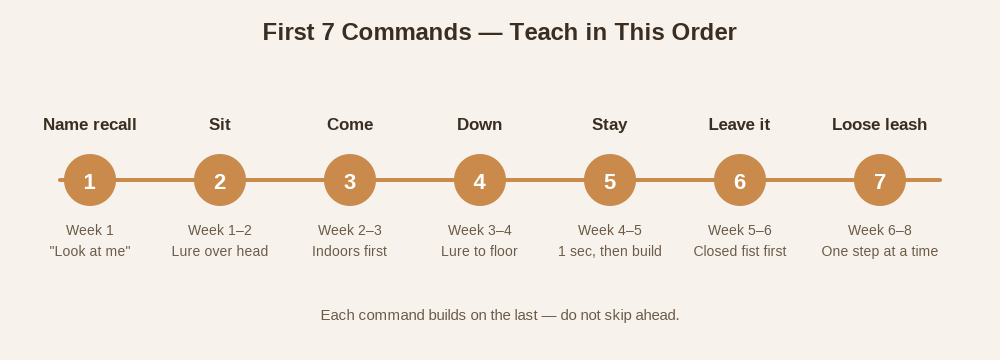
Teach commands in this order, because each one makes the next one easier. Do not rush ahead — a puppy that truly knows its name and “sit” learns “down” in half the time of a puppy drilled on six cues at once.
1. Name recall — “Look at me”
Before any command works, your puppy must know its name means “pay attention to me.” Say the name once, in a happy tone. The instant the puppy turns toward you, mark it with “yes!” and deliver a treat. Within a few days, most puppies whip around at their name — and every other command depends on that attention.
2. Sit
Hold a treat just above the puppy’s nose, then move it slowly back over their head. As the nose follows the treat up, the rear end drops down. The moment the bottom touches the floor, say “yes!” and give the treat. Add the word “sit” only after the puppy is offering the behavior reliably, usually by day 3 or 4. Practice in five short reps, then stop while the puppy still wants more.
3. Come
Start indoors, two or three steps away. Crouch down, open your arms, and say “come” in a bright voice. When the puppy runs to you, reward generously — three or four treats in a row, not one. Never call your puppy to come for something unpleasant, like a bath or nail trim; “come” must always predict good things, or the puppy will stop coming.
4. Down
Ask for a sit first, then lure a treat from the puppy’s nose down to the floor between their front paws. If your puppy stands up and walks toward the treat instead, try luring under a low chair or your leg — the puppy has to lie down to reach it.
5. Stay
With the puppy in a sit, hold your palm up like a stop sign and say “stay.” Wait one second, then say “yes!” and treat. Build duration slowly: 2 seconds, then 5, then 10. If the puppy breaks, you asked for too much — go back to a duration that worked and rebuild.
6. Leave it
Hold a treat in a closed fist. The puppy will sniff, lick, and paw at your hand — say nothing, just wait. The instant the puppy pulls back, even slightly, say “yes!” and give a different, better treat from your other hand. After a few days, add the words “leave it” as you present the closed fist. This command keeps puppies from eating chicken bones on the sidewalk, so it deserves more practice than any other cue on this list.
7. Loose-leash basics
Indoors first, with no distractions. Hold a treat at your left side, take one step, and reward the puppy for staying near your leg. Add one step at a time. The rule is simple: the leash stays loose, or you stop moving. Puppies learn fast that pulling gets them nowhere and staying close gets them treats — but only if you are consistent every single walk.
What should a realistic puppy training schedule look like for the first 8 weeks?
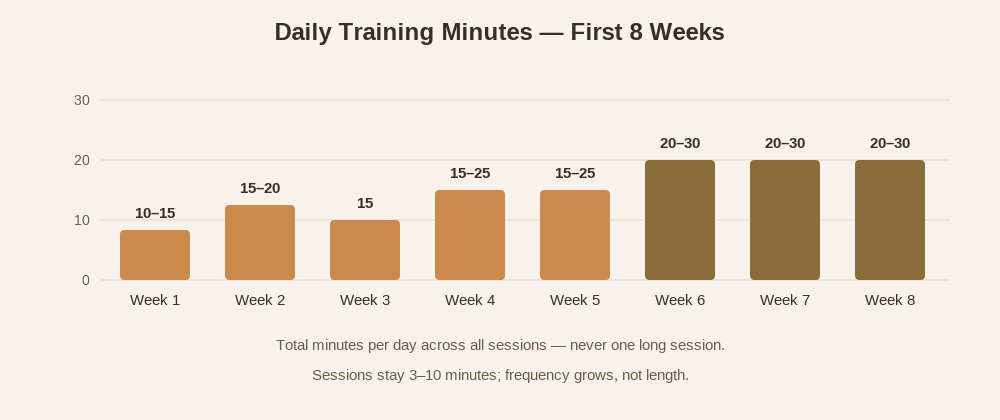
A realistic schedule is built around your puppy’s age in weeks, not your ambitions. Puppies aged 8 to 16 weeks can focus for about 5 minutes at a time, and they learn most from tiny repetitions scattered through a normal day — sitting before meals, waiting at the door, coming when called from another room.
| Week | Puppy age | Focus commands | Sessions per day | Daily training |
|---|---|---|---|---|
| 1 | 8 weeks | Name recall, sit | 3–4 × 3–5 min | 10–15 min |
| 2 | 9 weeks | Sit, come (indoors) | 3–4 × 5 min | 15–20 min |
| 3 | 10 weeks | Come, down | 3 × 5 min | 15 min |
| 4 | 11 weeks | Down, stay (1–3 sec) | 3 × 5–10 min | 15–25 min |
| 5 | 12 weeks | Stay, leave it (closed fist) | 3 × 5–10 min | 15–25 min |
| 6 | 13 weeks | Leave it, loose-leash indoors | 3 × 10 min | 20–30 min |
| 7 | 14 weeks | All 7 cues, new rooms | 2–3 × 10 min | 20–30 min |
| 8 | 15–16 weeks | All 7 cues, mild distractions | 2–3 × 10 min | 20–30 min |
Notice what the table does not contain: no hour-long sessions, no weekend crash courses, and no expectation of reliability before week 6. The schedule works because it fits inside a puppy’s attention span instead of fighting it. For a day-by-day breakdown of how training fits around meals, naps, and potty breaks, see our puppy training schedule by age.
How long should puppy training sessions last at each age?
Session length follows a simple rule: about one minute per week of age, capped at 10 minutes for puppies under 4 months. An 8-week-old gets 5-minute sessions; a 12-week-old can handle 10 minutes.
| Puppy age | Session length | Sessions per day | Best time of day |
|---|---|---|---|
| 8–10 weeks | 3–5 minutes | 3–4 | After naps, before meals |
| 11–14 weeks | 5–10 minutes | 3 | After naps, before meals |
| 15–20 weeks | 10 minutes | 2–3 | Before meals, after play |
| 5–6 months | 10–15 minutes | 2 | Before meals, low-distraction times |
Watch for the signs that a session has run too long: the puppy yawns, looks away, sniffs the ground, or starts mouthing your hands. Those are not defiance — they are a tired brain. End on a success, with an easy cue the puppy knows, and stop. Three good 5-minute sessions beat one frustrated 20-minute session every time.
Frequency matters more than duration. Five one-minute reps of “sit” scattered through the day — before breakfast, at the back door, before the leash goes on — teach faster than a single 15-minute block.
What treats work best for puppy training?
The best training treats are small, soft, smelly, and quick to eat. A treat that takes 30 seconds to chew kills the training rhythm — you want it gone in one gulp so you can repeat the rep.
Keep treats at about 10% of your puppy’s daily calories, as a rough guide from veterinary nutrition guidance — training treats add up fast when you are doing 50 reps a day, so cut back regular meals slightly on heavy training days. Use the puppy’s regular kibble for easy reps at home, and save the high-value treats for hard things like recall outdoors. That contrast is what makes the good treats powerful. For specific product picks, see our guide to the best puppy training treats. If you prefer tracking sessions on your phone, our roundup of free puppy training apps covers timers, progress logs, and clicker apps.
What are the 5 most common mistakes that slow down puppy training?
Most puppy training problems are not puppy problems — they are trainer problems, and they are all fixable.
1. Sessions that run too long. A 20-minute session with an 8-week-old puppy produces a tired, frustrated puppy and a trainer who thinks the puppy “isn’t getting it.” Keep sessions under 5 minutes at 8 weeks and end while the puppy is still engaged.
2. Inconsistent cues. If “down” means lie down on Monday, “lay down” on Tuesday, and a hand wave on Wednesday, the puppy learns none of them. Pick one word and one hand signal per behavior, write them down, and make sure everyone in the household uses the same ones.
3. Punishment instead of redirection. Yelling at, jerking, or smacking a puppy for a mistake teaches the puppy to fear you, not to understand the cue. The AKC’s training guidance is clear that reward-based methods build faster, more reliable behavior than punishment-based ones, and the American Veterinary Medical Association has long supported positive reinforcement for companion-animal training. (AKC training hub)
4. Training when the puppy is overtired. A puppy that has been awake for two hours, skipped a nap, and just finished a wild play session cannot learn. Train after naps, when the puppy is alert and hungry — never right after a big play session or when the puppy is visibly sleepy.
5. Skipping the socialization window. The prime socialization period closes around 14 to 16 weeks of age, as of November 2026 veterinary guidance. A puppy that never meets strangers, hears traffic, or sees other dogs during those weeks will be much harder to train around distractions later.
When should you get a professional trainer?
Get a professional trainer when any of these apply: the puppy shows aggression (growling, snapping, or guarding food or toys), fear that does not improve in two weeks, or you have practiced a cue correctly for three weeks with zero progress. A good trainer also helps when the household disagrees on methods — an outside voice often settles that faster than any article can.
Group puppy classes are worth it even when nothing is wrong. A well-run class gives your puppy controlled exposure to other dogs and people, which is the best way to proof the commands you teach at home. Look for a trainer who uses reward-based methods, keeps classes small (6 puppies or fewer), and lets you observe a session before you sign up. Our guide on how to choose puppy training classes explains what to ask and which red flags to walk away from.
Frequently asked questions
When should I start obedience training my puppy?
Start at 8 weeks old, the day your puppy comes home. Early training means name recall, sit, and house manners in 3- to 5-minute sessions — not formal drills.
How many commands should a puppy know by 6 months?
A puppy should reliably know about 7 basic commands by 6 months: name recall, sit, come, down, stay, leave it, and loose-leash walking. Reliability at home comes first; reliability outdoors takes several more months.
How long does it take to obedience train a puppy?
Basic obedience takes about 4 to 6 months of consistent daily practice, as of November 2026 training guidance. Your puppy can learn each command in days, but doing it reliably around distractions is a months-long project.
Should I use treats forever in puppy training?
No. Treats are the training wheels, not the vehicle. Once a cue is reliable at home, start rewarding every second or third success instead of every one, and replace some food rewards with praise, play, or access to something the puppy wants, like going outside.
Is it too late to train a 6-month-old puppy?
No, 6 months is not too late — it is a normal starting point for many owners. Older puppies learn just as well as 8-week-olds, and they can focus for longer sessions, so progress often feels faster.
The bottom line
Puppy obedience training works when it is short, consistent, and rewarding — 5 to 10 minutes at a time, several times a day, with the same words and the same rewards from everyone in the house. Teach the seven commands in order, follow the 8-week schedule, and skip the five mistakes above. Your puppy will not be perfectly obedient at 16 weeks, and that is fine. What you are really building is a puppy that loves training and trusts you.