
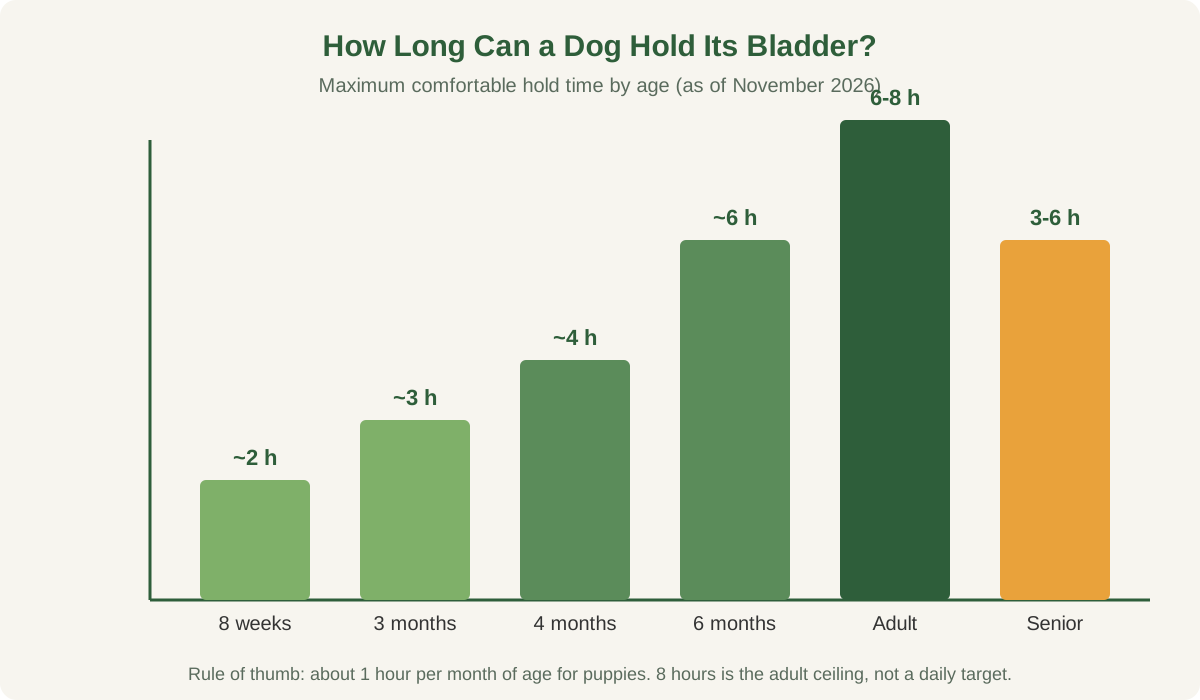
A healthy adult dog can usually hold its bladder for 6 to 8 hours during the day, while a puppy manages roughly one hour for every month of age. Those are maximums, not targets: most dogs are far more comfortable with a break every 4 to 6 hours.
How long can a puppy hold its bladder?
A puppy can generally hold its bladder for about as many hours as its age in months: two hours at two months, three at three months, four at four months. That is the rule of thumb the American Kennel Club (AKC) uses in its house-training guidance, and it is a planning ceiling, not a daily schedule.
The rule stops scaling at around nine months to a year, and the adult ceiling of six to eight hours applies after that. A ten-month-old puppy should never be asked to hold it for ten hours. The AKC’s guidance on leaving a puppy alone is more cautious still: about one hour under ten weeks, about two hours at ten to twelve weeks, and up to about six hours only after six months.
One catch: puppies cannot really control their bladder until about sixteen weeks old, according to the AKC. Before that age, the numbers describe what a calm, resting puppy might manage. A puppy that has just woken, eaten, drunk, or played hard will need to go out within minutes, whatever the clock says.
| Puppy age | Rough maximum hold | How often to offer a break |
|---|---|---|
| 8 to 10 weeks | About 1 to 2 hours | Every 1 to 2 hours while awake |
| 3 months | About 3 hours | Every 2 to 3 hours |
| 4 months | About 4 hours | Every 3 to 4 hours |
| 5 months | About 5 hours | Every 4 to 5 hours |
| 6 months | About 6 hours | Every 4 to 6 hours |
| 9 to 12 months | 6 to 8 hours | Every 4 to 6 hours |
These numbers assume a healthy puppy at rest. Excitement, play, meals, and drinking all shorten the window, so offer the break early when in doubt. A puppy that succeeds outside learns faster than one that fails inside.
How long can an adult dog hold its bladder?
A healthy adult dog can typically hold its bladder for six to eight hours during the day, the practical maximum the AKC gives for adult dogs. Many sleep through an eight-hour night without a break, because a sleeping dog produces less urine and is not drinking, eating, or moving around.
Eight hours is a maximum, not a recommendation. Dogs that regularly wait that long are more likely to develop urinary tract infections, and they spend much of the day uncomfortable. The Royal Society for the Prevention of Cruelty to Animals (RSPCA) advises that adult dogs should not routinely be left alone for more than about four hours. Four to six hours between breaks is a kinder daily rhythm.
Large breeds do not automatically hold it longer than small breeds. Control depends on muscle tone, training, and health as much as on bladder size, so your own dog’s habits are a better guide than any breed average. In practice, small adults often need breaks every four to six hours, while many medium and large dogs manage six to eight.
Seniors need breaks every three to six hours, and some need a nighttime trip outside. Weakening bladder muscles, arthritis that slows the trip to the door, and conditions such as kidney disease can all shorten the window. If your older dog starts having accidents after years of reliability, that is a vet conversation, not a training problem.
What affects how long a dog can hold it?
Age is the biggest factor: puppies have small bladders and undeveloped control, adults are at their peak, and seniors lose muscle tone. Hold time follows a curve: short, then long, then shorter again.
Size plays a role, especially in puppies and small adults. Small breeds have smaller bladders and need more frequent breaks, though a well-trained small dog can still manage a workday with a midday break.
Health is the factor owners most often overlook. A urinary tract infection makes a dog need to go constantly, in small amounts. Kidney disease, diabetes, and Cushing’s disease all increase thirst and urine output, as do some medications such as steroids and diuretics. A dog that suddenly needs to go out twice as often is usually telling you something about its health, not its manners.
Water and activity matter too. A dog that has just drunk a large bowl after a long walk will need to go out sooner than a dog that has been napping, and hot weather increases drinking. The six-to-eight-hour figure assumes a normal day, not one that started with a long hike and a full water bowl.
Can holding it too long hurt my dog?
Yes. The most common risk is a urinary tract infection: urine sitting in the bladder gives bacteria time to multiply, and dogs that routinely wait eight hours or more develop infections more often. The infection then makes the dog need to go more urgently, creating a cycle of accidents and discomfort.
Very long waits can also contribute to bladder stones in dogs already prone to them, since minerals have more time to form crystals. A desperate dog will pace, whine, circle, or stare at the door.
Twelve hours without a break is too long for any dog. If your schedule regularly keeps you away for ten or more hours, your dog needs help: a midday dog walker, a trusted neighbor, or doggy daycare. A walker costs far less than a vet bill for a urinary infection.
How often should I let my dog out?
A practical schedule for a healthy adult dog is a break every four to six hours: first thing in the morning, around midday, in the late afternoon, and once more before bed. Four breaks a day is a sensible minimum, and most dogs are happier with five.
Puppies need a much tighter schedule. The AKC lists the moments a young puppy should go out whatever the clock says: first thing in the morning, last thing at night, after every nap, after time in a crate, after meals, after drinking, after chewing, and after indoor play. If you are bringing a new puppy home, our guide to how to introduce a puppy to an older dog covers the routines that make house training work.
Seniors need a schedule that bends to their body: a break every three to six hours, a late-evening trip, and a nighttime outing if your dog asks. A doggy door or easy garden access helps an arthritic dog that cannot hold it while waiting for the door.
Crates are often misunderstood. A crate should never force a dog to hold its bladder for hours: a dog avoids soiling its sleeping area, which is why crate training works, but that instinct has limits. A puppy should spend no longer in a crate than its age-based hold time, and an adult should not be crated for a full workday without a break. Our guide to the best dog crate for anxious dogs explains how to choose one and introduce it gradually.
What are the signs my dog needs to go out right now?
Dogs usually signal clearly: pacing, circling, sniffing the floor intensely, whining, barking at the door, or sitting and staring at it. Some learn to ring a bell or paw at the door; others become suddenly restless after being calm.
Puppies signal with less warning. One that suddenly stops playing, sniffs in circles, or wanders toward a corner needs to go out immediately. The window between the signal and the accident can be under a minute.
Do not punish accidents: a punished dog learns to hide them, not hold them, and will start peeing behind furniture, which makes house training harder. Clean up with an enzymatic cleaner, note the timing, and bring the next break earlier.
When should I see a vet about urination?
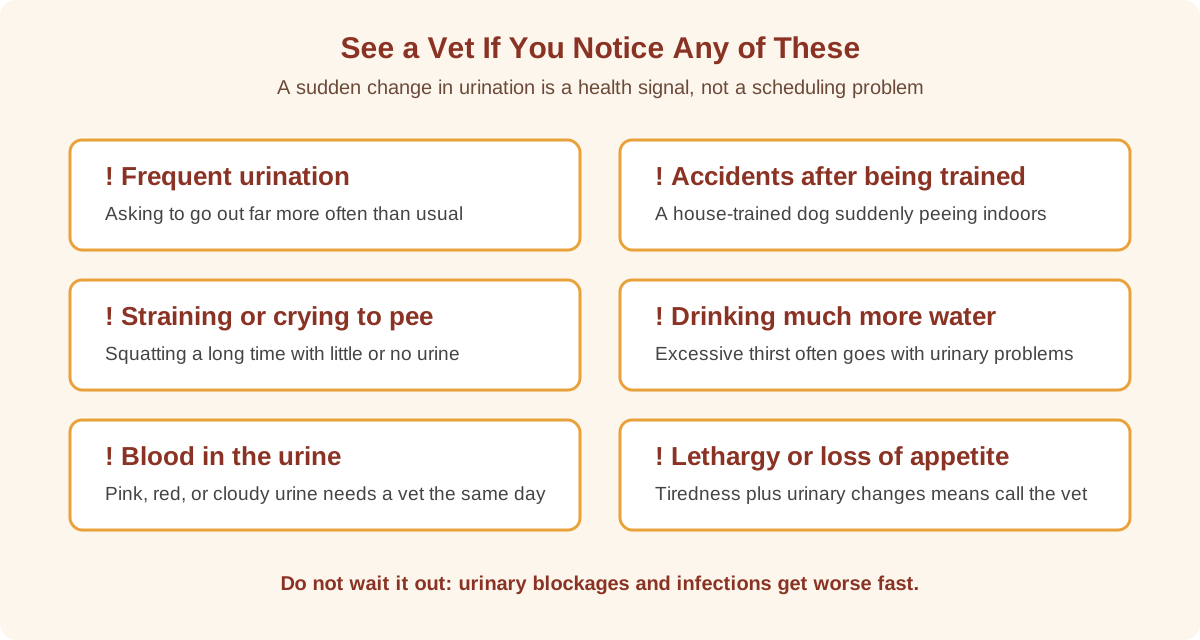
A change in urination habits is one of the clearest signals a dog can give you. Book a vet visit if your dog suddenly needs to go out much more often, has accidents after being reliably house trained, strains or cries while peeing, or passes only small amounts. Blood in the urine needs a vet the same day.
Excessive thirst deserves attention too: a dog that suddenly drinks far more than usual and urinates more often may have kidney disease, diabetes, or another condition that increases urine output. Your vet can check with simple blood and urine tests. The same applies to a senior that starts waking you at night after years of sleeping through.
The American Veterinary Medical Association (AVMA) advises owners to work with their veterinarian on house training and to rule out medical causes before treating a urination problem as a behavior problem. Training cannot fix an infection, and no schedule fixes diabetes.
Male dogs can develop a urinary blockage, an emergency. A dog that strains to urinate and produces nothing, or only drops, needs emergency veterinary care the same day: blockages can become life threatening within hours.
How can I help my dog hold it longer safely?
You cannot safely stretch a dog’s bladder beyond its natural capacity. What you can do is build a routine that makes waiting comfortable.
Start with a predictable schedule: feed, water, and go out at the same times each day. A dog that knows a break comes at noon waits more calmly than one with no idea when the next break is.
Exercise helps more than most owners expect. A dog that has had a proper walk and play session is relaxed, drinks normally, and sleeps through the gaps between breaks, while a bored, under-exercised dog drinks out of habit and asks to go out more often. A Labrador, for example, needs far more daily activity than many owners expect, and our guide to how much exercise a Labrador needs shows how quickly the numbers add up.
Do not restrict water to stretch the wait. Limiting water is dangerous, especially in hot weather or after exercise, and can cause dehydration and kidney problems. If your dog drinks excessively, the answer is a vet visit, not an empty bowl.
For long workdays, arrange a midday break: a dog walker, a neighbor, a family member, or doggy daycare. A grass patch on a balcony can help in an emergency, but it is a backup, not a replacement for going outside. Dogs need the walk, the sniffing, and the movement as much as the bathroom break.
Frequently asked questions
How long can a dog hold its bladder overnight?
Most healthy adult dogs can sleep through a 7 to 8 hour night without a break, because a sleeping dog produces less urine. Most puppies can do the same somewhere between 4 and 6 months of age; younger puppies need a nighttime break.
How long can a 3-month-old puppy hold its bladder?
About 3 hours at most, often less when awake. The AKC’s rule is roughly one hour per month of age, so a 3-month-old needs a break every 2 to 3 hours during the day, plus a trip outside after meals, naps, and play.
Is it cruel to leave a dog alone for 8 hours?
Eight hours is the maximum a healthy adult dog can manage, not a comfortable daily routine. Most dogs are happier with a break every 4 to 6 hours, so arrange a midday walker or daycare if you are regularly away that long.
Can a dog hold its bladder for 12 hours?
No dog should be asked to hold its bladder for 12 hours. Routinely waiting that long raises the risk of urinary tract infections and causes real discomfort, so arrange a midday break from a walker, neighbor, or daycare.
Why is my house-trained dog suddenly having accidents?
A sudden change usually points to a medical cause, such as a urinary tract infection, kidney disease, or diabetes, or to stress from a change at home. Book a vet visit first to rule out medical causes before treating it as a training problem.
The bottom line
A puppy can hold its bladder for roughly one hour per month of age, and a healthy adult dog can manage six to eight hours at most. Both are ceilings, not targets: most dogs are healthier with a break every four to six hours.
Build a predictable routine, give your dog enough exercise, never restrict water, and arrange a midday break on long days. If your dog’s habits change suddenly, accidents appear in a house-trained dog, or you see straining, blood, or excessive thirst, the next step is a vet, not a new schedule. This article was reviewed against current guidance from the AKC and the AVMA as of November 2026.