
Only two puppy training apps are genuinely free in 2026: Pupford’s free 30-day video course and Pocket Puppy School’s ad-supported lessons. Every other popular app is a free trial or a small free sample leading to a subscription of roughly $9 to $30 a month.
Which puppy training apps are actually free?
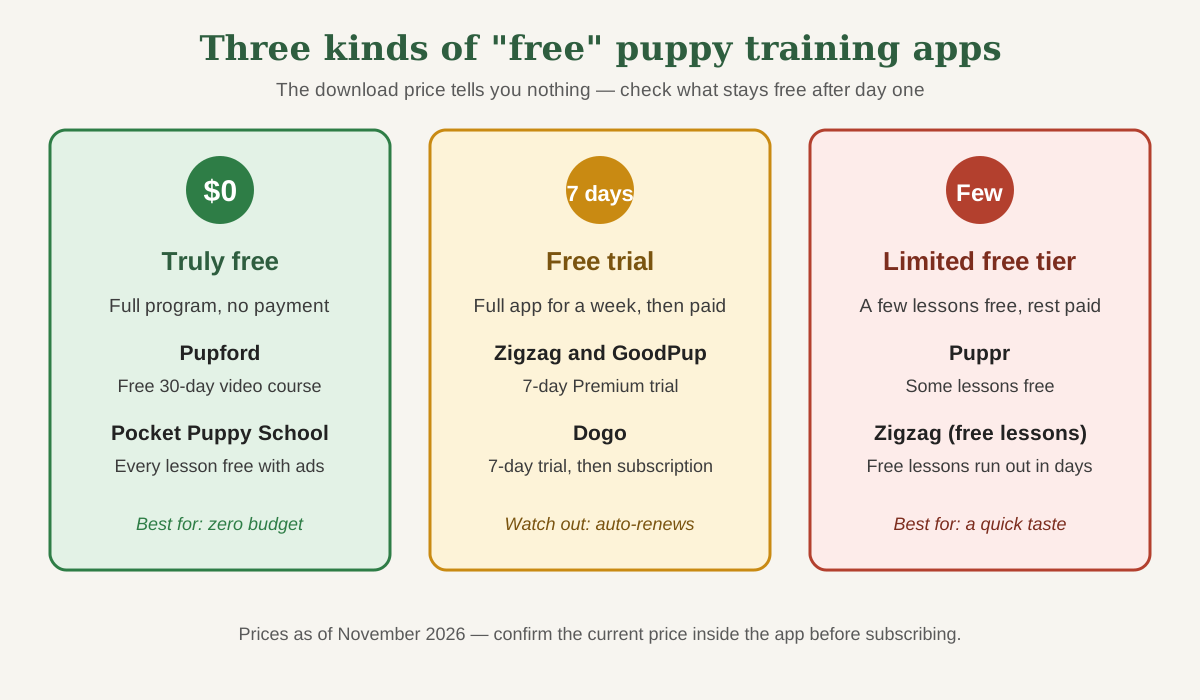
Most apps that call themselves “free” fall into three groups: truly free apps, free trials, and limited free tiers that lock most lessons behind a paywall. The table compares the six best-known puppy training apps, using prices from US App Store listings checked in October 2026.
| App | What is free | What it teaches | Free-tier limit | Paid price (as of November 2026) |
|---|---|---|---|---|
| Pupford | Full 30-day video course | Sit, stay, recall, leash manners, impulse control, crate training | No time limit on the 30-day course; advanced Academy courses are paid | Academy $9.99/month or $199.99 lifetime |
| Pocket Puppy School | Every lesson, with ads | Day-by-day puppy topics, clicker training, potty schedule | Ads in the app; PRO removes ads and adds extras | PRO $49.99 once (lifetime) |
| Zigzag | A few free lessons plus a 7-day Premium trial | Age- and breed-based puppy plan, socialization, house training | Free lessons run out after a few days; Premium unlocks 250+ lessons | $8.99–$9.99/month or $24.99–$49.99/year |
| Puppr | A small set of free lessons | Tricks and basic obedience, step-by-step videos | Most of the 100+ lessons need Premium | $13.99/month or $99.99/year |
| Dogo | A limited free version plus a 7-day trial | Daily obedience, tricks, clicker, video feedback | Free version covers only basic obedience | $29.99/month or $49.99/quarter; lifetime $299.99 |
| GoodPup | A 7-day free trial only | Live one-on-one video coaching with certified trainers | Nothing free after the trial week | About $29–$34/week for a program |
The pattern is clear: to spend zero dollars, choose Pupford or Pocket Puppy School. If you will pay after a trial, Zigzag is the strongest puppy-specific program, and GoodPup is the closest thing to hiring a real trainer through your phone. Prices change often, so confirm the current price in the app before subscribing.
What does Pupford’s free 30-day course actually cover?
Pupford is the best free starting point, because its free tier is a complete course rather than a sample. The “30-Day Perfect Pup” video course, led by trainer Zak George, is listed on Google Play as free forever, and it covers sit, stay, recall, leash manners, impulse control, and crate training in a puppy’s first month at home. It also touches on reactivity and separation anxiety, which most free tiers never mention.
The course is one lesson a day for 30 days, which matches how puppies learn: daily sessions beat one long weekend session, and an eight-week-old puppy’s attention span is only a few minutes.
What you do not get for free is Pupford’s Academy, the paid library of more than 100 extra courses ($9.99 a month, $39.99 for six months, or $199.99 for lifetime access). You do not need it in the first month — start with the free course, and only pay if you want help with a specific problem such as barking or leash pulling. Pupford works on iPhone, iPad, and Android.
Is Pocket Puppy School really free?
Pocket Puppy School is the only app here where every lesson is free. It earns money through ads and a one-time PRO upgrade, not by locking lessons behind a subscription — so the free version costs nothing, and PRO is a single $49.99 lifetime payment that removes ads.
The app organizes training into day-by-day topics, with a built-in clicker and a calendar for tracking potty breaks and progress. The lesson library is smaller and less polished than Zigzag’s or Pupford’s video courses, and there is no live trainer to ask questions. But for a tight budget, it is the only app where “free” means the whole program, not a teaser.
What do you get free from Zigzag, Puppr, and Dogo?
Zigzag, Puppr, and Dogo are good apps, but their free versions are samples, not programs. Knowing exactly where each one stops helps you decide whether to pay or move on.
Zigzag is built only for puppies. The app builds a 12-week plan around your puppy’s age and breed, with three short lessons a day covering socialization, bite inhibition, and house training in the order a puppy’s development needs them, plus 24/7 chat with expert trainers. The free version gives you a few lessons and a 7-day Premium trial; after that, Premium costs $8.99 to $9.99 a month or $24.99 to $49.99 a year. If you want a structured daily plan and a trainer to message at midnight, Zigzag is the app to pay for — but its free tier runs out too fast to finish the job.
Puppr is the fun one. Its library of more than 100 trick and obedience lessons is the largest here, and its step-by-step videos make it easy to teach a puppy to shake, roll over, or spin on cue. A small set of lessons is free — enough to learn whether your puppy enjoys trick training — while the full library needs Premium at $13.99 a month or $99.99 a year. Puppr is a poor choice as your only training app, because tricks are not obedience, but it is an excellent second app once the basics are solid.
Dogo sits in the middle. Its free version covers basic obedience, and its paid plans add a daily personalized lesson plan, a clicker, and video feedback from a real trainer who watches clips of your sessions. That feedback is Dogo’s best feature — and the reason it is expensive at $29.99 a month, $49.99 a quarter, or $299.99 for lifetime access. Most owners will find Pupford’s free course plus Zigzag’s cheaper subscription a better deal, unless video feedback is the feature you want.
Is GoodPup worth it if the trial is the only free part?
GoodPup is not a free app at all. It offers a 7-day free trial, then charges about $29 to $34 a week for live one-on-one video sessions with a certified trainer, plus 24/7 chat support between sessions.
Whether that price is worth it depends on the comparison. A group puppy class costs $100 to $300 for a four- to eight-week course, and a private session costs $75 to $200 an hour in 2026 — so a week of live video coaching is cheaper than a single private session. But for ordinary problems such as potty training, nipping, and jumping up, a free app plus a group class fixes things for far less. GoodPup earns its price when you need a trainer to watch your specific puppy and adjust the plan, for example with fear, aggression, or severe separation anxiety. In those cases, ask your veterinarian for a referral to a certified behaviorist as well.
When is a free app enough, and when should you pay?
A free app is enough when your puppy is healthy, confident, and struggling only with normal puppy problems: potty training, crate training, sit, stay, recall, loose-leash walking, and polite greetings are all teachable with Pupford’s free 30-day course or Pocket Puppy School.
Consider paying when one of three things is true. First, your puppy has a problem the free course does not cover, such as resource guarding, fear of strangers, or separation anxiety that does not improve in two weeks. Second, you need accountability: a daily plan with reminders and a trainer to check in with is worth paying for if you will not practice without it. Third, you have tried a free course properly for at least three weeks and the behavior is not improving — but paying for a different app will not fix a problem that inconsistent practice caused, so be honest about whether the sessions actually happened before you blame the app.
One more thing: an app cannot replace a group class for socialization, so use a free app as homework between classes, not as a replacement for them.
How should you use a free puppy training app?
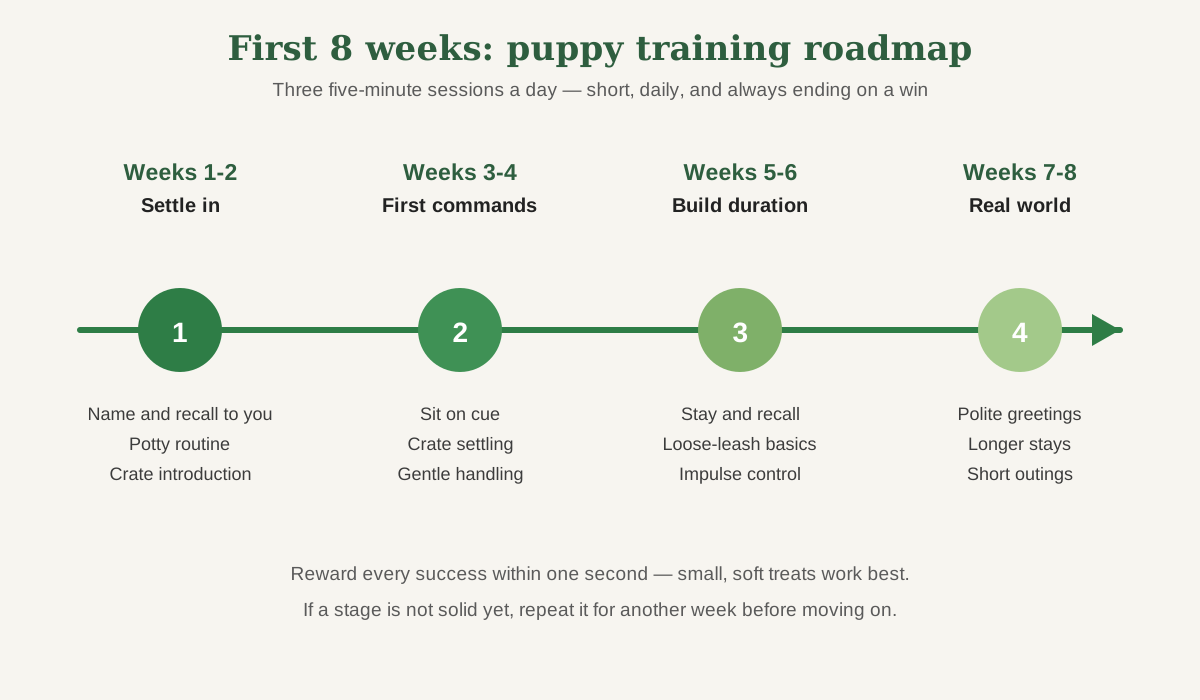
An app only works if the training happens, so the routine below is built to fit into your day: about 15 minutes in total.
Start with three five-minute sessions a day — morning, midday, and evening. Use small, soft treats the puppy can swallow in one second, and reward within one second so the puppy connects the treat to the action. The American Kennel Club recommends reward-based training for puppies, and every app here teaches that way — if an app ever tells you to punish, scold, or physically correct a puppy, delete it.
Follow the app’s order instead of skipping ahead: a puppy that cannot sit on cue will not learn a reliable recall. Keep a simple log of what you practiced so you can see progress over weeks rather than judging a single bad day.
Finally, involve everyone who lives with the puppy: training only works when the whole household uses the same cues and rules. If your puppy still struggles with the basics after a month of consistent practice, talk to your veterinarian before buying a more expensive app — pain, illness, or anxiety can look like stubbornness. Our guide to introducing a puppy to an older dog covers the same consistency idea for multi-dog homes, and our Labrador exercise guide explains how much activity a high-energy puppy needs before it can focus on training.
What should you watch out for in free training apps?
Free apps have three traps worth knowing before you download. The first is the trial that converts silently: several apps here offer a seven-day free trial that starts charging the moment the week ends, so set a phone reminder for day six and cancel from the App Store settings if you do not want to keep it. The second is the app that teaches the wrong methods — alpha rolls, shock collars, spray bottles, or scruffing a puppy are outdated and harmful, and the American Veterinary Medical Association supports reward-based training. The third is the app that is really a shop: if every lesson ends with a prompt to buy treats or toys, the app’s business is selling products, not training your puppy.
None of the six apps here falls into the second or third trap. But new training apps appear every month, and the app store does not check their methods — before you trust any app with your puppy, check that certified trainers or veterinary behaviorists wrote the lessons.
If you are crate training alongside an app, our guide to the best dog crate for anxious dogs explains how to choose a setup that helps a nervous puppy settle.
Frequently asked questions
Is there a completely free puppy training app?
Yes. Pupford’s 30-day video course is free with no time limit, and Pocket Puppy School offers every lesson free with ads — the only two apps where “free” means a full program rather than a trial or a sample.
Are free puppy training apps enough for a new puppy?
Yes, for most puppies. A free course covers sit, stay, recall, leash manners, and crate training — everything a normal puppy needs in its first month. You only need a paid app or a trainer if fear, aggression, or separation anxiety does not improve after three weeks of practice.
How long should a puppy training session last?
Five minutes, three times a day. Puppies under 12 weeks old lose focus after about five minutes, so short sessions that end on a success teach faster than long ones.
What is the cheapest way to train a puppy?
Start with Pupford’s free 30-day course, practice three short sessions a day, and join a local group puppy class for socialization ($100 to $300 for a four- to eight-week course) — less than one private session, covering both obedience and socialization.
Which free puppy training app is best depends on what free means to you. If free must mean zero dollars forever, download Pupford for its structured 30-day course and Pocket Puppy School as a backup, and you may never need to pay for training software. If free means “try it before I pay,” Zigzag’s seven-day trial shows you the best puppy-specific program, and its $9-a-month Premium plan is the cheapest paid upgrade. What matters most is not the app but the 15 minutes a day you spend with your puppy, a pocket full of treats, and the patience to repeat the same lesson until it sticks.