
The best puppy training treats are small, soft, and smelly enough to hold a puppy’s attention: about the size of a pea, under 4 calories each, and easy to swallow in one bite. Zuke’s Mini Naturals, Blue Buffalo Blue Bits, and Wellness Soft Puppy Bites top recommendation lists, and freeze-dried single-ingredient treats suit sensitive stomachs best.
The short version: buy Zuke’s Mini Naturals for everyday training and freeze-dried single-ingredient treats for high-value rewards. Keep every treat pea-sized, keep treats under 10% of daily calories, and skip anything hard or sweetened with xylitol. No affiliate links are included here.
What Makes a Good Puppy Training Treat?
A training treat is not a snack. It is a paycheck, paid dozens of times in a single session. A treat that takes a puppy more than a second or two to eat breaks the rhythm of training: the puppy wanders off, forgets what it did right, and needs to be lured back.
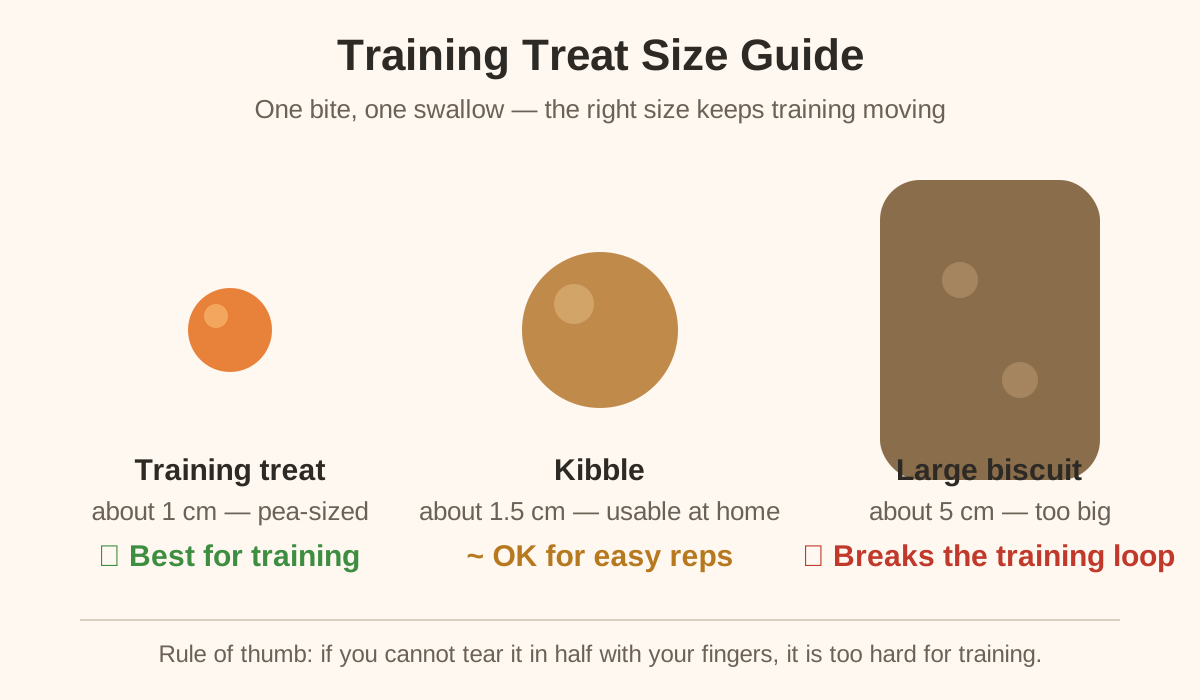
Size and softness come first. A good training treat is about the size of a pea, roughly 1 centimeter across. It should be soft enough to swallow without chewing, because chewing slows the reward. Break or quarter anything bigger — the bag’s “small” size is not always small enough.
Calories are the hidden trap. A session can easily use 20 to 30 treats. At 3 calories each, that is 60 to 90 calories, or most of a small puppy’s 10% treat budget for the day. Low-calorie treats, about 2 to 4 calories each, let you repeat a behavior many times without overfeeding.
Smell and ingredients are the last two tests. A strong, meaty smell wins a puppy’s attention outdoors, where distractions are stronger. A short ingredient list you recognize is the simplest safety check: meat first, no xylitol, and nothing your puppy has already reacted badly to.
Which Training Treats Should You Compare First?
| Treat | Calories per treat | Texture | Best for |
|---|---|---|---|
| Zuke’s Mini Naturals | 2 kcal (Nov 2026) | Soft and chewy, easy to tear | Everyday training at any age |
| Blue Buffalo Blue Bits | About 4 kcal (Nov 2026) | Soft-moist, heart-shaped | Puppies that like chicken or beef |
| Wellness Soft Puppy Bites | 6 kcal whole; ~1.5 kcal per quarter (Nov 2026) | Soft, puppy-sized bites | Puppies under 1 year |
| Bil-Jac Little Jacs | Low, soft liver-based treat | Soft, small, strong smell | Picky puppies and outdoor training |
| Freeze-dried single-ingredient | Usually 2–4 kcal per piece | Crisp but crumbles easily | Sensitive stomachs, high-value rewards |
Most training treats cost roughly $5–$12 per bag as of November 2026, and a 6-ounce bag of Zuke’s Mini Naturals works out to roughly 20–23 treats per dollar (about 150 treats per bag, at a typical list price around $7). These per-treat costs are estimates only: prices change often, so check the current shelf price before you buy.
Zuke’s Mini Naturals: the everyday workhorse
Zuke’s Mini Naturals are the closest thing to a default training treat: about 2 calories each, soft enough to tear in half for tiny puppies, and strong-smelling enough for outdoor work. They come in peanut butter, chicken, and salmon; rotate flavors if your puppy loses interest.
Blue Buffalo Blue Bits: the soft-moist all-rounder
Blue Bits are soft, moist, heart-shaped treats made with real chicken or beef as the first ingredient. They suit puppies that prefer a meaty, slightly sweet treat, and their small size needs no breaking for most breeds.
Wellness Soft Puppy Bites: the puppy-specific pick
Wellness Soft Puppy Bites are the only pick here made specifically for puppies under one year old, with DHA for brain development and a size that fits small mouths. At 6 calories each, quarter them for training so one bite stays close to 1.5 calories.
Bil-Jac Little Jacs: the high-value motivator
Bil-Jac Little Jacs are small, soft, liver-based treats with a smell that most puppies find hard to ignore. Save them for the hard jobs — recall outdoors, vet visits, and first introductions to new places — so they keep their value.
Freeze-dried single-ingredient treats: the sensitive-stomach option
Freeze-dried treats made from one ingredient — chicken breast, beef liver, or salmon — are the simplest option for puppies with sensitive stomachs or food allergies. They crumble easily, so break them small, and carry them in a sealed pouch so they stay dry.
Which Training Treats Work Best for Puppies 8 to 12 Weeks Old?
At 8 to 12 weeks, your puppy is learning its name, where to potty, and that following you pays off. Sessions should last 3 to 5 minutes, with a treat every few seconds at first: the goal is to make good behavior feel like the easiest choice.
For this stage, pick the smallest, softest, lowest-calorie option you can find. Zuke’s Mini Naturals or quartered Wellness Soft Puppy Bites are the usual starting points, because they are easy to swallow and easy to count.
Our puppy training schedule by age lays out what to teach in each of the first weeks and how many sessions a day to run. If you want a ready-made plan, our roundup of free puppy training apps includes tools that track sessions and suggest the next skill to teach.
Avoid anything that needs chewing at this age, and avoid introducing more than one new treat type in a single day. If your puppy gets loose stools after a new treat, stop that treat and try a single-ingredient option instead.
Which Training Treats Work Best for Puppies 3 to 6 Months Old?
Between 3 and 6 months, training gets harder on purpose. You start practicing outside, around distractions, and with longer gaps between treats. Your puppy still needs frequent rewards, but the rewards need to be worth more.
Use a low-value treat, like Zuke’s Mini Naturals or Blue Bits, for easy reps at home: sit, down, and name recall in the kitchen. Switch to a high-value treat, like Bil-Jac Little Jacs or freeze-dried liver, for the hard reps: recall at the park, loose-leash walking past other dogs, and settling on a mat.
Teething starts in this window, usually around 4 months. A puppy that suddenly ignores soft treats may be in pain: try a chilled treat, or a soft treat soaked in a little water, and check with your vet if the puppy stops eating.
This is also the age when most owners accidentally overfeed treats: three 5-minute sessions at 15 treats each is 45 treats, or 90 calories at 2 calories a treat. Count treats out before each session so you know where the day’s budget went.
Which Training Treats Work Best for Puppies 6 Months and Older?
By 6 months, your puppy knows the basics, and training shifts from teaching new behaviors to proofing them in real life. The treats that worked in the kitchen may not work at the dog park, so the value of the reward has to match the difficulty of the situation.
At this stage, start fading treats for easy behaviors and saving them for new or difficult ones. A puppy that sits on cue in the kitchen 9 times out of 10 can be rewarded every other time; a puppy learning to walk past a squirrel still earns a treat every time.
Bigger puppies can handle slightly larger treats now, but a treat should still be swallowed in one swallow. Keep the pea-size rule and spend your budget on better smells instead of bigger pieces.
Which Training Treats Should You Avoid?
Hard biscuits are the most common mistake: they take too long to eat, they crumble, and they interrupt the training flow. Save biscuits for a chew-time reward after the session, not during it.
Rawhide is a firm no for puppies. It is hard to digest, it can splinter or swell, and it poses a choking risk. Choose a digestible chew instead, and supervise any chew time.
High-calorie treats are the quiet problem. A single large biscuit can carry 20 or more calories, so a handful of them can use up the entire daily treat budget. Check the calorie count on the label and treat it like a budget, not a guess.
Finally, check every label for xylitol, also listed as birch sugar. Xylitol is highly toxic to dogs, even in small amounts, and it appears in some sugar-free treats and peanut butters. If you are unsure about a label, ask your vet.
How Many Training Treats Can a Puppy Have Per Day?
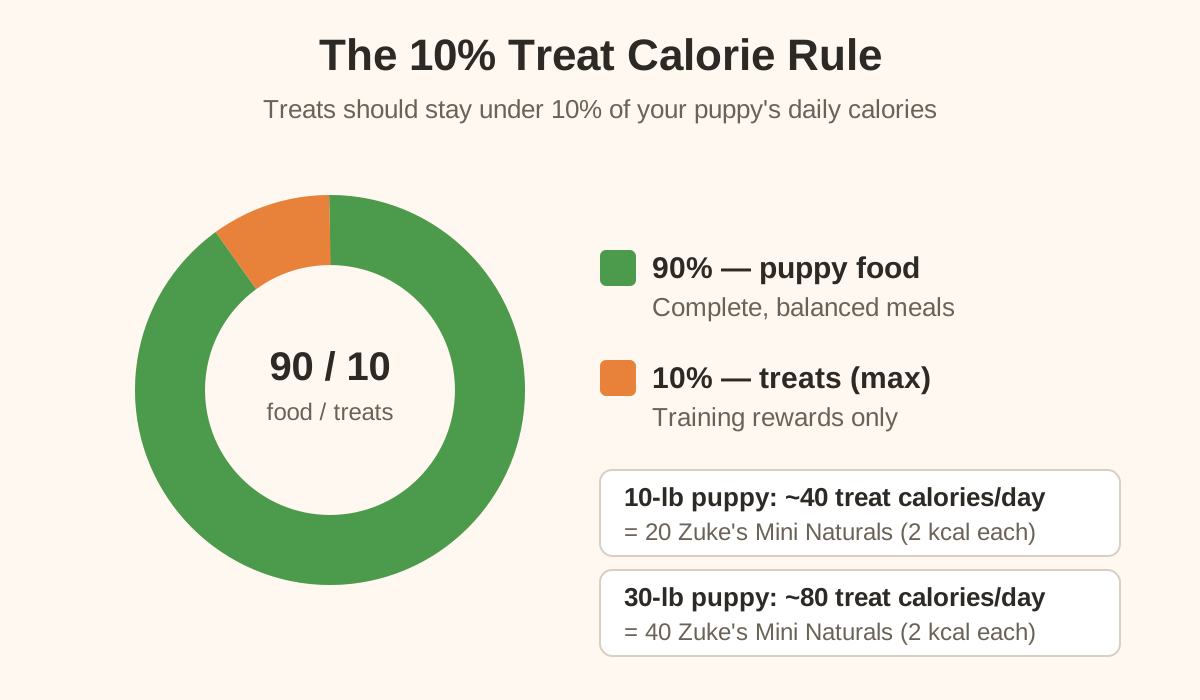
Treats should make up no more than 10% of your puppy’s daily calories — the guideline veterinarians use is 10% of calories from treats, 90% from a complete and balanced puppy food.
What 10% means depends on your puppy’s size. A 10-pound puppy eating about 400 calories a day has about 40 calories for treats, or about 20 treats at 2 calories each. A 30-pound puppy eating about 800 calories a day has about 80 calories for treats, or about 40 treats at 2 calories each.
Count treats per session, not per day. A 5-minute session should use 10 to 20 treats at most. If you hit the limit, end the session: a tired puppy is not learning.
How Should You Store Training Treats and Use Them in Sessions?
Store soft treats sealed, cool, and dry. Once a bag is open, air dries them out within days, and dried-out treats are harder to eat and less appealing. Reseal the bag, or move treats into a small airtight container, and use the bag within a few weeks.
Prep before the session, not during it. Count out 15 to 20 treats, break or quarter anything that needs it, and put them in a pouch or pocket so your hand is free to reward quickly.
End every session while your puppy still wants more. Three short sessions a day beat one long one, and a puppy that ends on a win is more likely to come back for the next one.
Frequently Asked Questions
What size should puppy training treats be?
About the size of a pea, roughly 1 centimeter across. If a treat is bigger, break it into pea-sized pieces before the session, so your puppy can swallow it in one bite.
How many training treats can a puppy have in one day?
Treats should stay under 10% of your puppy’s daily calories: roughly 20 small treats a day for a 10-pound puppy and about 40 for a 30-pound puppy, using 2-calorie treats. Ask your vet for your puppy’s exact daily calorie target.
Are Zuke’s Mini Naturals safe for puppies?
Yes, Zuke’s Mini Naturals are widely used for puppies, with a label limit of 3 treats per pound of body weight per day. They are soft, small, and about 2 calories each.
What treats should puppies avoid?
Puppies should avoid hard biscuits during training, rawhide, cooked bones, high-calorie treats with no printed calorie count, and anything with xylitol (birch sugar), which is toxic to dogs. If your puppy eats something you are unsure about, contact your vet or the ASPCA Animal Poison Control Center right away.
Do puppies need special puppy training treats, or will any small treat work?
Any small, soft, low-calorie treat works for training, even if it is not labeled for puppies. Puppy-specific treats are formulated for puppies under one year, but size, softness, and calorie count matter more than the label. Choose the treat your puppy will work for, and keep it pea-sized.
The best puppy training treat is the one your puppy will work for, in a size you can afford to repeat twenty times a session. Start with Zuke’s Mini Naturals, keep a freeze-dried treat for the hard jobs, and count your treats like your puppy’s meals.