
Pet dental care means brushing your dog’s or cat’s teeth with pet-safe toothpaste, offering VOHC-accepted chews or treats, and getting a professional cleaning when your vet advises it. Daily brushing is the best home step: it removes plaque before it hardens into tartar and prevents the gum disease most pets develop by age three.
Most owners never look inside their pet’s mouth until something smells wrong. All you need is a finger brush, pet toothpaste, and two minutes a day.
Why does pet dental care matter so much?
Every meal leaves plaque on your pet’s teeth. If it is not brushed away within 24 to 48 hours, saliva minerals harden it into tartar — a rough crust no toothbrush can remove. Tartar shelters bacteria against the gumline, where the real damage starts.
The American Veterinary Medical Association (AVMA) reports that most dogs and cats show some evidence of periodontal disease by age 3, making it the most common clinical condition in adult pets (AVMA pet dental care). It is a progressive, painful infection of the tissues holding teeth in place, and its bacteria can enter the bloodstream.
Pets almost never show dental pain the way people do: a dog with a cracked tooth will usually keep eating and playing, and cats hide it even better. By the time a pet refuses food, the disease is usually advanced — which is why vets treat dental care as prevention. Small breeds face the highest risk, with the same 42 adult teeth crowded into a much smaller jaw.
How often should you brush your pet’s teeth?
Daily brushing is the gold standard. The AVMA notes that brushing daily is the most effective way to slow plaque buildup at home (AVMA pet dental care). Every other day still removes plaque before most of it hardens; once a week will not, because plaque hardens within about two days.
Two minutes is enough — focus on the outer surfaces facing the cheeks, where plaque accumulates fastest.
What tools do you need for pet dental care?
You need a pet toothbrush or finger brush, pet toothpaste, and a few minutes of patience.
Pet toothpaste is non-negotiable. Human toothpaste contains fluoride and often xylitol — xylitol is highly toxic to dogs. Pet toothpaste is made to be swallowed and comes in poultry, beef, and fish flavors.
A finger brush is a rubber sleeve with soft bristles that slips over your fingertip — the easiest starting tool for cats and small dogs. A pet toothbrush has a longer handle and a smaller, angled head. Either works; pick the one your pet tolerates. Dental wipes are a backup for pets that refuse a brush. Buy for your pet’s mouth, not its body.
How do you brush a dog’s teeth step by step?
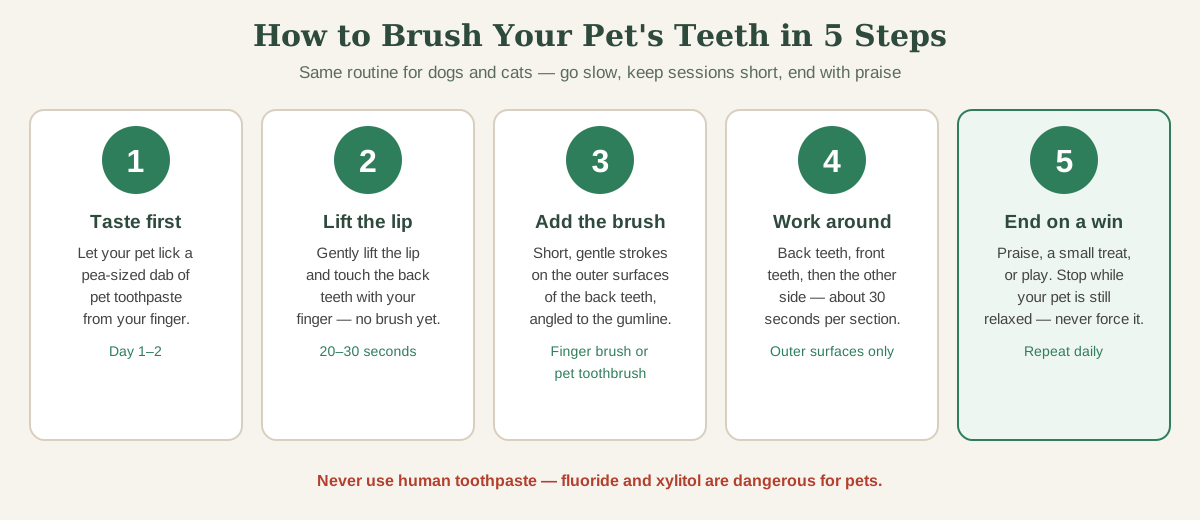
Start slow: a dog new to mouth handling needs a few days of introduction first.
- Let your dog taste the toothpaste. Squeeze a pea-sized dab onto your finger and let your dog lick it.
- Lift the lip and touch the teeth. Lift one side of the upper lip and run your toothpaste-coated finger along the outer surfaces of the back teeth.
- Introduce the brush. Use short, gentle strokes on the outer surfaces of the back teeth, angled toward the gumline.
- Work around the mouth. Move from the back teeth on one side to the front teeth, then to the other side.
- End on a win. Finish with praise, a small treat, or play. Your dog should associate brushing with good things.
If your dog growls, snaps, or panics, stop and go back a step. Try again tomorrow with just the toothpaste taste.
How do you brush a cat’s teeth step by step?
Cats are harder than dogs — smaller, faster, and far less tolerant of mouth handling. The introduction must be slower and shorter.
- Start with touch, not tools. For a few days, touch your cat’s face and lift its lip for a second while it is relaxed.
- Introduce the toothpaste. Let your cat lick fish- or poultry-flavored pet toothpaste from your finger. Try a second flavor if the first is rejected.
- Try a finger brush or gauze. A finger brush gives the best control in a small mouth. If your cat rejects bristles, wrap damp gauze around your fingertip instead.
- Brush in short bursts. Use tiny circular motions on the outer surfaces of the upper back teeth — ten to twenty seconds per side.
- Keep it brief and positive. A 30-second session your cat tolerates beats a two-minute session that ends in a bite.
The Cornell Feline Health Center notes that daily brushing is the best home defense against feline dental disease, and kittens accept it far more easily than adults (Cornell Feline Health Center — dental disease).
For adult cats that will not accept brushing, do not force it — focus on VOHC-accepted dental treats and regular vet checkups. If you already handle your cat for grooming, add a quick tooth check; see our guide on how to brush a long-haired cat.
What are the stages of periodontal disease?
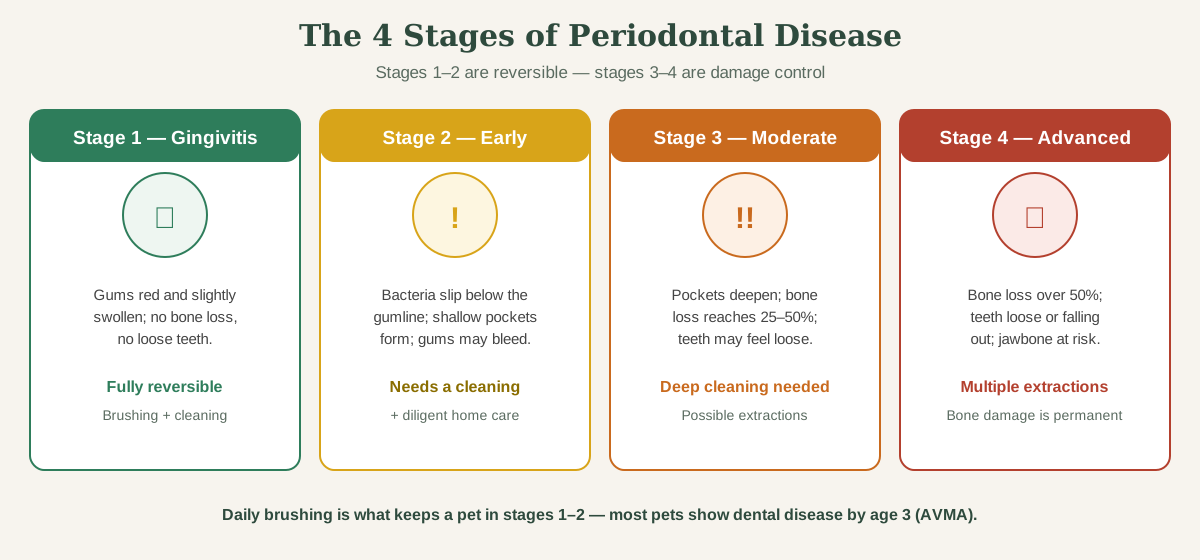
Stage 1 — Gingivitis. The gums are red and slightly swollen, but there is no bone loss. Fully reversible with brushing and a professional cleaning.
Stage 2 — Early periodontitis. Bacteria have slipped below the gumline and shallow pockets form around the teeth.
Stage 3 — Moderate periodontitis. Pockets deepen and bone loss reaches 25 to 50%.
Stage 4 — Advanced periodontitis. Bone loss exceeds 50%, teeth are loose or falling out, and infection may have spread to the jawbone. Treatment usually means multiple extractions.
Stages 1 and 2 are manageable and largely reversible; stages 3 and 4 are damage control. The difference is usually a year or two of ignored plaque — exactly what daily brushing prevents.
Which home dental products actually work?
The pet aisle is full of dental treats and chews that promise clean teeth; most do very little. The filter is the VOHC seal — the Veterinary Oral Health Council awards it only to products proven in trials to reduce plaque or tartar. As of November 2026, the VOHC list covers selected diets, chews, treats, and additives; check it at vohc.org before buying.
| Home option | What it does | How well it works | Best for |
|---|---|---|---|
| Daily brushing | Removes plaque before it hardens | Most effective home method; only one that cleans at the gumline | Every dog and cat that tolerates it |
| VOHC-accepted dental chews | Scraping and enzymes reduce plaque as the pet chews | Moderate; does not replace brushing | Dogs that chew thoroughly |
| VOHC-accepted dental treats | Like chews, smaller and lower-calorie | Moderate; a supplement to brushing | Cats and small dogs |
| Dental diets (VOHC kibble) | Larger kibble scrubs teeth as the pet bites | Moderate; only if the pet actually chews | Pets that chew instead of gulping |
| Water additives | Antimicrobials in drinking water reduce bacteria | Mild; a backup, not a primary method | Pets that refuse brushing |
| Raw bones and antlers | Hard chewing can scrape tartar | Risky; can crack teeth — most vets advise against them | Not recommended |
Size matters: a chew too small gets swallowed whole; one too large can choke. Never give cooked bones, which splinter. Water additives are mouthwash, not a substitute: they freshen breath but do not remove plaque. Keep the bowl clean — our guide on how to clean a cat water fountain covers the routine.
How often does a pet need a professional dental cleaning?
Even a perfectly brushed pet eventually develops some tartar. Most vets recommend a dental assessment at every annual checkup, and a full cleaning when they find tartar or gum recession — typically every one to two years.
A pet cleaning happens under general anesthesia: scaling below the gumline and X-rays require a still patient. Anesthesia-free “cleanings” only scrape the visible surface.
A standard cleaning includes a pre-anesthetic blood panel, anesthesia with monitoring, ultrasonic scaling above and below the gumline, polishing, full-mouth X-rays, and extraction of teeth too damaged to save. Most pets go home the same day. As of November 2026, a routine cleaning in the US commonly runs a few hundred dollars; one with extractions can run into four figures.
What are the warning signs of dental problems?
Check your pet’s mouth once a month. These signs mean a vet visit is needed soon:
- Bad breath that suddenly worsens. A sharp change in smell can signal infection or an abscess.
- Red, swollen, or bleeding gums. Healthy gums are pink and firm; redness or bleeding is early periodontal disease.
- Yellow or brown buildup on the teeth. That is tartar — it will not brush off.
- Loose, cracked, or missing teeth. Any loose tooth in an adult pet is a problem.
- Pawing at the face, or dropping food. Pets in pain often paw at one side.
- Refusing food, or eating much more slowly. A cat that walks away from food may be avoiding pain — urgent in cats, which can develop liver problems after days without eating.
- Swelling under the eye or along the jaw. In dogs, swelling below the eye often means an abscessed upper tooth.
Never give your pet human painkillers — ibuprofen and acetaminophen are toxic to dogs and cats. The ASPCA notes that regular veterinary exams catch dental disease early, when treatment is simplest (ASPCA pet care — dental care).
What does a home dental routine look like by age?
Puppies and kittens (8 weeks to 6 months). Focus on handling, not cleaning. Touch the mouth daily and let your pet lick pet toothpaste. Flag any retained baby tooth to your vet.
Adult dogs and cats (1 to 7 years). This is the daily-brushing era: brush daily if you can, every other day at minimum, and add a VOHC-accepted chew most days. See our guide on can dogs eat bananas for a tooth-friendly treat.
Senior pets (7 years and older). Keep brushing, but be gentler — older gums recede and teeth loosen. Senior pets usually need professional cleanings more often.
What are the most common pet dental care mistakes?
We compared vet guidance, product specs, and verified owner feedback:
- Using human toothpaste. Fluoride and xylitol are dangerous for pets.
- Brushing once a week. Plaque hardens into tartar within about two days.
- Only brushing the front teeth. The back teeth collect the most tartar.
- Starting with a brush on day one. A pet new to mouth handling needs days of introduction first.
- Trusting “dental” labels without the VOHC seal. Most such products have never been tested.
- Choosing anesthesia-free cleaning. The disease lives under the gumline.
- Ignoring bad breath. Foul breath is usually the first sign of dental disease.
- Waiting until the pet stops eating. By then the disease is advanced. Monthly mouth checks catch problems earlier.
Frequently asked questions
Can I use human toothpaste on my dog or cat?
No. Human toothpaste contains fluoride and often xylitol — xylitol is highly toxic to dogs. Use toothpaste made specifically for pets.
How often should I brush my pet’s teeth?
Daily is best; every other day is the minimum for real prevention. Plaque hardens into tartar within 24 to 48 hours.
Do dental treats and chews replace brushing?
No. Treats and chews help reduce plaque and tartar, especially VOHC-accepted products, but no chew cleans at the gumline the way bristles do.
Is anesthesia really necessary for a pet dental cleaning?
Yes. A proper cleaning requires scaling below the gumline and X-rays, which no awake pet will tolerate.
My cat will not let me brush its teeth. What should I do?
Do not force it. Try a finger brush or gauze, try a different flavor, and keep sessions under 30 seconds. If your cat still refuses, focus on VOHC-accepted treats and vet checkups.
What does it cost to get a pet’s teeth cleaned?
As of November 2026, a routine cleaning in the US commonly costs a few hundred dollars, while one with multiple extractions can cost four figures.
Why does my dog’s breath smell so bad?
Persistently bad breath is usually the first sign of dental disease. Bacteria in plaque and tartar produce foul-smelling compounds. If your dog’s breath suddenly gets worse, book a vet visit — and see our guide on why does my dog lick his paws for when licking means a vet visit is due.
The bottom line
Pet dental care is a two-minute habit with an outsized payoff. Brush daily with pet-safe toothpaste, offer a VOHC-accepted chew or treat, check your pet’s mouth once a month, and let your vet handle the tartar home care cannot reach. Most dogs and cats show some evidence of periodontal disease by age 3 — but brushed pets keep their teeth and skip expensive extractions.
Start tonight: let your pet taste the toothpaste, lift the lip, and brush the back teeth for thirty seconds. Tomorrow, do it again.