
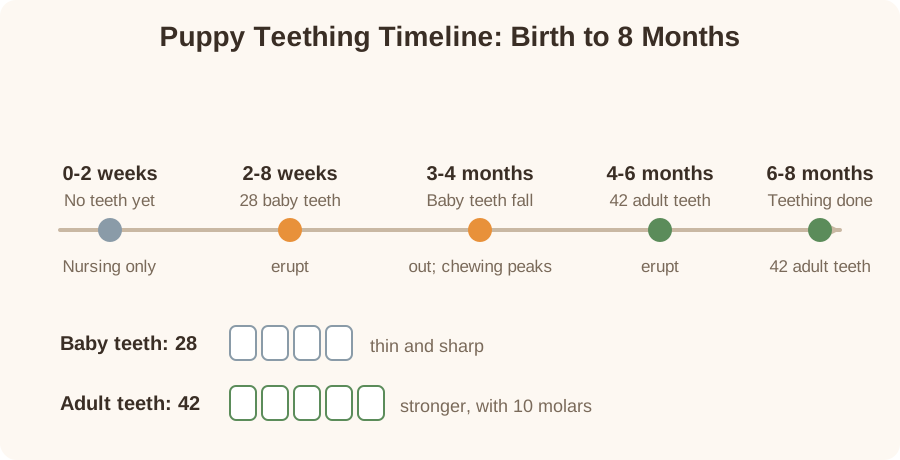
Puppies are born without teeth, grow 28 needle-sharp baby teeth by about 8 weeks old, then lose every one of them and grow 42 adult teeth. Most of that swap happens between 3 and 6 months of age. This timeline shows what to expect each month, which chews are safe, and when to call the vet.
How Many Teeth Do Puppies Have?
Puppies grow 28 baby teeth, also called deciduous teeth. Adult dogs have 42 permanent teeth. Puppies lose all 28 baby teeth and grow 14 more teeth than they started with, including molars they never had as babies.
The baby set has 12 incisors, 4 canines, and 12 premolars — no baby molars. The adult set adds 10 molars, which is why the back of the mouth finishes last. The American Kennel Club notes that puppies’ baby teeth begin erupting at about 3 weeks of age, and most puppies have all 28 by 6 to 8 weeks. Baby teeth are thin and sharp; adult teeth are thicker and built to last a lifetime.
What Does the Puppy Teething Timeline Look Like?
The whole process runs from birth to about 6 to 8 months.
| Age | What is happening | What you will notice |
|---|---|---|
| Birth to 2 weeks | No teeth yet | Puppy nurses only |
| 2 to 4 weeks | Baby incisors and canines erupt | First tiny teeth appear |
| 4 to 8 weeks | All 28 baby teeth come in | Sharp needle teeth; starts solid food |
| 8 to 12 weeks | Baby teeth fully in | Everything goes in the mouth |
| 3 to 4 months | Baby teeth start falling out | Tiny teeth on the floor; sore gums |
| 4 to 6 months | Adult teeth erupt | Incisors, canines, premolars, molars |
| 6 to 8 months | Teething finishes | All 42 adult teeth in |
Puppies swallow most of their baby teeth, so do not expect to find all 28. Finding a few tiny teeth is normal, and finding none is also normal. The American Kennel Club’s chief veterinarian, Dr. Jerry Klein, notes that puppies are likely to swallow most of the teeth they lose.
What Happens at 2 to 4 Weeks Old?
The first teeth to appear are the baby incisors, the small front teeth, followed closely by the needle-like baby canines. Eruption usually starts at about 3 weeks, and by 4 weeks a puppy has a working set of front teeth.
At this age puppies are still with their mother and littermates, and that matters. Littermates teach each other bite control: when one puppy bites too hard, the other yelps and stops playing.
What Happens at 8 to 12 Weeks Old?
This is the age most puppies go home, and it is also when teething starts to affect your daily life. All 28 baby teeth are in, and the puppy explores the world by putting it in its mouth. Shoes, chair legs, remote controls, and your fingers are all chew targets now.
Chewing at this age is how a puppy learns, so redirect instead of punishing. Every time the puppy chews something it should not, trade it for something it can chew, then praise the swap.
Start a gentle mouth-handling routine now. Once a day, lift the puppy’s lip for a few seconds and touch the gums and teeth, then reward with a treat. A puppy that accepts mouth handling at 10 weeks will let you check for loose or retained baby teeth at 5 months. A calm weekly bath is another chance to check the mouth — our guide to how often you should bathe a dog covers how to keep grooming low-stress.
What Happens at 3 to 4 Months Old?
This is when the shedding starts. The baby incisors loosen first, usually around 12 to 16 weeks, followed by the baby canines. You may find tiny teeth on the floor or stuck in a toy. Gums may look red and swollen, and a drop of blood on a chew toy is normal.
Chewing peaks now: erupting teeth hurt, and chewing presses on the gums in a way that relieves the pressure.
Nipping also peaks now. The fix is simple: the moment teeth touch skin, the fun stops. Stand up, turn away, and ignore the puppy for ten seconds. Then offer a toy. A structured daily routine helps too — our puppy training schedule by age lays out what to practice each week, including bite inhibition, so teething and training move together.
What Happens at 4 to 6 Months Old?
The adult teeth erupt in a set order: incisors first, then canines, then premolars, and finally the molars at the back. Each adult tooth pushes its baby tooth out, and the swap usually takes about two months.
This stage brings a second wave of heavy chewing, because the large adult molars erupting at the back put pressure on the gums. Rotate chew toys every few days, and size up to toys rated for the puppy’s current weight.
Watch the mouth during this stage, not just the chewing. The most common problem is a retained baby tooth: a baby canine that stays in place while the adult canine erupts beside it, leaving two teeth in one spot. Retained canines trap food and plaque. If you can see two canines side by side after the adult tooth is fully in, call your vet — a retained baby tooth usually needs to be removed by a veterinary professional.
What Happens at 6 to 8 Months Old?
By 6 months, teething is finished for most puppies. The adult teeth are all in, the gums have settled, and the frantic chewing usually calms down. Some puppies take until 8 months.
What does not end at 6 months is chewing itself. Adolescent dogs keep chewing because it is enjoyable and relieves boredom and stress. A 7-month-old dog that destroys the couch is not teething; it is bored, under-exercised, or anxious, and the fix is enrichment and exercise, not a teething toy.
Do a final mouth check at 6 months: 42 teeth is the full adult set, and look for retained baby teeth, crooked teeth, or a tooth that never appeared.
What Are the Signs Your Puppy Is Teething?
Teething looks different from illness. These are the normal signs:
- Chewing everything. Furniture, shoes, hands, and the rug. Chewing spikes during the 3-to-6-month window.
- Drooling more than usual. A wet chin and damp toys are normal.
- Red or slightly swollen gums. Gums look pinker where a tooth is about to break through.
- A small amount of blood on toys. A drop or two is normal. Blood that soaks a toy or appears in the food bowl is not.
- Reluctance to eat hard kibble. Soaking kibble in warm water usually fixes sore gums.
- Mild irritability and restless sleep. Sore gums make puppies grumpy and wakeful.
- Loose or missing teeth. Finding a baby tooth on the floor is the clearest sign of all.
Teething does NOT cause a high fever, vomiting, diarrhea, or refusing food and water for a full day. Those are signs of illness — call your veterinarian.
What Should Puppies Chew — and What Should They Never Chew?
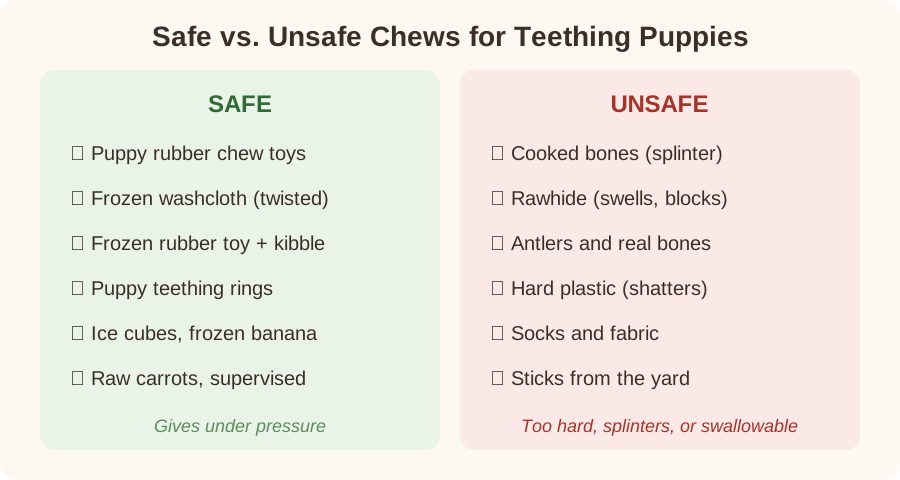
The rule is simple: a teething puppy should chew things that give under pressure and cannot break into sharp pieces. The AKC’s guidance on what puppies can safely chew makes the same point: choose toys made for puppies, sized to the puppy, and check them often for damage.
| Safe for teething puppies | Avoid — unsafe |
|---|---|
| Rubber chew toys made for puppies | Cooked bones of any kind (they splinter) |
| Frozen washcloths (wet, twisted, frozen) | Rawhide and compressed chews that swell |
| Frozen rubber toys stuffed with kibble | Antlers and real bones (too hard; crack teeth) |
| Puppy teething rings and ropes | Hard plastic toys that shatter |
| Ice cubes and frozen banana pieces | Socks, fabric, and anything swallowable |
| Carrots (raw, puppy-sized, supervised) | Sticks from the yard (splinters) |
The thumbnail test is the fastest safety check. Press your thumbnail into the chew: if it dents slightly, it is soft enough for puppy teeth. If your nail cannot dent it, it is too hard. VCA Animal Hospitals warns that very hard chews are a leading cause of broken puppy teeth.
Supervise every chew session. Inspect toys daily and throw away anything with chunks missing. A toy the puppy can fit entirely in its mouth is a choking risk, so check the size rating against your puppy’s current weight every month.
How Can You Soothe a Teething Puppy?
Relief comes from two things at once: cold to numb the gums, and pressure to counter the ache.
- Freeze a wet washcloth. Wet a clean washcloth, twist it into a rope, freeze it for a few hours, and let the puppy chew it under supervision.
- Keep rubber toys in the freezer. A rubber chew toy stuffed with a little kibble and frozen overnight becomes a cold, long-lasting project. Rotate two or three so one is always ready.
- Offer frozen treats. Ice cubes, frozen banana pieces, and frozen carrot sticks are cheap and effective. Bananas are safe for dogs in small amounts — our guide to whether dogs can eat bananas covers portions and what to avoid.
- Massage the gums. Wash your hands, then rub the puppy’s gums gently with a fingertip for a few seconds at a time. Stop if the puppy pulls away or the gums bleed.
- Redirect before the chewing starts. Puppies chew hardest when they are tired, bored, or just woke up. Offer a frozen chew at those predictable moments instead of waiting for the puppy to find your shoes.
Never give a puppy ibuprofen, acetaminophen, or aspirin — all three are toxic to dogs. If your puppy seems to be in real pain, only a vet can prescribe a safe medication.
When Should You Call the Vet About Teething?
Most teething needs no vet at all. But these situations are worth a call:
Call your vet if a baby tooth is still in place after the adult tooth has fully erupted beside it, if the gums bleed more than a few drops or bleed for more than a day, if the puppy refuses food for more than 24 hours, or if the adult teeth come in visibly crooked or crowded.
Call your vet promptly if your puppy swallows a piece of a toy, a sock, or any object that could block the intestines. The signs are vomiting, straining to defecate, a swollen belly, or sudden lethargy.
VCA Animal Hospitals’ guide to teeth, teething, and chewing in puppies lists the same warning signs, and the American Kennel Club’s teething timeline confirms the 6-month finish line most owners should expect. This article is general information, not veterinary advice — if you are unsure whether something is normal, a quick call to your vet costs nothing.
Frequently Asked Questions
When do puppies start teething?
Puppies start teething at about 3 weeks old, when the baby teeth begin to erupt. The heavy phase — losing baby teeth and growing adult teeth — starts at 3 to 4 months and is usually finished by 6 months, though some puppies take until 8 months.
How long does puppy teething last?
Puppy teething lasts about 3 to 4 months of active tooth loss and eruption, from roughly 3 months to 6 months of age. Small breeds may run a few weeks longer.
Do puppies lose all their baby teeth?
Yes, puppies lose all 28 of their baby teeth. The adult set of 42 teeth replaces them, and most puppies swallow the baby teeth they lose, so owners usually only find a few. A baby tooth that stays in place after the adult tooth erupts is called a retained tooth and should be checked by a vet.
Is it normal for a teething puppy to bleed?
Yes, a small amount of bleeding is normal when a baby tooth falls out. A drop or two on a chew toy or a pink tinge on the gums is expected. Bleeding that soaks a toy, lasts more than a day, or appears in the food bowl is not normal — call your vet.
Can teething cause diarrhea or fever in puppies?
No, teething does not cause diarrhea, vomiting, or a high fever. Mild drooling, red gums, and grumpy behavior are normal teething signs. Diarrhea, vomiting, refusing food for a full day, or a fever over 103°F (39.4°C) are signs of illness, not teething, and need a vet visit.
The Short Version
Puppy teething runs about six months: 28 sharp baby teeth arrive by 8 weeks, start falling out at 3 to 4 months, and are replaced by 42 adult teeth by about 6 months. Frozen chew toys, daily mouth checks, and a calm response to nipping get most puppies through it; the only things that need a vet are retained baby teeth, heavy bleeding, swallowed objects, and any sign of illness.