
Neither wet nor dry food is better for every cat. Wet food wins on hydration and is easier to eat, while dry food wins on cost and convenience. Most healthy cats do well on either format — or a mix — as long as the food is complete and balanced and portions match the cat’s needs.
Photo: Pexels.
The short answer:
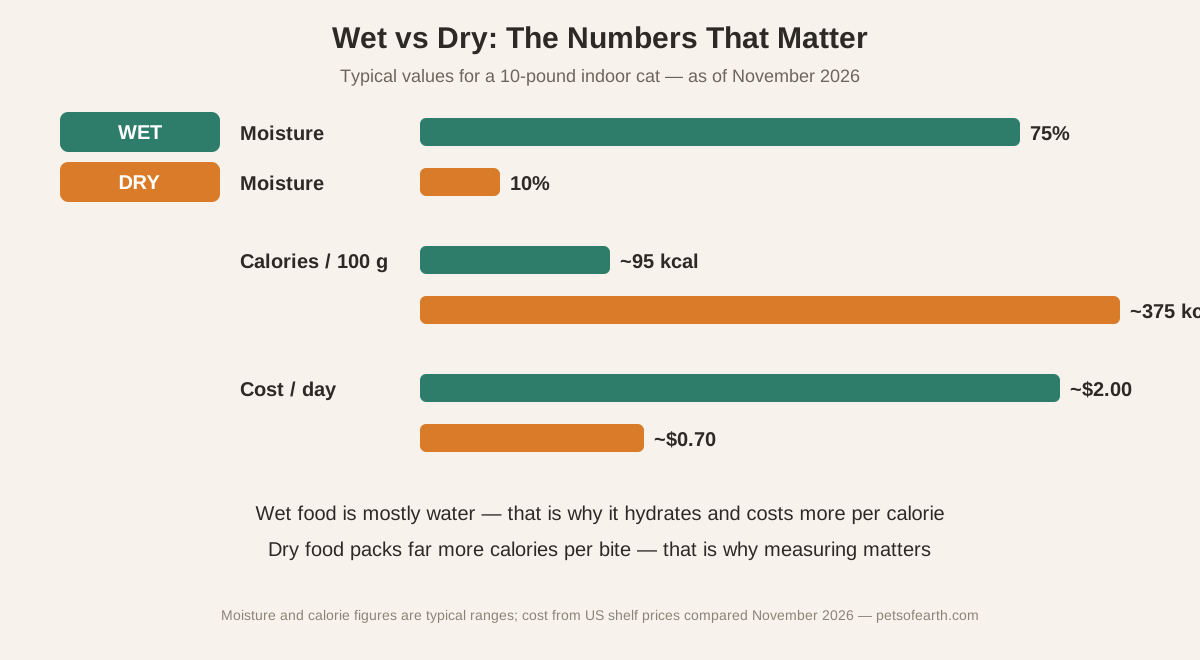
- Wet food is about 70–80% water; dry food is about 10%. That moisture gap is the biggest real difference.
- Neither format is automatically healthier. A complete and balanced food meets a cat’s needs when fed in the right amount.
- Dry food is far cheaper per calorie. Wet food typically costs 2–3x more, based on typical US prices we compared as of November 2026.
- Dry food does not reliably clean teeth. Only diets with a Veterinary Oral Health Council (VOHC) seal are proven to cut tartar.
Guidance compared from Cornell Feline Health Center, the AVMA, and the ASPCA.
Wet food vs dry food at a glance
| Wet food | Dry food | |
|---|---|---|
| Moisture | About 70–80% water | About 10% water |
| Calories per 100 g | Roughly 70–120 kcal | Roughly 350–400 kcal |
| Cost per calorie | Higher — often 2–3x dry | Lower — the budget option |
| Dental benefit | None on its own | Only VOHC-approved diets help |
| After opening | Refrigerate, use in 2–3 days | Reseal, lasts weeks |
| Left out | Discard after 1–2 hours | Can sit out all day |
What is the real difference between wet and dry cat food?
The difference is mostly water, not nutrition. Both formats can be complete and balanced — containing all the nutrients a cat needs in the right proportions, as defined by AAFCO nutrient profiles. Look for that phrase on the label; it matters far more than wet or dry.
A typical 5.5-ounce (156 g) can holds roughly 150–180 calories, while the same calories come from only about 45 grams of dry food. Protein and fat levels overlap heavily once you compare them on a dry-matter basis — after removing the water from the math. A wet food labelled 10% protein may actually be 40% on a dry-matter basis, similar to a kibble labelled 35%.
The format is a delivery system, not a quality grade.
Which food keeps cats better hydrated?
Wet food is the clear winner on hydration: a cat eating only wet food can get most of its daily water from its meals, since each can is roughly three-quarters water. A cat on dry food must drink nearly all its water from a bowl — and cats are famously reluctant drinkers.
Cats evolved from desert animals and have a low thirst drive. The Cornell Feline Health Center notes that cats often do not drink enough water on their own, and feeding wet food is one practical way to increase intake — which is why vets frequently recommend it for cats prone to urinary or kidney problems.
How much water does a cat need? A common veterinary rule of thumb is about 3.5 to 4.5 ounces (100–130 ml) per 5 pounds (2.3 kg) of body weight per day, from food and drinking combined. A 10-pound cat on an all-dry diet needs to drink roughly a full cup of water a day — and many cats simply do not.
Wet food is the easiest way to get more water into a cat that does not drink much.
Which is better for weight control and calories?
Dry food makes overfeeding easy, and wet food makes portion control easier — but the calories are what count, not the format.
Kibble is calorie-dense: roughly 350–400 calories per 100 grams, against roughly 70–120 for wet food. A small handful of extra kibble adds up fast, which is one reason free-feeding dry food is linked to weight gain. The ASPCA’s cat nutrition guidance stresses measuring meals rather than keeping the bowl permanently full.
Wet food has the opposite advantage: each serving is mostly water, so the portion looks large while calories stay modest. But it is not a weight-loss guarantee — some wet foods are rich in fat. The real weight-control tool is the measuring cup and the feeding schedule, not the can or the bag.
An average 10-pound indoor cat needs roughly 200–250 calories per day.
Does dry food really clean cats’ teeth?
This is the most repeated claim in the wet-versus-dry debate, and it is mostly a myth. Most cats swallow kibble whole or shatter it with one bite, so the food barely contacts the tooth surface. The Cornell Feline Health Center explains that there is little evidence regular dry food provides meaningful dental cleaning.
What does help is a diet proven for dental health: the Veterinary Oral Health Council (VOHC) awards its seal only to products shown in trials to reduce plaque or tartar, using larger, fibrous kibbles the tooth sinks into.
Wet food offers no dental benefit — but neither does it rot teeth faster, a common myth. Decay is driven by plaque and genetics far more than by food texture.
If dental health is the goal, brush your cat’s teeth or use a VOHC-approved diet — do not rely on ordinary kibble.
Which costs more — and by how much?
Dry food is much cheaper, and the gap is large. Based on typical US shelf prices we compared as of November 2026, feeding a 10-pound cat mid-range wet food costs roughly $1.50–$2.50 per day, against roughly $0.50–$0.90 for dry food — two to three times the cost per calorie.
The reason is simple: you are paying to ship and store water, and cans cost more to make than bags. For several cats, the gap decides it — three cats on wet food only can cost $150+ a month, against perhaps $50–$70 for dry food. A complete and balanced kibble fed every day beats a premium wet food you have to stop buying.
Mixed feeding is the middle ground: one wet meal a day plus measured dry food runs roughly $0.90–$1.40 a day for the same cat, based on the prices we compared.
Which is easier to store, serve, and leave out?
Dry food wins on convenience by a wide margin. An unopened bag keeps for weeks or months, and once opened it only needs resealing. You can measure it in seconds, leave it in the bowl while you are at work, and use it in puzzle feeders and automatic feeders.
Wet food is fussier: an opened can must be refrigerated and used within two to three days, and many cats refuse cold food straight from the fridge. A served portion should not sit out for more than one to two hours. It also smells stronger and needs more washing up — small daily frictions that add up for busy owners.
What about picky eaters?
Picky cats usually prefer wet food: its strong aroma, soft texture, and warmth are closer to what a cat’s senses expect, and many cats that refuse kibble will eat it eagerly.
Some cats are the opposite: they imprint on kibble as kittens and refuse anything soft. Warming the wet food slightly, offering a little alongside the familiar kibble, and trying different textures — pate, chunks in gravy, shredded — usually wins them over.
Sudden fussiness can have a medical cause: dental pain, nausea, and kidney problems can all show up first as pickiness. Never let a cat go without eating for more than 24 hours — cats can develop hepatic lipidosis, a serious liver condition, after even a short fast. If your cat refuses food entirely, call your vet the same day.
Cats eat best in a calm, quiet spot, away from the litter box and other pets — our guide to how to litter train a kitten covers the same calm-environment principles. And kneading around mealtimes is a comfort behaviour, not a hunger signal; see why cats knead.
Which food suits kittens, seniors, and cats with health issues?
Life stage changes the answer more than any other factor.
Kittens need calorie-dense food labelled for kittens or “all life stages.” Either format works if it carries that label, but many owners start kittens on wet food because it is soft and aromatic.
Senior cats (roughly 11+) often benefit from wet food: older cats drink less, and sore mouths make kibble painful. Wet food’s moisture and soft texture help on both counts.
Cats with kidney disease are the clearest case for wet food: vets commonly recommend it, and prescription kidney diets are often wet, because extra water helps the kidneys and dilutes the urine. Cats with diabetes often do better on wet food, which tends to be lower in carbohydrates — though the diet must be chosen with a vet. Overweight cats usually do better on measured wet food.
None of this is a prescription — if your cat has a diagnosed condition, choose the diet with your vet. The AVMA and ASPCA nutrition guides are good starting points.
Which is better for which cat?
- Mostly wet food if your cat drinks little, has kidney or urinary issues, is a senior with dental problems, is overweight, or refuses kibble.
- Mostly dry food if you are on a tight budget, feed several cats, travel often, use an automatic feeder, or your cat prefers kibble and drinks well.
- A mix if you want wet food’s hydration with dry food’s cost and convenience — the best default for most healthy adult cats.
- A prescription diet if your vet has diagnosed a condition — the formula matters more than the format.
There is no universally better food — there is only the better food for your cat, your budget, and your routine.
Can you feed both? How to mix wet and dry food
Yes — mixed feeding is the most popular compromise. A simple routine for a healthy adult cat:
- Morning: wet food. Roughly half a 5.5-ounce can for a 10-pound cat.
- Evening: dry food. Roughly 1/4 to 1/3 cup of kibble.
- Measure both. Keep the daily total at your cat’s target — about 200–250 calories for a 10-pound indoor cat.
- Do not simply add wet food on top of a full dry ration. That is how mixed feeding accidentally becomes overfeeding.
- Keep fresh water available at all times, even on wet-food days.
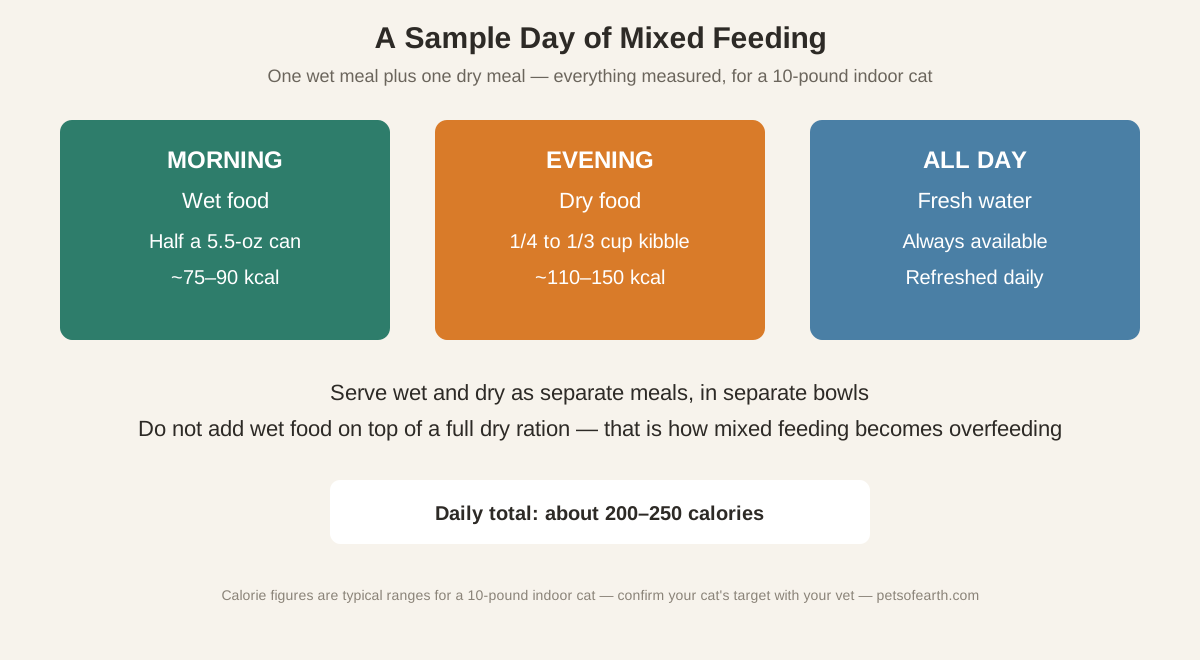
Do not mix them in the same bowl and leave it out: the wet portion spoils within a couple of hours and the kibble goes soggy. Serve separate meals in separate bowls.
How do you switch your cat’s food safely?
Cats dislike sudden change, and a fast switch can cause vomiting, diarrhoea, or a food strike. Change food gradually over 7–10 days: 25% new food for days 1–3, 50/50 for days 4–6, 75% new for days 7–9, then new food alone from day 10.
Mild soft stools for a day or two are common; persistent diarrhoea, vomiting, or refusal to eat are reasons to slow down or call your vet. Measure the new food by calories, not by volume — the density changes between formats.
Frequently asked questions
Is wet food or dry food better for cats overall?
Neither. Wet food is better for hydration, dry food for cost and convenience. Most healthy cats do well on either format, or a mix, as long as the food is complete and balanced.
Can cats live on dry food alone?
Yes, if the food is complete and balanced and the cat drinks enough water — just keep fresh water available and watch the cat’s weight.
Is wet food better for cats with kidney disease?
Wet food is commonly recommended because its moisture supports hydration and dilutes urine — but the specific diet should be chosen with your vet.
Does wet food cause dental problems in cats?
No. Dental disease is driven mainly by plaque build-up and genetics, and is common in cats fed either format. Brushing and veterinary dental care matter far more than food texture.
How much wet and dry food should I feed my cat per day?
Roughly 200–250 calories per day for an average 10-pound indoor cat, split across two meals: half a 5.5-ounce can of wet food in the morning plus about 1/4 to 1/3 cup of dry food in the evening. Confirm the amount with your vet.
The bottom line
Wet and dry food are two ways of delivering the same nutrition; the choice is mostly hydration versus convenience. For most healthy cats, a mix of both — wet in the morning, dry in the evening, everything measured — captures the best of each side.
Whatever you choose, the details matter more than the format: a complete and balanced label, measured portions, fresh water always available, and a vet involved whenever your cat’s health, weight, or appetite changes.
Sources: Cornell Feline Health Center, “Feeding Your Cat” — vet.cornell.edu; American Veterinary Medical Association, “Pet Nutrition” — avma.org; ASPCA, “Cat Nutrition Tips” — aspca.org. Prices compared from typical US retailers, as of November 2026.