
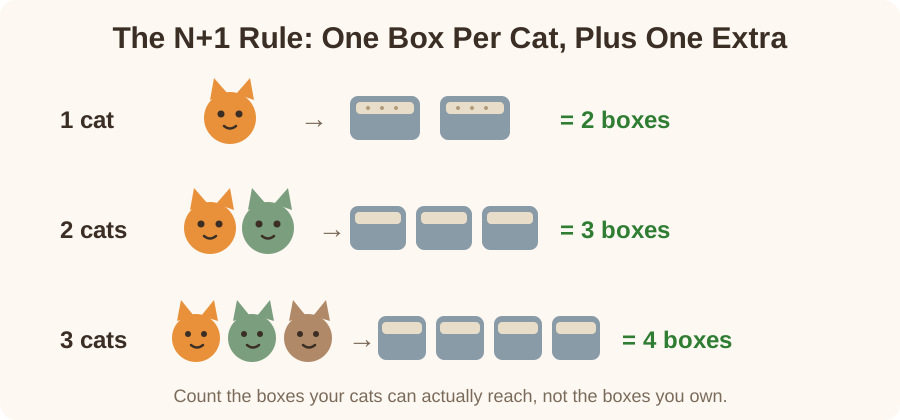
Most cats need one litter box per cat, plus one extra. That means two boxes for one cat, three for two cats, and four for three cats. This is the n+1 rule, recommended by feline veterinarians, and it works because cats avoid dirty or occupied boxes. Spread the boxes across different rooms so every cat always has a clean, private option.
What Is the N+1 Rule for Litter Boxes?
The n+1 rule is the standard recommendation from feline veterinarians: provide one litter box for every cat in the home, plus one spare. If n is the number of cats, you need n+1 boxes. One cat needs two boxes. Two cats need three. Three cats need four.
The rule exists because cats are fastidious. A cat that finds its only box dirty, occupied, or blocked by a closed door will often choose the rug, the bathtub, or a pile of laundry instead. The extra box is insurance against exactly that moment.
The Cornell Feline Health Center recommends this approach, noting that cats prefer clean, accessible boxes and that enough boxes in separate locations prevents many common elimination problems. The ASPCA gives the same advice when a cat starts avoiding the box: add a box, and put it somewhere new.
The rule is a minimum; what matters most is whether every cat can reach a clean box without crossing another cat’s path.
How Many Litter Boxes Do You Need?
Use this table as your starting point. The numbers follow the n+1 rule, and the placement notes reflect how cats actually behave in shared homes.
| Cats in the home | Litter boxes needed | Placement notes |
|---|---|---|
| 1 cat | 2 boxes | Two different rooms, not side by side. The spare covers times when the other is dirty or the door is shut. |
| 2 cats | 3 boxes | At least two rooms, so cats can reach a box without passing each other. |
| 3 cats | 4 boxes | At least two rooms, ideally three. Give the shyest cat a box in its own safe zone. |
| 4 cats | 5 boxes | Three or more rooms; one box on each floor in a large home. |
| 5 cats | 6 boxes | Same as four cats, plus a box where the lowest-ranking cat spends most time. |
| 6 or more cats | 7 or more boxes | Keep adding one box per cat. Watch for guarding: one cat can block a hallway and cut off several boxes. |
A single box per cat is not enough, even in a peaceful home. Two friendly cats will still avoid a box the other has just used, because cats prefer a clean surface. The spare box removes that wait.
Size matters too. A box should be at least one and a half times your cat’s length, nose to base of tail, so the cat can turn around and dig comfortably. For most adults that means 20 to 24 inches long; Maine Coons often need 26 inches or more. Kittens and arthritic seniors need a low entry of 3 to 4 inches on one side.
A box counts only if a cat can reach it, turn around inside it, and leave without being ambushed. A box behind a rattling washing machine, or one in a closet with a door that swings shut, does not count. Count the boxes your cats can use, not the boxes you own.
Where Should You Put the Litter Boxes?
Placement is where the n+1 rule either works or fails. Two boxes side by side in one bathroom count as one location in a cat’s mind, so if a cat is blocked from that room or one cat guards the doorway, both boxes are gone at once. Spread them out.
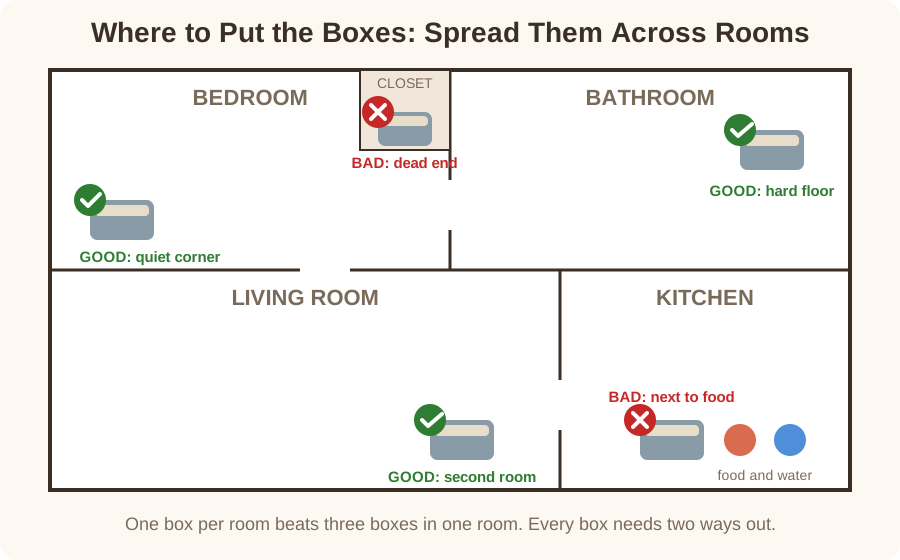
Good locations are quiet, easy to reach, and offer an escape route. A cat wants to see its surroundings while it eliminates and wants a second way out if something startles it. A spare bedroom corner, a quiet hallway, or a laundry room with the door propped open all work well. The box should sit on a hard floor or a washable mat, not carpet that absorbs odor.
Put at least one box on every floor your cats use. A cat will not reliably walk downstairs at 3 a.m. to reach the only box in the house. In a two-story home with two cats, that means one box upstairs and one downstairs, plus the third where the cats spend the most time.
Keep boxes away from food and water. Cats avoid eliminating near where they eat, and a box next to the food bowl is one a cat will use reluctantly or not at all. The same applies to the water fountain: keep it in a different room from the nearest box.
Bathrooms are popular for a reason: hard floors and easy cleaning. But a bathroom only works if the door stays open, so fit a doorstop or latch that holds it open. A door that swings shut turns a good location into a trap.
What Should You Avoid When Placing Litter Boxes?
Some spots look convenient to people and feel unsafe to cats. Avoiding them prevents more problems than any litter brand ever will.
Dead-end corners. A box in a closet, under a stairwell, or at the end of a narrow hallway gives a cat no escape route. In a multi-cat home, a confident cat can sit in the hallway and block access. Every box needs at least two ways in and out, or an open room around it.
Next to noisy appliances. Washing machines, dryers, and furnaces start without warning, and a cat startled mid-use may avoid that box for weeks. If the laundry room is your only option, place the box as far from the machines as the room allows.
Beside the food bowl. Cats are fastidious about separating eating from eliminating. A box next to the food station will be used less and the food area will smell worse, so keep at least one room between them when you can.
Near the dog’s bed or the dog’s door. Dogs that eat cat litter or chase cats at the box are a common cause of avoidance. If you share the home with a dog, put at least one box in a room the dog cannot enter, using a baby gate with a cat-sized gap or a door propped open just wide enough for a cat.
All boxes in one room. This is the single most common placement mistake: three boxes in one bathroom are, for practical purposes, one box. Spread them out, even if it means a box in a room you would rather keep tidy. A litter mat and a quick daily sweep handle the mess.
How Do You Handle Litter Boxes in a Small Apartment?
Small apartments test the n+1 rule, because floor space is scarce and every room does double duty. The rule still applies, but placement changes.
For one cat in a studio or one-bedroom apartment, two boxes still fit: one in the bathroom and one in a quiet corner of the main room, behind a screen or furniture if you want it less visible. A litter box cabinet, furniture with a cut-out entrance that hides the box, works well here.
For two cats in a small apartment, three boxes are the goal, and the third box is often the hard one. Use every nook: one in the bathroom, one in the bedroom, and one in a hallway nook or a closet with the door removed. If there is genuinely no third spot, two boxes in two rooms with twice-daily scooping is a workable compromise, but add the third box the moment a spot opens up.
Choose low-tracking litter to keep the mess down, since small spaces show every scattered granule. Our guide to the best non-tracking cat litter compares the options that stay in the box best. Scoop at least once a day in a small space, twice a day if two cats share it, because odor concentrates faster when the box is ten feet from the sofa.
Why Is My Cat Avoiding the Litter Box?
A cat that stops using the box is telling you something. Work through this checklist from the most common causes to the least.
The box is dirty. This is the most common cause by far. Scoop daily and wash the box with mild soap and water every two to four weeks. Cats can smell a box you think is clean, so if you scoop less than once a day, start there.
The box is in a bad spot. A box that was fine for months can become a problem when something changes: a new washing machine, a new dog, or a cat guarding the hallway. Move the box to a quieter spot and see if use resumes within a few days.
You changed the litter. Cats are creatures of habit, and a sudden switch to a new litter type, scent, or texture can put one off. If avoidance started right after a litter change, go back to the old litter and transition gradually over a week.
Another cat is guarding the box. In multi-cat homes, one cat may sit near the box and block or chase the other cat. The guarded cat will go elsewhere. The fix is more boxes in more rooms, so the guarded cat always has an option the other cat is not watching. This is exactly the problem the n+1 rule was designed to solve.
The cat is in pain. Cats with urinary tract infections, bladder stones, arthritis, or constipation often associate the box with pain and start eliminating elsewhere, usually on soft surfaces like beds or laundry. If a cat that used the box reliably suddenly stops, especially if it strains, cries, or visits the box often without producing anything, call your veterinarian that day. Straining without urinating is an emergency in male cats: a blocked urinary tract can become life-threatening within hours. The ASPCA’s litter box problems guidance says the same: sudden avoidance with straining is a vet visit, not a training problem.
The cat is stressed. A move, a new baby, a new pet, or construction noise can push a cat to eliminate outside the box. Adding a box in the cat’s safe room and keeping the routine steady usually help. If the problem persists for more than a week, talk to your veterinarian.
Do not punish a cat for eliminating outside the box. Punishment only teaches the cat to hide when it eliminates, which makes the problem harder to find and fix. Clean the soiled spot with an enzymatic cleaner, fix the cause, and give the cat a better option.
Scoop every box at least once a day, top up litter to 2 to 3 inches, and do a full litter change and wash every two to four weeks. Our guide on how to litter train a kitten covers the first weeks, and the n+1 rule applies to kittens too.
Frequently Asked Questions
How many litter boxes does one cat need?
One cat needs two litter boxes: one box per cat plus one spare, in two different rooms.
Is one litter box enough for two cats?
No. Two cats need three boxes under the n+1 rule, spread across at least two rooms, so each cat always has a clean box available.
Can I put two litter boxes next to each other?
You can, but it does not help much. Cats treat two boxes side by side as one location, so one guarded doorway or closed door takes out both boxes. Spread them across rooms instead.
Do indoor cats need more litter boxes than outdoor cats?
Indoor cats rely entirely on the boxes you provide, so the rule matters most. Outdoor-access cats still need indoor boxes, because weather or a closed cat flap can keep them in. See the indoor vs outdoor cats trade-offs, but the rule is the same: one per cat, plus one extra.
How far apart should litter boxes be?
In different rooms, or at least on opposite sides of a large room. The goal is that no single blocked doorway, guarding cat, or closed door can cut off every box at once.
The n+1 rule is simple, but it solves a surprising number of cat problems. Most litter box avoidance starts with too few boxes, boxes in the wrong places, or boxes that are not scooped often enough. Get the count right, spread the boxes across rooms, and keep them clean. As of November 2026, feline veterinary guidance has not changed: one box per cat, plus one extra, remains the standard every cat owner should start with.