
The best harness for a dachshund is a padded Y-front or vest style that spreads pressure across the chest, never the neck. Measure the chest just behind the front legs first — that single number decides the size. A good fit lets you slide two fingers under every strap.
Why does a dachshund need a different harness than other small dogs?
A dachshund is not just a small dog: it is a long dog on short legs, and that shape changes how a harness should fit. The long spine carries more leverage on every tug, so a harness that presses on the neck or twists the shoulders turns an ordiinary walk into strain on the back.
The concern is intervertebral disc disease (IVDD): discs between the vertebrae degenerate and press on the spinal cord, causing pain, weakness, or in severe cases paralysis. Dachshunds are the breed most associated with it — the American College of Veterinary Surgeons estimates they account for 40 to 75 percent of all IVDD cases, and the Dachshund Club of America notes about one in four dachshunds will have some degree of disc-related problems in their lifetime. The American Kennel Club explains that the long body and short legs make the breed predisposed, and Cornell University College of Veterinary Medicine notes about 65 percent of cases affect the mid-to-lower back.
A good harness keeps pressure off the neck and spreads load across the chest and ribcage. If your dachshund shows back-pain signs — reluctance to jump, a hunched back, yelping when picked up, or wobbly hind legs — call your veterinarian before buying new gear. This article is general guidance, not a diagnosis.
What should you measure before you buy a harness?
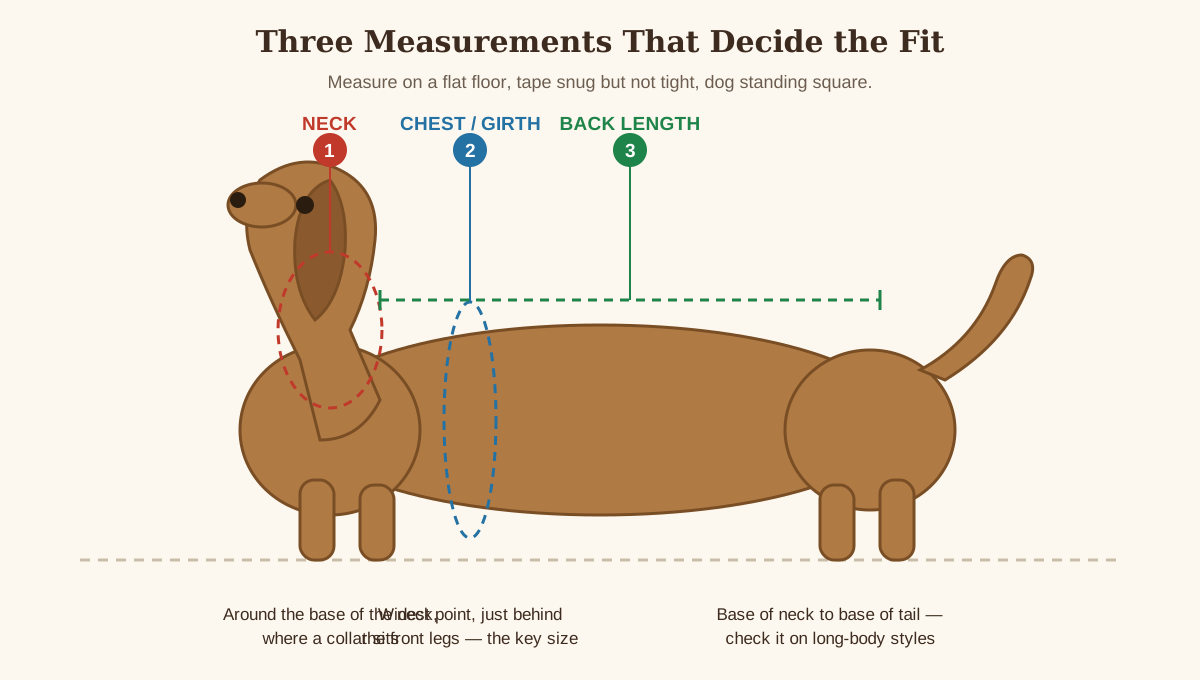
Never buy by weight alone: two 11-pound dachshunds can need different sizes, because one has a deep barrel chest and the other is a lean miniature. The chest measurement, called the girth, matters most. Measure your dog standing square on a flat floor, after a walk when the dog is calm, with a soft tape kept snug but not compressing the coat. Take each measurement twice and use the larger number.
- Neck: Around the base of the neck, where a collar would sit. This matters most for step-in and vest styles.
- Chest or girth: Around the widest part of the ribcage, just behind the front legs — the size that decides the harness. If the number falls between two sizes, size up and use the adjustment straps to take up the slack.
- Back length: From the base of the neck to the base of the tail. Vest harnesses need this number, because a panel that is too long will bunch behind the shoulders.
| Dachshund size | Typical weight | Typical girth | Typical neck |
|---|---|---|---|
| Miniature | Under 11 lb (5 kg) | 12–16 in (30–41 cm) | 9–12 in (23–30 cm) |
| Standard | 16–32 lb (7–15 kg) | 16–22 in (41–56 cm) | 12–16 in (30–41 cm) |
| Tweenie (between sizes) | 11–16 lb (5–7 kg) | 14–18 in (36–46 cm) | 10–14 in (25–36 cm) |
These ranges reflect the breed’s standard proportions as of November 2026; treat them as a starting point and your tape measure as the final word. A “tweenie” between miniature and standard is most likely to fall between sizes, and benefits most from three or more adjustment points.
Which harness styles actually suit a dachshund’s body?
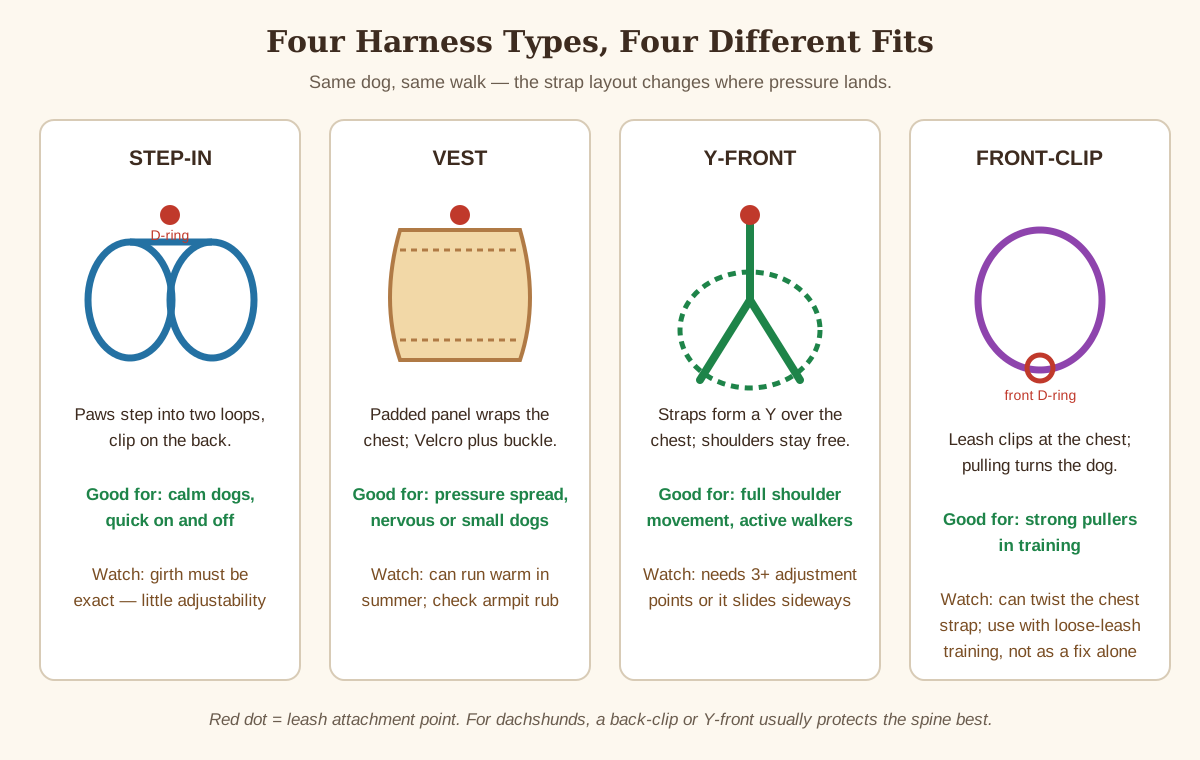
Four harness designs dominate the market. Compare the designs, not the brand names.
Step-in harnesses
A step-in harness is two loops the dog steps into, joined by a strap across the back with a D-ring for the leash. It is the fastest style to put on. The trade-off is adjustability: with one or two adjustment points, the girth has to be nearly exact, and on a dachshund a loop that fits the deep chest may gape at the narrow waist. Step-ins suit a steady adult, not a growing puppy.
Vest harnesses
A vest harness wraps a padded panel around the chest and fastens with Velcro, a buckle, or both. It spreads pressure over the widest area of any style, which is exactly what a long-backed dog needs. The downsides are heat and armpit rub: a full panel traps warmth, so a heavy vest can be uncomfortable on summer walks, and a vest that is too long will chafe behind the front legs. Check the panel length against your dog’s back measurement, and choose mesh padding for warm weather.
Y-front harnesses
A Y-front harness runs two straps up the chest in a Y shape, leaving the shoulders completely free. This is the design most often recommended for active dogs, because it does not restrict the natural reach of the front legs. The catch is adjustment: a Y-front only works when all of its straps are set correctly, and a poorly adjusted one slides sideways and rides up toward the throat. Buy a Y-front only if it has at least three adjustment points.
Front-clip no-pull harnesses
A front-clip harness attaches the leash to a D-ring on the chest instead of the back. When the dog pulls, the chest attachment gently turns the dog back toward you, which reduces the leverage a pulling dog can generate — the mechanism behind the “no pull” label. It works as a training aid, not a solution on its own: a front-clip harness can twist the chest strap if the dog lunges hard, and it does nothing to teach loose-leash walking by itself. Pair it with short, consistent training sessions.
| Harness type | Pressure placement | Best for | Main drawback |
|---|---|---|---|
| Step-in | Chest and back | Calm dogs, quick outings | Little adjustability |
| Vest | Broad chest panel | Pressure spread, nervous dogs | Heat, armpit rub |
| Y-front | Chest, shoulders free | Active walkers, full stride | Needs careful adjustment |
| Front-clip no-pull | Chest, turning force | Strong pullers in training | Can twist; not a fix alone |
Start with a vest or a Y-front: both keep pressure off the neck and spread load across the chest.
How do you know the harness fits?
A harness can look right and still fit badly. Run the two-finger test: slide two fingers flat under every strap. Two fingers fitting snugly means the strap is right; three or four means it is too loose and the dog can slip out; fewer than two means it is too tight and will rub or restrict breathing.
Then run the fit checklist:
- No neck pressure. The front strap should sit on the chest bone, not against the throat — ask the dog to look up and check it does not press the windpipe.
- Two fingers behind the front legs. There should be a clear gap between the belly strap and the armpit, or it will chafe within one walk.
- No sliding. Walk ten steps and watch the back D-ring; if it drifts to one side, tighten the chest strap first, then the belly strap.
- No escape route. Pull gently backward on the harness while the dog faces away. It should not slide forward over the head, even when the dog backs up.
- Full stride. Watch the front legs from the side: the dog should reach forward freely without the chest strap catching the shoulder. A shortened, choppy step means the harness restricts movement.
Check the fit again after the first week: straps settle and padding compresses, so a harness that passed on day one can loosen by day seven.
Should you choose a no-pull harness for a dachshund?
A no-pull harness is worth considering if walks feel like a tug of war; many owners see a difference on the first walk. But keep expectations honest: a no-pull harness manages pulling, it does not train the dog out of it. The long-term fix is loose-leash training — short sessions, frequent direction changes, and rewarding the dog for walking beside you. The harness buys comfortable walks while that training takes hold. We compared specs, prices, and verified owner reviews across the common designs, and the consistent finding is that the best results come from pairing a front-clip harness with training, not from the harness alone.
There is also a spine consideration unique to this breed: the turning action applies a sideways force to the chest, and the chest is attached to the spine. For a healthy adult, that force is small. For a dog with a known back problem, or a puppy whose growth plates are still open, ask your veterinarian first. If your dachshund only pulls occasionally, a standard back-clip Y-front or vest harness is usually enough.
What mistakes do dachshund owners make with harnesses?
Most harness problems are fitting and habit problems. Buying by weight instead of girth is the most common: weight is a rough guide, not a size. Leaving the harness on all day mats the coat, traps moisture against the skin, and hides the rub spots that tell you the fit is wrong — take it off after every walk. Using a collar for walks puts the entire force of a pull on the neck, the one place a dachshund least needs pressure; collars are fine for ID tags, but clip the leash to the harness. Ignoring the puppy growth spurt: a puppy can outgrow a harness in six weeks, so check the fit every two weeks until the dog is a year old. After muddy walks, rinse a vest so the padding does not hold grit against the coat — the same routine as in our guide on how often you should bathe a dog. Finally, avoid single-adjustment harnesses: one belly strap cannot fit a deep chest and a narrow waist at the same time.
How do you get a dachshund used to a new harness?
Some dachshunds freeze, flop, or refuse to move the first time a new harness goes on. A slow introduction over three or four days usually solves it. On day one, lay the harness by the dog’s bed with a few treats on top and let the dog sniff it. Do not put it on yet. On day two, let the dog step into it, fasten it, give a treat, then take it straight off — the goal is to link the harness with good things. On day three, put the harness on, walk around the house for five minutes, then clip the leash on for a short garden walk. By day four, most dachshunds accept the harness as part of the walk routine. Puppies take to a harness faster than adults — fold the introduction into the weeks you teach leash manners, using a puppy training schedule by age as a guide.
When should you replace the harness?
A harness is not a lifetime purchase — replace it when any of these show up: frayed straps or a cracked buckle; padding that has gone flat, because compressed padding stops spreading pressure; a fit you can no longer adjust into place, meaning the dog has outgrown it; persistent smell after washing; or visible rub marks on the coat or skin — dachshunds are stoic and will not always complain. A well-made harness used daily lasts 12 to 18 months before the padding and straps show real wear, as of November 2026. Budget harnesses ($15 to $25) wear faster than padded designs ($30 to $45), which usually last the full span.
Frequently asked questions
Is a harness or a collar better for a dachshund?
A harness is better for walks: it spreads pressure across the chest instead of concentrating it on the neck and spine.
Can a harness hurt a dachshund’s back?
A poorly fitted harness can strain the neck and shoulders, which is why fit matters so much for this breed. A well-fitted padded harness should not hurt the back — but any dog with back symptoms should be checked by a veterinarian.
Do dachshunds need a no-pull harness?
Only if the dog pulls hard on most walks. A standard back-clip vest or Y-front is enough for a calm walker; the front-clip design works best as a training aid with loose-leash training.
Can my dachshund wear a harness to daycare?
Most facilities ask you to remove the harness on arrival so dogs do not get tangled during group play. Our guide on how to choose a doggy day care covers what to ask about gear, supervision, and playgroups.
The short version
Choosing the right harness for a dachshund comes down to three numbers and one test: measure the neck, girth, and back length, match the girth to the size chart, and size up between sizes. Start with a padded vest or Y-front, use a front-clip design only while training a strong puller, and check the fit with the two-finger test weekly.