
When your dog paws at you, it is usually asking for something — attention, affection, food, or a trip outside. Dogs use their paws the way people use a tap on the shoulder — a gentle nudge meant to get a response. The exact meaning depends on context, so always read the paw together with the rest of your dog’s body language.
That one gesture can mean five different things — affection, a demand, appeasement, hesitation, or pain — and learning to tell them apart helps you respond and build trust instead of accidentally rewarding pushy behavior.
What does each paw signal mean?
Dogs do not have words, so they borrow the tools they have — paws, nose, body, and voice. The paw is the most “hand-like” of these, which is why dogs use it to reach out to people — and they direct it at humans far more than at other dogs, because they have learned over thousands of years that it works on us.
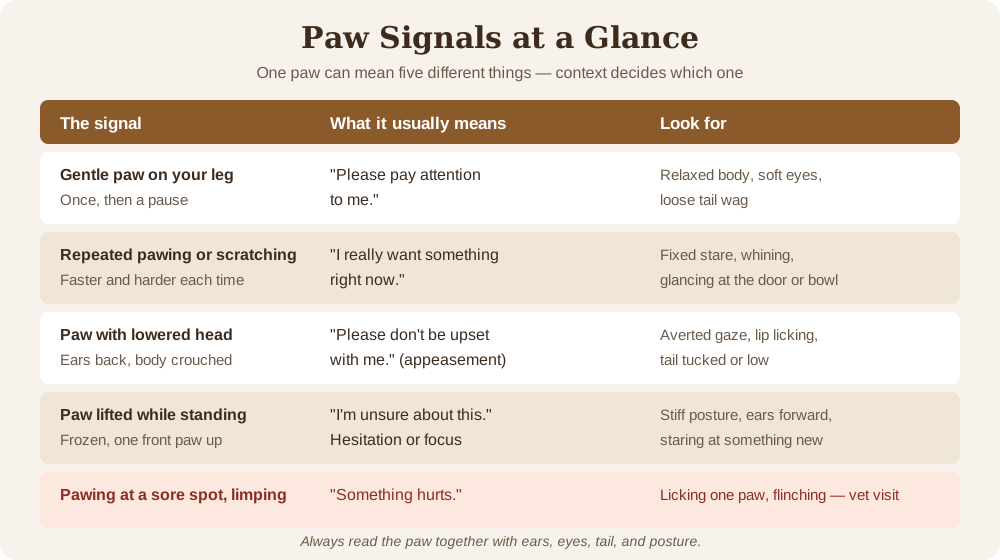
The table below covers the five paw signals owners see most.
| Paw signal | What it usually means | Context clues |
|---|---|---|
| Gentle paw on your leg, once, then a pause | “Please pay attention to me.” | Relaxed body, soft eyes, loose tail wag |
| Repeated pawing or scratching, faster each time | “I really want something right now.” | Fixed stare, whining, glancing at the door or food bowl |
| Paw with lowered head and ears back | “Please don’t be upset with me.” (appeasement) | Averted gaze, lip licking, tail tucked or held low |
| One front paw lifted while standing still | “I’m unsure about this.” (hesitation or focus) | Stiff posture, ears forward, staring at something new |
| Pawing at a sore spot, or pawing plus limping | “Something hurts.” | Licking one paw, flinching when touched, sudden change |
No single signal is a diagnosis — the same paw means something different from a relaxed dog than from a tense one. The rest of the body is the decoder.
Why do dogs paw at people in the first place?
Dogs paw at people because it works. A puppy that bats at its mother gets her attention. A dog that paws its owner gets petted, fed, or let outside. Every time pawing produces a result, the behavior gets a little stronger — the same reinforcement mechanism behind every trick your dog has ever learned, except nobody deliberately taught this one.
Most pawing is a mix of four reasons.
Attention. This is the most common reason. Your dog has learned that a paw on your arm reliably interrupts whatever you are doing and points your focus at them — especially when you are looking at a phone, a laptop, or the television.
Affection. Dogs also paw as a form of contact, the way a person might rest a hand on a friend’s arm. The American Kennel Club (AKC) notes that pawing is one of the ways dogs show affection and seek closeness with their people (AKC: Why do dogs put their paw on you?). A dog that paws you softly while you are petting it is often asking for more.
Appeasement. When a dog feels worried about your reaction — after knocking something over, or when you raise your voice — it may offer a paw with its head low and ears back. This is not guilt in the human sense. It is an appeasement gesture, an attempt to defuse tension and signal “I’m no threat.”
Learned habit. Some dogs paw simply because it has become their default way of interacting with people. If every request has been answered after a paw — food, the door, a toy, a greeting — pawing becomes the dog’s first move for everything. That is not dominance or defiance. It is a habit that paid off, and habits can be reshaped with the same consistency that built them.
What do related paw signals mean?
Pawing rarely happens alone. Dogs combine it with nudges and other signals, and each combination shifts the meaning.
The nose nudge. A dog that pushes its nose into your hand or leg is usually making the same request as a paw, just more gently. Nudging often comes first; if it is ignored, the paw follows. Reward the nudge — it is the polite version, and worth encouraging.
Pawing at an object. When the paw is aimed at something rather than at you, your dog is pointing at what it wants. A paw on the back door means outside. A paw on the food bowl means dinner. A paw on a toy under the sofa means “get that for me.”
How can you tell normal pawing from anxiety or pain?
Most pawing is normal communication. But pawing can also be a symptom — of anxiety, or of pain — and the difference matters. The ASPCA advises owners to read the whole dog, not one signal in isolation, because stress shows up as a cluster of small changes: tucked tail, ears pinned back, yawning, lip licking, and avoidance, all at once (ASPCA canine body language).
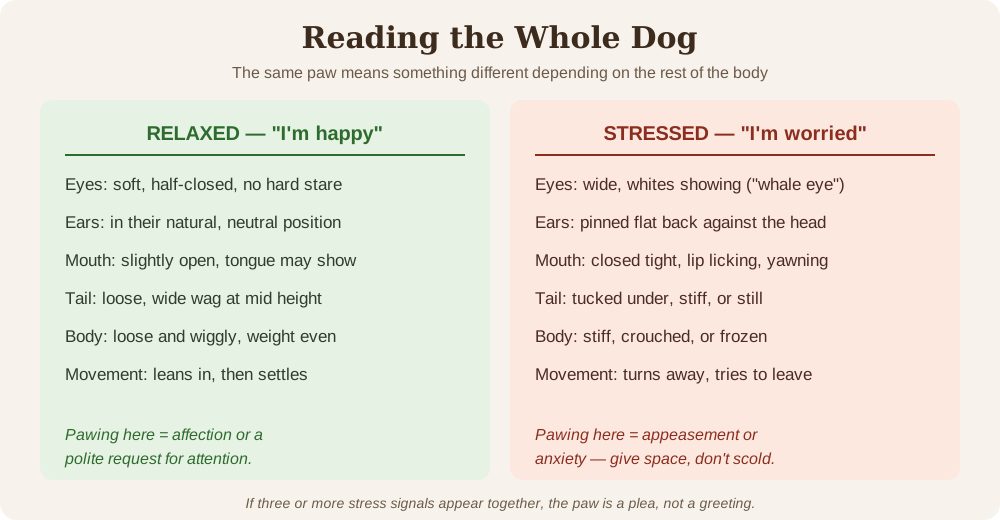
Three or more stress signals appearing together with pawing means your dog is asking for reassurance or space, not for a treat.
Pawing that signals anxiety tends to be frantic rather than gentle: rapid, repeated scratching at you, at the door, or at the floor, often combined with panting, pacing, whining, or following you from room to room. It often spikes around predictable triggers — thunderstorms, fireworks, visitors arriving, or the moment you pick up your keys. If your dog paws frantically every time you prepare to leave, discuss it with your vet or a certified behaviorist, because it may point to separation anxiety rather than a simple habit.
Pawing that signals pain usually looks different from both attention-seeking and anxiety. A dog in pain may paw or lick at one specific spot — a paw, an ear, a sore joint — again and again, and may flinch when you touch the area. It may also hold a paw up while walking, limp, or suddenly refuse stairs it used to climb easily. Sudden pawing at the face or ears, especially with head shaking, can point to an ear infection or a dental problem. Any sudden change in pawing behavior deserves a vet visit — especially if it is new, intense, one-sided, or paired with limping, licking, or a change in appetite.
One more distinction matters: pawing at you is not the same as paw licking. A dog that licks its own paws constantly may have allergies, irritation, or a wound. If your dog is licking its paws often, read our guide on why dogs lick their paws to learn the most common causes and when to call the vet.
How should you respond to pawing without rewarding it?
The goal is not to eliminate pawing — a gentle paw from a relaxed dog is a perfectly good way to say hello. Shape it instead: keep the soft version, stop paying the pushy version. The rule is simple: reward the behavior you want, ignore the behavior you don’t — and do it the same way every time.
Here is a practical approach based on the same positive-reinforcement methods trainers use for demand behaviors:
- Decide what counts as polite. Choose the version you will always reward: one soft paw, a nose nudge, or your dog sitting calmly and making eye contact. Pick one and stick to it.
- Reward the polite version immediately. When your dog paws gently once, or offers the polite signal you chose, respond right away — a word, a pat, or the thing it asked for. The reward must land within a second or two of the behavior.
- Withdraw attention for the pushy version. When pawing turns into repeated scratching, turn away, fold your arms, and wait. Do not push the paw away, because that is still touch, and touch is attention. Wait for a pause, even a two-second one.
- Reward the pause. The moment your dog stops pawing and settles, mark it with a calm “yes” and give the attention or the thing it wanted. You are teaching your dog that calm works better than frantic.
- Teach an alternative. Give your dog a better way to ask. “Sit” is the classic replacement: a dog that sits to ask for something cannot paw at the same time. Practice it at calm moments first, then use it when your dog would normally paw.
- Be consistent with everyone. Ask guests to ignore pawing and greet your dog only when all four paws are on the floor. Our guide on introducing a puppy to an older dog covers the same calm-greeting principles.
What not to do. Do not scold, shout, or push your dog away for pawing — a raised voice reads as excitement or threat, and either one can make pawing worse. And do not give in “just this once” after ignoring ten paws in a row; that one payoff teaches your dog that persistence wins.
How long does it take? Based on owner feedback and standard training timelines, most dogs show a clear improvement within two to four weeks of consistent responses, as of November 2026. If pawing is tied to anxiety rather than habit, training alone may not be enough — talk to your vet about a behavior plan.
What about pawing from puppies, new dogs, and seniors?
Puppies paw a lot — a puppy uses its paws to explore everything, including you. The good news is that puppies learn fast, so the response rules above work even better on them than on adult dogs. Start early: reward the gentle paw, ignore the scratchy one, and your puppy will settle on the polite version on its own. Newly adopted dogs may also paw more than usual in their first weeks, while they learn how the household works and ask for reassurance in an unfamiliar place.
Senior dogs deserve a special note. A dog that has never been a pawer and suddenly starts pawing at you, or at a specific part of its body, may be telling you something has changed. Older dogs develop arthritis, dental pain, and cognitive changes that can show up first as new pawing behavior. If your senior dog’s pawing changes suddenly, treat it as a health question first and a behavior question second.
Frequently asked questions
Why does my dog paw at me when I stop petting him?
Because he wants it to continue — a paw when you stop is your dog pressing the “more please” button. Wait for a pause before resuming, so your dog learns that calm, not pawing, restarts the petting.
Is it bad if my dog paws at me all the time?
Not necessarily, but constant pawing usually means the behavior is rewarded every time, so it has become your dog’s default. It is worth reshaping if the pawing is rough, scratches you, or happens during meals and work calls. Check whether your dog is getting enough play and exercise — boredom is a common driver of demand pawing. Dogs that hold their bladder for long stretches can also become restless and paw to ask to go out; our guide on how long a dog can hold its bladder explains the limits by age and size.
Why does my dog paw at me when I pet another dog?
Usually jealousy, or more precisely, resource guarding of your attention. Your dog has learned that pawing moves your hand back to them, and the other dog is competition for that resource. Stay calm and reward your dog for waiting patiently while you greet the other dog. If the pawing escalates into growling or snapping, consult a certified trainer.
Does pawing mean my dog is trying to dominate me?
No. The dominance explanation for pawing is outdated and not supported by current canine behavior science. Pawing is a request, a greeting, or an appeasement signal — not a power play. Dogs paw because it has worked for them, and the fix is teaching a better way to ask.
Should I teach my dog to “shake” if it already paws too much?
Yes, and it can actually help. Teaching “shake” on cue gives your dog a proper outlet for the same behavior, under your control. Reward the paw only when you ask for it, and ignore the uninvited version. The same on-cue principle works for barking — our guide on stopping dog barking at the doorbell shows how to put a noisy behavior on cue and then control it.
The bottom line
When your dog paws at you, it is talking to you in the clearest language it has. Most of the time it means “I love you,” “pay attention to me,” or “I need something.” Sometimes it means “I’m worried.” Rarely, it means “something hurts.” The paw itself never tells you which one — the rest of the dog does.
Learn the five signals, watch the ears, eyes, tail, and posture, and answer the gentle paw while calmly ignoring the pushy one. Do that consistently, and the pawing you keep will be the kind worth having: a soft touch from a dog that trusts you enough to ask.