
Most healthy adult Labradors need 60 to 120 minutes of exercise every day, split across walks, play, and training. Puppies need far less — about five minutes per month of age, twice a day — and seniors need shorter, gentler sessions. The right amount depends on age, weight, and health, not on a single magic number.
Photo: Pexels.
TL;DR — the short answer:
- Adult Labradors need 60–120 minutes of exercise a day, the range most breed and veterinary sources agree on, as of November 2026.
- Puppies need much less: five minutes of structured exercise per month of age, up to twice a day — a four-month-old gets about 20 minutes per session.
- Seniors need shorter, gentler exercise: 30–60 minutes of low-impact activity, split into two or three short outings.
- Mix the activities. Swimming, fetch, and training games all count — and mixing them protects joints better than one long run.
- Too little exercise shows up fast: weight gain, restlessness, chewing, and barking.
- When in doubt, ask your vet. A dog with joint, breathing, or heart problems needs an exercise plan built around its diagnosis.
We compared guidance from the AKC, the AVMA, Cornell University College of Veterinary Medicine, and the UK Kennel Club to build this guide. Every range below comes with its source — and none of it replaces advice from your own veterinarian.
How much exercise does an adult Labrador need?
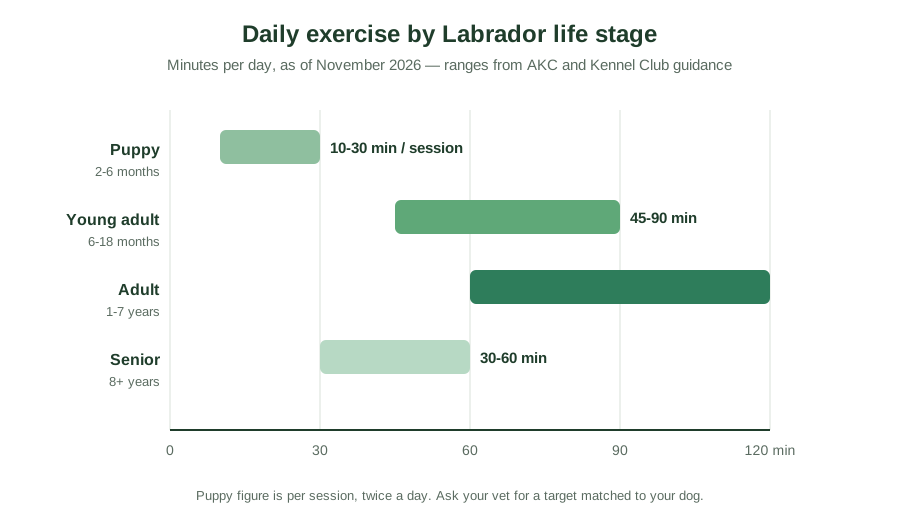
A healthy adult Labrador — roughly 1 to 7 years old — needs 60 to 120 minutes of physical activity per day. The UK Kennel Club recommends “upwards of two hours” a day, while the AKC describes the breed as needing lots of daily exercise and warns that a bored, under-exercised Lab will invent its own entertainment. One hour is the floor, two hours suits a fit young adult, and most pet Labs land happily in the middle.
An adult Labrador needs at least one hour of exercise every day, and two hours suits a fit young adult.
Split that total across two or three sessions: it is easier on joints and better for behavior than one exhausting two-hour hike. Mix steady walking with something that raises the heart rate — fetch, swimming, or a hike — plus a little training, which tires a Lab’s brain as surely as running tires its legs.
| Life stage | Daily exercise | How to split it | Notes |
|---|---|---|---|
| Puppy (2–6 months) | 10–30 min per session, twice daily | Two short walks plus free play | Five minutes per month of age; no forced running |
| Adult (1–7 years) | 60–120 min | Two to three sessions | Mix walks, fetch, swimming, and training |
| Senior (8+ years) | 30–60 min | Two to three short, gentle outings | Low-impact only; watch for stiffness and fatigue |
How much exercise does a Labrador puppy need?
Labrador puppies need surprisingly little structured exercise — and giving them too much is a real risk. The guideline used by the UK Kennel Club and widely repeated by veterinarians is five minutes of exercise per month of age, up to twice a day: a three-month-old gets about 15 minutes per walk, a six-month-old about 30. That covers lead walks and other structured activity, not the free play a puppy does around the house and garden, which it can stop whenever it gets tired.
A Labrador puppy needs about five minutes of exercise per month of age, twice a day — and no forced running until its joints mature.
The reason is growth: a Labrador’s growth plates — the soft areas at the ends of long bones where new bone forms — do not fully close until roughly 12 to 18 months. Repetitive impact on open growth plates, from long runs or repeated jumping, is linked to joint problems later in life. Labradors are already prone to hip and elbow dysplasia, so the puppy months are the time to be conservative.
That does not mean a puppy should sit still. Short lead walks, garden play, sniffing games, and basic training all build coordination and confidence. Let the puppy set the pace, carry it up and down steep stairs, and save long hikes and jumping games until your vet confirms the growth plates have closed.
How much exercise does a senior Labrador need?
Senior Labradors — generally 8 years and older — still need daily exercise, but the goal changes: keeping muscles strong, joints mobile, and weight under control. Most healthy seniors do well on 30 to 60 minutes a day, split into two or three short outings of 10 to 20 minutes each.
A senior Labrador needs shorter, gentler exercise — 30 to 60 minutes a day, split into short sessions.
Watch the dog, not the clock. A senior that lags behind, pants heavily, or lies down mid-walk is telling you the session is over. Stiffness after rest or a limp after exercise is worth mentioning to your vet — the AVMA notes that arthritis is common in older dogs, and that pain management, weight control, and gentle exercise keep them mobile far longer than rest alone.
Swimming is the senior Lab’s best friend: water supports body weight, so a dog can work its muscles without pounding its joints. Short swims beat a long walk. After a swim, a gentle wash keeps the coat healthy; our guide to how often you should bathe a dog covers how often to wash a dog that swims regularly.
What counts as exercise for a Labrador?
Almost any activity that gets a Lab moving counts, but different activities do different jobs. The table below is a quick reference for building a balanced week.
| Activity | Energy burn | Joint impact | Best for |
|---|---|---|---|
| Lead walk (brisk) | Moderate | Low | Every day, all ages |
| Fetch / retrieving | High | Moderate | Adults; short sessions for puppies |
| Swimming | High | Very low | All ages, seniors, overweight dogs |
| Training and scent games | Low physical, high mental | None | Rainy days, puppies, seniors |
Mental exercise deserves a real place on this list. Ten minutes of scent work — hiding treats around the garden, or teaching a new trick — can tire a Labrador as effectively as a much longer walk. Keep food rewards small: a slice of banana makes a healthy training treat, and our guide explains whether dogs can eat bananas and how much is safe.
How do you know if your Labrador is getting enough exercise?
A Lab that gets the right amount of exercise settles after outings and keeps a healthy weight. The signs of too little are just as clear — and owners usually notice the behavior before they notice the weight.
The clearest sign of an under-exercised Labrador is destructive or restless behavior at home — chewing, digging, pacing, and barking.
Look for these signals:
- Chewing and destruction. A Lab that shreds cushions, shoes, or garden plants is often a Lab with energy and nowhere to put it.
- Restlessness in the evening. Pacing or pestering for attention after dinner usually means the day’s activity fell short.
- Weight gain. A Lab should have a visible waist from above and ribs you can feel with light pressure. The Association for Pet Obesity Prevention’s 2018 survey found about 56% of US dogs were overweight or obese — and Labradors are over-represented.
- Over-excitement on walks. A dog that explodes with pulling and jumping at the start of every walk often does not get out enough.
Too much exercise has signs too: a dog still exhausted hours later, or limping after activity, is being pushed too hard. A puppy that flops down mid-walk is done, and should be carried home.
What happens if a Labrador does not get enough exercise?
The consequences arrive in two waves: behavior first, health second. The behavior wave is the one owners see — chewing, barking, digging, and stealing food off counters. Labradors were bred as working retrievers, and a working dog with no work finds its own.
The health wave is slower and more serious, and weight gain is the biggest part of it. Cornell University College of Veterinary Medicine lists obesity as one of the most common health problems in dogs: excess weight worsens arthritis, strains the heart, and shortens life. A 14-year Purina study found that dogs kept lean lived a median of 2.5 years longer than their overweight littermates.
An under-exercised Labrador gains weight, and extra weight shortens a Lab’s life — lean dogs in a 14-year study lived a median of 2.5 years longer.
Exercise also protects joints, since strong muscles stabilize the hips and elbows. The AVMA recommends regular, moderate exercise for dogs with joint disease rather than rest.
How should you exercise a Labrador in hot weather?
Labradors are not built for heat. Their thick double coat and enthusiasm — a Lab will keep fetching long after it should have stopped — make them vulnerable to overheating, and heatstroke is a veterinary emergency. The AKC advises exercising dogs in the cooler parts of the day.
In hot weather, exercise your Labrador early in the morning or late in the evening, and cut the session short if panting becomes heavy.
Practical rules for summer:
- Walk before 9 a.m. or after 7 p.m., and bring water. Pavement that burns your hand will burn your dog’s paws — if it is too hot to hold your palm on the ground for five seconds, it is too hot for paws.
- Use water, not running. A swim or a wading pool cools a Lab while it exercises; a long run in midday sun does the opposite.
- Never exercise a Lab right after a big meal. Wait at least an hour after feeding — deep-chested breeds like Labradors are at higher risk of bloat.
- Know the warning signs. Excessive panting, thick drool, bright red gums, or wobbling mean stop immediately, move the dog to shade, cool it with water, and call a vet.
How do you build a weekly exercise plan for your Labrador?
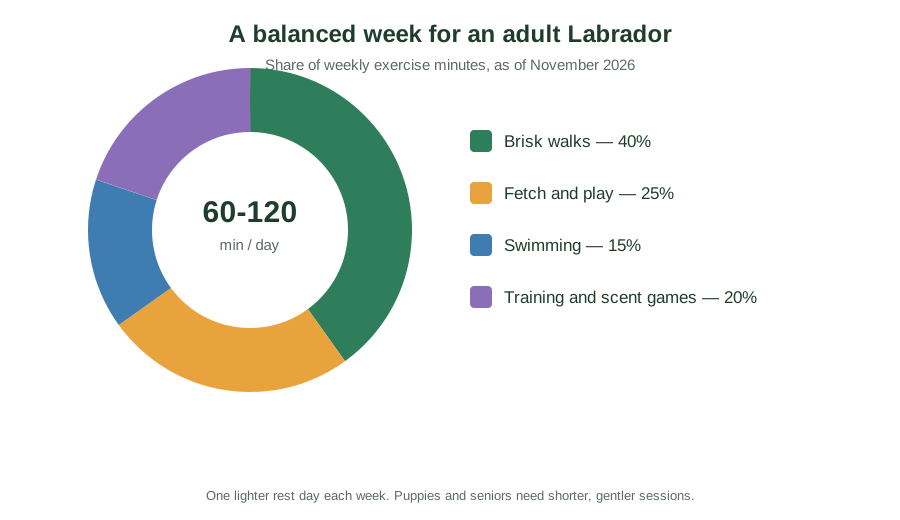
The goal is a week that mixes steady walking, one or two higher-energy activities, and a little mental work — with one lighter day for recovery.
| Day | Activity | Approx. time |
|---|---|---|
| Monday | Two brisk walks plus 10 min training | 70 min |
| Tuesday | Morning walk, evening fetch session | 80 min |
| Wednesday | Long walk or easy hike | 90 min |
| Friday | Morning walk, swimming session | 75 min |
| Saturday | Long walk or hike, training games | 90 min |
| Sunday | Two gentle walks (rest day) | 45 min |
A balanced week mixes walking, play, swimming, and training — with one lighter day for recovery.
Adjust the numbers to your dog. A fit two-year-old will want the top of the ranges; a nine-year-old with stiff hips will want the bottom, with swimming swapped in for fetch. The plan is a guide, not a prescription: if your Lab has a health condition or a weight problem, ask your vet to set the numbers.
Frequently asked questions
How much exercise does a Labrador need per day?
A healthy adult Labrador needs 60 to 120 minutes of exercise per day, split into two or three sessions. Puppies need about five minutes per month of age twice a day, and seniors usually need 30 to 60 minutes of gentle activity.
Can you over-exercise a Labrador puppy?
Yes. Repetitive impact on growing joints can contribute to hip and elbow problems later in life, so keep structured exercise to about five minutes per month of age, twice a day, and avoid forced running and jumping until your vet confirms the growth plates have closed at around 12 to 18 months.
Is one walk a day enough for a Labrador?
No. Most adults need two or three outings totalling at least an hour, plus some play or training — a single daily walk usually leaves a Lab restless and prone to chewing and weight gain.
Is swimming good exercise for Labradors?
Yes — swimming is one of the best exercises for a Labrador. It burns a lot of energy with almost no impact on the joints, which makes it ideal for seniors, overweight dogs, and Labs recovering from injury. Start with short swims and always supervise.
The bottom line
How much exercise a Labrador needs comes down to age: puppies need about five minutes per month of age, healthy adults need 60 to 120 minutes a day, and seniors need 30 to 60 gentle minutes. Mix walking with fetch, swimming, and training, watch your dog’s weight and behavior, and treat the numbers as a starting point — your vet has the final say.
Sources: AKC (akc.org); AVMA (avma.org); Cornell University College of Veterinary Medicine (vet.cornell.edu); The Kennel Club (UK); APOP 2018 survey; Purina 14-year lifetime study. As of November 2026.