
To brush a long-haired cat without mats, comb daily for 5 to 10 minutes with a wide-tooth metal comb first, then a slicker brush, working in small sections from the hair tips toward the skin. Check the armpits, belly, and behind the ears every session, and never cut a mat with scissors.
Photo: Pexels.
Why do long-haired cats get mats so easily?
A long-haired cat wears two coats at once: long outer guard hairs over a soft, fine undercoat. Every day the undercoat sheds a little, and in a long coat those shed hairs have nowhere to fall — they stay trapped, tangle with live hairs, and tighten into knots.
Mats are not just cosmetic. A tight mat pulls constantly on the skin, and a cat that cannot reach it will chew or scratch until the skin is raw. Under a dense mat, air cannot reach the skin, so moisture and heat build up and invite infection. Prevention beats removal: five minutes a day beats an hour with a groomer.
Persians mat fastest, Maine Coons grow thick tufts behind the ears and between the hind legs, and Ragdolls tangle less but still mat in the friction zones. Older cats groom themselves less effectively, and the Cornell Feline Health Center notes that a sudden drop in grooming can signal a health problem, so a cat that suddenly mats more than usual deserves a vet check.
What tools do you need to brush a long-haired cat?
Three tools cover nearly every long-haired cat. Based on specs and owner feedback we compared, a simple metal comb does the most real work.
| Tool | What it does | When to use it | What to avoid |
|---|---|---|---|
| Wide-tooth metal comb | Detangles and finds hidden knots down to the skin | First, every session | Forcing it through a tangle — it will pull and hurt |
| Slicker brush | Lifts loose undercoat and breaks up small tangles | After the comb, on tangle-free sections | Pressing hard — the fine wires can scratch skin |
| Pin brush with rounded tips | Smooths the finished coat and adds fluff | Last, as a finishing pass | Using it alone — it glides over mats instead of removing them |
| Dematting comb | Splits a small, loose mat a few hairs at a time | Only on small mats you can lift away from the skin | Using it on a mat pressed flat against the skin |
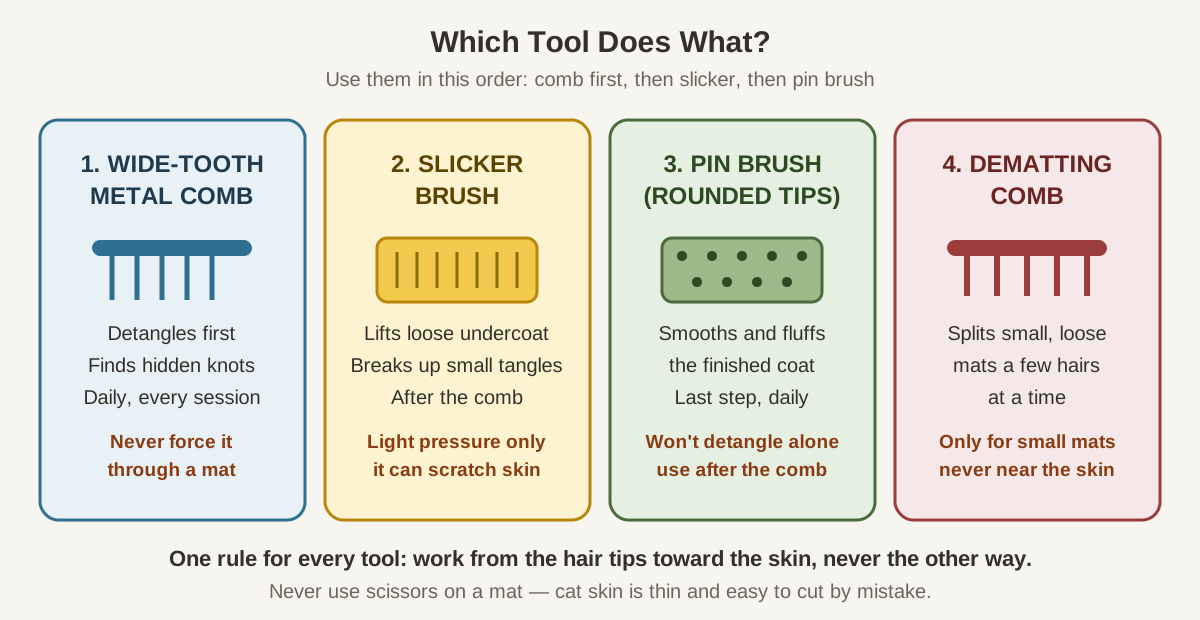
The wide-tooth metal comb matters most. A brush can glide over the top of a coat and leave a knot hiding underneath; a comb reaches the skin. If the comb slides through a section from skin to tip without catching, that section is truly tangle-free.
A slicker brush comes second: its fine wires catch the loose undercoat the comb has loosened, but pressed hard they can scratch thin cat skin, so use a light hand. A pin brush finishes the job, smoothing the top coat, but on its own it does almost nothing against tangles.
How do you brush a long-haired cat step by step?
The whole session takes 5 to 10 minutes. Keep it short and calm, and always end while the cat is still relaxed.
1. Pick a calm moment and a comfortable spot
Brush when the cat is already relaxed — after a meal or in a sunny spot the cat chose itself. Put the cat on your lap or a stable surface with a towel underneath, and keep treats nearby.
2. Start with a quick hands-on check
Run your fingers through the coat before any tool touches it. You will feel knots your eyes miss, especially behind the ears and under the collar.
3. Comb one small section at a time
Work in sections about the width of your hand, starting at the back and moving toward the tail. Hold the base of the hair with your free hand so the comb pulls on your fingers, not on the cat’s skin. Comb from the tips toward the skin.
4. Follow the comb with the slicker brush
Once a section is tangle-free, run the slicker brush over it in short, gentle strokes in the direction the hair grows. Work the same section twice at most; more passes only irritate the skin.
5. Work through the mat-prone zones last
The armpits, belly, inner hind legs, and base of the tail mat first, and cats dislike being touched there. Do the easy areas first, then tackle one sensitive zone at a time.
6. Finish with the pin brush, tail, ears, and collar line
A few long, gentle strokes with the pin brush smooth the top coat. Then comb the tail from base to tip, run the comb through the ear tufts, and check under the collar, where fur rubs into a ring of knots. Outdoor cats face the same friction plus dirt — see our guide to indoor vs outdoor cats.
7. End with praise and a treat
Stop while the cat is still happy, even if you did not finish every section. Give a treat, a chin scratch, and let the cat walk away. Starting young helps — see our guide to litter training a kitten.
How often should you brush a long-haired cat?
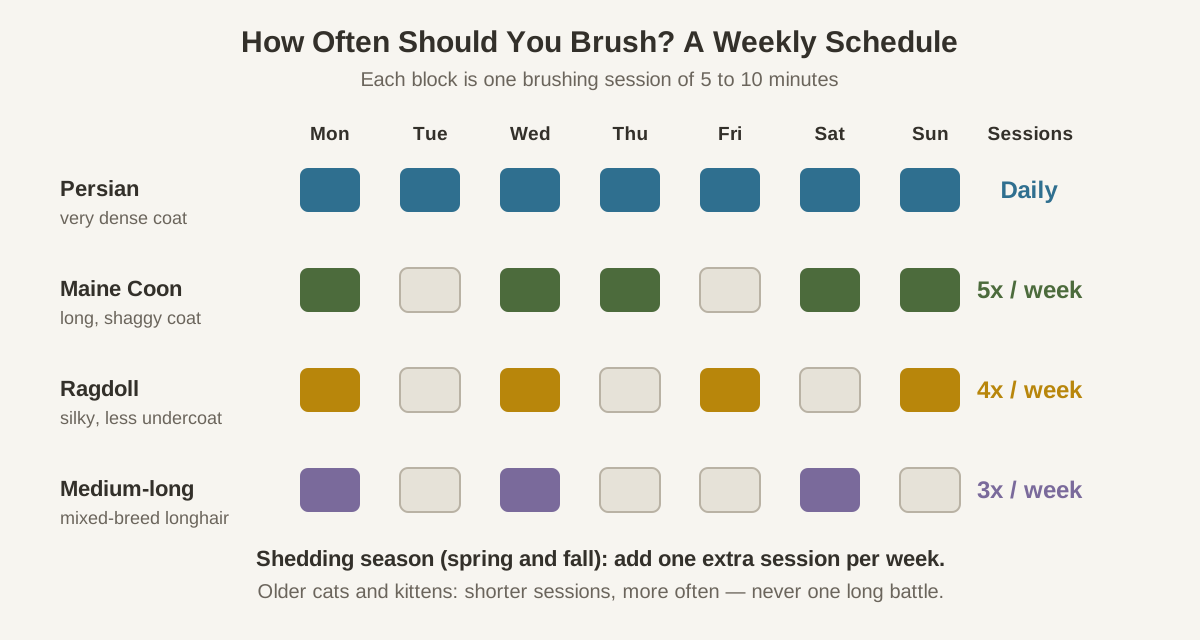
Daily is the honest answer for most long-haired cats. Five minutes a day beats a 30-minute battle once a week, because mats form in days, not weeks.
| Coat type | Sessions per week | Session length | Notes |
|---|---|---|---|
| Persian | 7 (daily) | 5–10 minutes | Densest coat; mats in 24–48 hours if skipped |
| Maine Coon | 5 | 5–10 minutes | Focus on ear tufts, hind legs, and tail base |
| Ragdoll | 4 | 5 minutes | Silkier coat with less undercoat; still check friction zones |
| Medium-long mixed breed | 3 | 5–10 minutes | Increase to daily during shedding season |
| Any longhair in shedding season | Add 1 session per week | 5–10 minutes | Spring and fall shed heaviest; loose hair mats fastest then |
| Senior longhair | 5–7 short sessions | 3–5 minutes | Older cats groom less; keep sessions short and gentle |
In spring and fall, cats drop far more undercoat, and that loose hair is exactly what felts into mats — one extra session a week during those months prevents most seasonal matting. The same little-and-often logic works for other routine care: see our guide to cleaning a cat water fountain. Kittens need a gentler version: two or three very short sessions a week.
Which spots mat first — and why do owners miss them?
Mats form where hair rubs against hair, against a collar, or against the cat’s own body — exactly where owners forget to look.
Behind the ears. The fine tufts behind the ears felt into small hard knots within days. Comb them every session with two or three gentle strokes.
The armpits. The front-leg armpits are the number-one matting spot. The legs move with every step, the skin is thin, and cats hate being touched there — so it gets skipped, and the mat grows. Lift the leg gently and comb in tiny strokes.
The belly and inner hind legs. The belly fur is the longest on the body and the hardest for the cat to groom. Do a few strokes each day while the cat lies on its side.
The tail base and britches. The thick fur on the back of the hind legs and the base of the tail catches litter, dirt, and loose hair. A quick weekly check is enough.
Under the collar. A collar rubs the same ring of neck fur all day. Remove it for brushing and comb the ring underneath. If it mats repeatedly, the collar may be too tight.
How do you remove a small mat safely?
First, decide whether the mat is a home job at all. A mat is safe to work on at home only if it is small — roughly the size of a coin — loose enough to lift away from the skin, and not in a sensitive area like the armpit or groin. Anything larger or pressed flat against the skin is a groomer or vet job.
For a small, loose mat, hold it at its base between your fingers so the skin does not get pulled. Tease it apart gently with your fingers, working from the outer edge inward. Once it has loosened, run the wide-tooth comb through from the tips toward the skin.
A dematting comb can help on a stubborn small mat: slide its teeth into the edge and draw it through slowly to split the mat, then comb the pieces out. If the cat cries or the skin looks red, stop immediately.
Never cut a mat out with scissors. Cat skin is thin, loose, and easy to tent up inside a mat, so it is frighteningly easy to cut the skin while trying to cut the hair. The ASPCA’s cat grooming guidance warns against cutting mats for exactly this reason. If a mat cannot be teased apart, it needs clippers in a professional’s hands.
When should a vet or groomer handle the matting?
Book a professional groomer when mats cover a large area, sit flat against the skin, or appear where the skin is thinnest — armpits, groin, or belly. As of November 2026, a session for a long-haired cat in the US typically costs $50 to $100.
See a vet — not just a groomer — when matting comes with other changes: sudden weight loss or gain, a cat that has stopped grooming, bald patches, red or broken skin, a bad smell, or a cat that cries when touched. The Cornell Feline Health Center points out that older cats can develop matting when arthritis or illness makes self-grooming painful, and those cats need medical care alongside grooming.
For a severely matted cat, a “lion cut” — clipping the body short while leaving the head, paws, and tail tip fluffy — is a standard, safe reset. The cat is immediately more comfortable, and the coat grows back over a few months.
What mistakes make matting worse?
Brushing only the easy parts. The back and sides look great while the armpits felt into solid mats. The comb test — sliding a comb through every section down to the skin — is the only way to know the whole coat is clear.
Bathing a matted cat. Water tightens mats. Never bathe a long-haired cat until every knot is combed out, or the bath will turn small tangles into felted mats that only clippers can remove.
Using the wrong tool first. Starting with a slicker brush on a tangled coat pushes the tangle tighter. Comb first, slicker second, pin brush last — the order is the technique.
Skipping a week “because the coat looks fine.” Mats start under the surface, where the coat still looks smooth — a week without brushing is enough for a Persian to develop mats.
Chasing a cat that walks away. A cat that learns brushing means being cornered will hide at the sight of the comb. Let the cat leave, and try again later with treats. Grooming is bonding time too — see our guide to why cats knead for the relaxed signals to watch for.
Frequently asked questions
How often should I brush my long-haired cat?
Brush daily for 5 to 10 minutes, or at minimum 4 to 5 times a week for silkier coats like Ragdolls. Daily brushing prevents mats, while weekly brushing only finds mats that have already tightened.
Can I use a regular human hairbrush on my cat?
No. Use a wide-tooth metal comb first to reach the skin and find knots, then a slicker brush — human brushes glide over the top of the coat and leave tangles underneath untouched.
What should I do if my cat hates being brushed?
Keep sessions to 1 to 2 minutes, brush only the easy areas the cat tolerates, and end with a treat every time. Build up slowly over two to three weeks.
Is it safe to cut a mat out of my cat’s fur with scissors?
No. Cat skin is thin and loose and can be pulled up inside a mat, so scissors easily cut the skin by mistake — tease small mats apart with your fingers, and leave tight or large mats to a groomer or vet.
Why does my long-haired cat keep getting mats even though I brush her?
Mats keep forming when brushing misses the friction zones — armpits, belly, behind the ears, and the tail base — or when the brush glides over the top without the comb reaching the skin. Check every section down to the skin.