
A cat peeing outside the litter box is usually telling you one of two things: something hurts, or something about the box is wrong. Medical causes like urinary tract infections and bladder stones are common, and behavioral causes like a dirty box, the wrong location, or stress are just as common. Rule out the medical causes first — a vet visit comes before retraining.
A cat that strains and produces almost nothing may have a urinary blockage — a life-threatening emergency, especially in male cats. If your cat cannot urinate at all, skip this article and call a vet now.
Why do cats suddenly stop using the litter box?
A cat that has used its box reliably for years does not change its mind for no reason. Something changed — in the cat’s body, in the box, or in the household.
Ask “what changed, and when?” A new baby, a move, a different litter brand, or a second cat can each be the trigger. Medical problems often arrive with no household change at all — the cat simply starts going elsewhere, more often, in smaller amounts.
Age matters too. Kittens are usually still learning, and seniors aged 7 and older are more likely to have medical causes such as kidney disease or arthritis.
What medical problems cause a cat to pee outside the litter box?
Several medical conditions make the litter box painful, urgent, or hard to reach. The cat is not being spiteful — it associates the box with pain, or it cannot hold urine long enough to get there.
Feline lower urinary tract disease (FLUTD) covers disorders of the bladder and urethra. Its most common form, feline idiopathic cystitis, is bladder inflammation with no identifiable cause, and affected cats often urinate frequently, in small amounts, outside the box (Cornell Feline Health Center).
Urinary tract infections (UTIs) are less common in young healthy cats than in people, but they do occur, especially in older cats. A UTI makes urination painful, so the cat starts to link the litter box with that pain and chooses the bed or the bathtub instead.
Bladder stones and crystals irritate the bladder lining and can partially block the urethra. Cats with stones often make repeated trips to the box, strain, and produce only a few drops — sometimes with blood. The American Veterinary Medical Association (AVMA) lists straining, frequent attempts, and blood in the urine as signs that a cat needs veterinary care promptly (AVMA).
Kidney disease is common in senior cats and increases thirst and urine volume. A cat that drinks far more water than usual and floods the box may be showing early kidney disease.
Diabetes also raises thirst and urination. A cat that suddenly drinks from the tap and pees large puddles outside the box may have diabetes, which a vet can diagnose with a blood and urine test.
Arthritis affects many cats over age 12. A high-sided box, a box up a flight of stairs, or a covered box with a small door can become an obstacle. The cat knows where the box is — it just hurts to get in.
None of these can be diagnosed at home. A vet visit usually includes a physical exam and a urine test, and it rules out the one scenario that cannot wait: a blocked bladder.
Is it a medical problem or a behavioral problem?
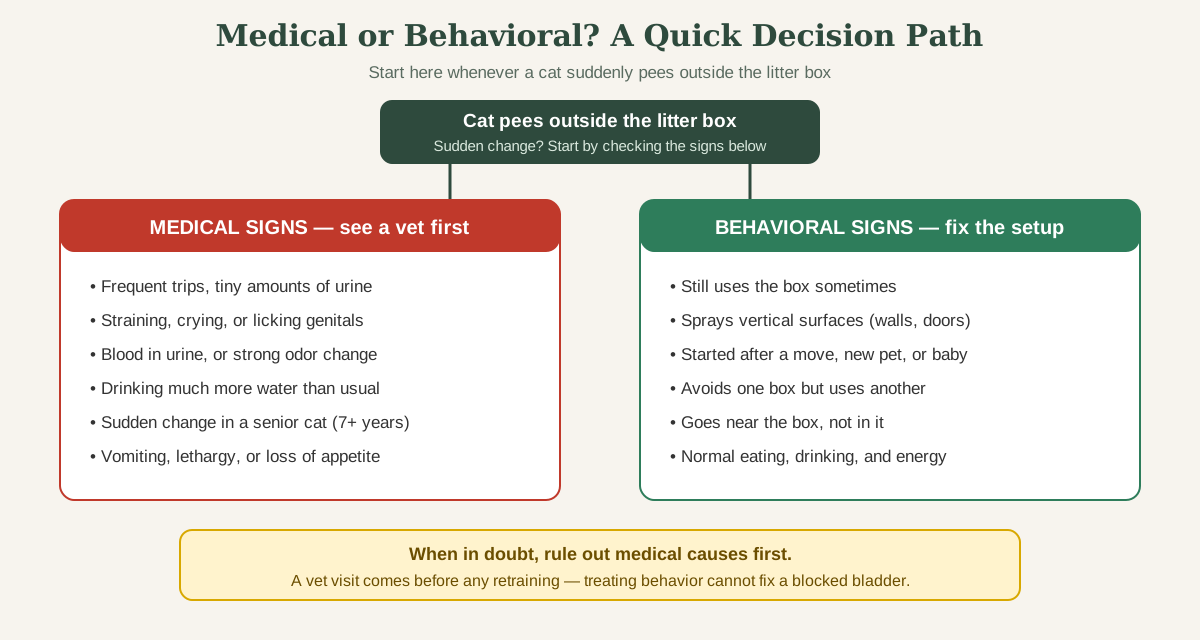
The table below compares the two groups of causes. Any medical sign on the left means the vet comes before any litter-box experiment.
| Clue | More likely medical | More likely behavioral |
|---|---|---|
| Frequency | Many trips, tiny amounts | Normal-sized puddles, normal frequency |
| Straining or crying | Yes, often visible effort | No, the cat pees normally, just elsewhere |
| Blood in urine | Possible — needs a vet promptly | No |
| Drinking and eating | Drinking much more | Normal appetite |
| Energy level | Lethargic or hiding | Normal and playful |
| Where it happens | Anywhere, including near the box | Specific spots — near the box, on beds, on laundry |
| Timing | Sudden, with no household change | After a move, new pet, new litter, or new schedule |
| The box itself | Cat may avoid the box entirely | Cat uses the box sometimes, or uses one box but not another |
One pattern deserves special attention: a cat that goes near the box but not in it. That usually points to the box itself — dirty, too small, covered, or in a spot the cat dislikes. A cat that sprays vertical surfaces — walls, doors, furniture legs — is marking, not failing to find the box. Marking is a different problem, and it also warrants a vet check first.
What should you do first when your cat pees outside the box?
Follow these steps in order. Do not skip step one.
- Book a vet visit, and collect a urine sample if you can. Call your vet the same day, sooner if your cat strains, cries, or produces blood. A fresh urine sample speeds up the diagnosis — ask your vet for non-absorbent litter to collect it. If your cat cannot urinate at all, treat it as an emergency and go immediately.
- Note the details. Before the visit, write down when and where the accidents happen and how often your cat tries to urinate — vets diagnose faster with a clear timeline.
- Clean every accident spot with an enzymatic cleaner. Regular cleaners and bleach do not fully remove cat urine odor. Soak the area with an enzymatic cleaner made for pet urine and let it air-dry. Avoid ammonia-based cleaners — ammonia smells like urine to a cat.
- Do not punish the cat. Rubbing a cat’s nose in urine or yelling does not teach litter-box use. It teaches the cat to fear you and to hide when it pees. The ASPCA advises against punishment for litter-box problems and recommends identifying the underlying cause instead (ASPCA, litter box problems).
- While waiting for the vet, check the basics. Make sure the box is scooped, the litter is the type your cat has always used, and nothing blocks the cat’s path to the box. Do not change litter brands or move the box the same week — one change at a time.
How many litter boxes does a cat need, and where should they go?
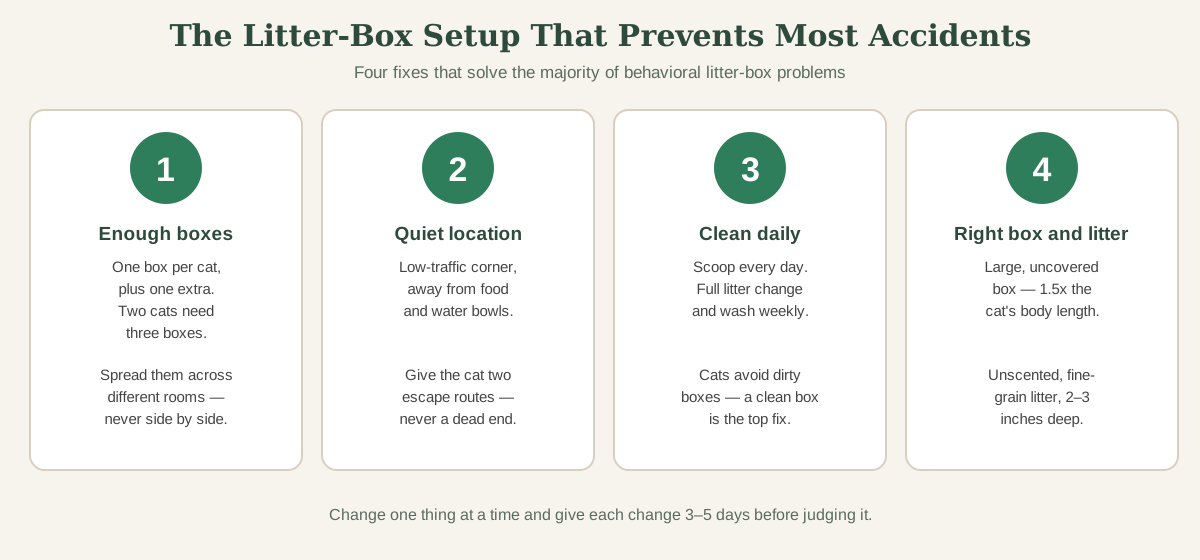
The standard rule, endorsed by most veterinary behaviorists, is one box per cat plus one extra. One cat needs two boxes; two cats need three. The boxes should be in different rooms, not side by side — two boxes next to each other count as one location in a cat’s mind. See how many litter boxes per cat for the full rule.
The best spot is a quiet, low-traffic corner with at least two escape routes, away from food and water bowls and noisy appliances like washing machines. Cats are vulnerable while they eliminate, and a box in a dead-end corner feels unsafe.
Cleanliness is the single most common behavioral fix. Scoop daily, change the litter and wash the box weekly, and replace scratched plastic boxes yearly — scratches hold odor no washing removes.
What behavioral causes make a cat avoid the litter box?
Once medical causes are ruled out, the remaining causes are about the box, the household, or the cat’s emotions — the most common behavioral triggers, as of November 2026.
A dirty box. This is the number-one behavioral cause. Some cats will tolerate a box that has not been scooped for a day; others refuse after a single use. If the problem started after a busy week or a holiday, cleanliness is the first suspect.
The wrong litter. Cats have strong litter preferences, usually formed as kittens. Switching from fine-grain unscented litter to a scented or coarse type can be enough to make a cat walk away. Scented litter is the most common offender — what smells “fresh” to a person smells overwhelming to a cat.
Stress and change. A move, new furniture, a new baby, a new pet, a houseguest, or construction noise can trigger litter-box avoidance. The cat is not protesting — it is anxious, and anxiety changes elimination habits. The ASPCA notes that reducing stress and restoring routine often helps (ASPCA, litter box problems).
Territory marking. Unneutered males are the classic markers, but spayed females and neutered males mark too, especially when a new cat appears outside the window. Marking looks different: small amounts of urine sprayed on vertical surfaces, often near doors and windows. Neutering reduces marking in most males.
Pain memory after treatment. A cat treated for a urinary problem may keep avoiding the box even after it feels better, because it still associates the box with pain. A fresh box in a new location gives the cat a clean slate. For kittens, see how to litter train a kitten.
How do you retrain a cat to use the litter box?
Retraining works best after the vet has cleared the cat and the setup is fixed. It is a patient process, not a weekend project — most cats improve within one to three weeks when the cause is behavioral.
Start by confining the cat to one small, comfortable room with its box, food, water, and a bed. A small space makes the right choice easy and prevents the cat from rehearsing the wrong one.
Keep the box spotless during retraining and scoop twice a day. Reward the cat calmly when it uses the box — a quiet word and a treat right after, not a fuss that startles it.
Gradually expand the cat’s territory. Once the cat uses the box reliably for three to four days in a row, open the door to one more room. If accidents return, go back a step — the cat was given too much space too soon.
When should you worry, and when can you wait?
Some situations cannot wait. Call a vet the same day — or go to an emergency clinic after hours — if your cat strains to urinate and produces nothing, cries while trying, has blood in its urine, vomits, stops eating, or becomes lethargic. Male cats are at higher risk of a complete urinary blockage, which can become fatal within 24 to 48 hours if untreated.
You can watch for a day or two, while still booking a vet visit, if your cat is eating, drinking, and playing normally and the accidents clearly followed a household change. Even then, a vet visit is the right move — medical and behavioral causes often overlap, and a stressed cat can develop bladder inflammation.
How can you prevent litter-box problems in the future?
Prevention is mostly maintenance. Scoop daily, keep the one-box-per-cat-plus-one rule, and place boxes in quiet spots with escape routes. Stick with the litter your cat likes — transition to a new type gradually, mixing it with the old litter over a week.
Watch your cat’s habits the way you would watch its appetite. A cat that visits the box more often, stays in it longer, or cries while going is giving you an early warning. Catching a urinary problem in its first day is far cheaper and far less painful than catching it in its first week.
Diet plays a supporting role. Cats that eat wet food take in more water, which helps keep urine dilute — one reason many vets favor wet food for cats prone to urinary issues. The tradeoffs are covered in wet food vs dry food for cats. Ask your vet what fits your cat’s age, weight, and health.
Finally, keep the routine steady. Cats cope best when feeding times, box locations, and the people in the house stay predictable — and a stable routine makes any real change in your cat’s habits easier to spot.
Frequently asked questions
Why is my cat suddenly peeing outside the litter box?
A sudden change usually means a medical problem or a recent household change. Book a vet visit first to rule out urinary tract disease, then check the box, the litter, and any recent stress.
Why does my cat pee on my bed but use the litter box sometimes?
Beds are soft, absorbent, and carry your scent, which makes them feel safe to an anxious or uncomfortable cat. This pattern can come from a medical problem or from stress, so it warrants a vet visit.
How many litter boxes should I have for one cat?
Two boxes for one cat, following the one-box-per-cat-plus-one rule. Place them in different rooms so the cat always has a nearby option, and scoop both daily.
Can changing cat litter cause litter-box problems?
Yes. Cats are sensitive to litter texture and scent, and switching to a scented, coarse, or pelleted litter can make a cat refuse the box. Switch back to the litter your cat used before, and mix any new type in gradually over a week.
When is peeing outside the litter box an emergency?
It is an emergency if your cat strains to urinate and produces nothing, cries while trying, or becomes lethargic. A blocked bladder can become fatal within 24 to 48 hours, especially in male cats, so go to a vet or emergency clinic immediately.