
The right puppy training class teaches your puppy basic cues, polite manners, and safe socialization through reward-based methods — and the right trainer matters more than the format. Group classes usually cost $100 to $200 for a six-week course, while private sessions run $50 to $150 per hour, as of November 2026.
A class is not a magic fix. It is a structured start: your puppy learns in a controlled setting, and you learn how to keep teaching at home.
What do puppy training classes actually teach?
A good puppy class covers four things: socialization, basic cues, bite inhibition, and household manners. Socialization means meeting new people, dogs, sounds, and surfaces in a positive way during the puppy’s prime learning window, which runs roughly from 3 to 14 weeks of age. The American Veterinary Medical Association (AVMA) notes that early, positive socialization is essential for preventing fear and aggression later in life (AVMA puppy socialization guidance).
Basic cues are the foundation commands: sit, down, come, stay, leave it, and walking on a loose leash. A class teaches these with food rewards and repetition, not force. Your puppy learns that listening to you pays off.
Bite inhibition is the skill puppies usually learn from littermates: how to control the pressure of their mouths. A class gives your puppy supervised play with other puppies, where a too-hard nip ends the game for a moment.
Household manners round out the curriculum. Most classes cover not jumping on guests, settling on a mat, waiting at doors, and coming when called even with distractions nearby.
Which type of puppy training class is right for you?
Group, private, and online classes all work — for different puppies and different owners. The right choice depends on your puppy’s temperament, your schedule, and what you most need help with.
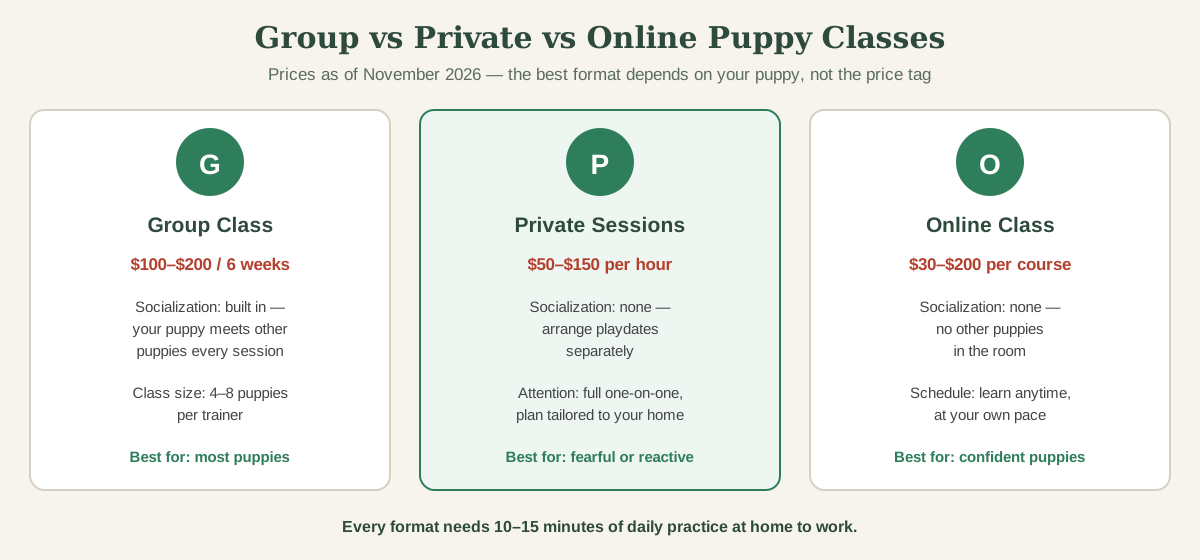
Group classes meet weekly at a training center, pet store, or vet clinic, usually with 4 to 8 puppies per class. They are the best option for socialization, because your puppy practices around other dogs and people every week. They are also the cheapest format. The trade-off is less individual attention: the trainer divides time across the whole group, and a very shy or very reactive puppy may struggle.
Private sessions happen one-on-one, at your home or at the trainer’s facility. They are the best choice for puppies with specific problems — fear, reactivity, resource guarding, or a bite history — and for owners who want a plan tailored to their house and routine. You get the trainer’s full attention, and scheduling is flexible. The cost is the main drawback, and your puppy gets no socialization from other puppies.
Online classes are video courses or live virtual sessions you follow at home. They are the cheapest and most flexible option, and they work well for confident puppies whose owners are motivated self-starters. They cannot replace in-person socialization, and no trainer is watching your timing to correct a mistake in the moment.
| Feature | Group class | Private sessions | Online class |
|---|---|---|---|
| Typical cost (as of November 2026) | $100–$200 for a 6-week course | $50–$150 per hour | $30–$200 for a full course |
| Socialization with other puppies | Yes — built into every session | No, unless arranged separately | No |
| Individual trainer attention | Shared across 4–8 puppies | Full attention, tailored plan | None, or limited in live sessions |
| Best for | Most puppies; first-time owners | Fearful, reactive, or specific behavior issues | Confident puppies; busy or rural owners |
| Schedule flexibility | Fixed weekly slot | Flexible, booked around you | Learn anytime |
| Owner effort between sessions | 10–15 minutes of daily practice | 10–15 minutes of daily practice | 10–15 minutes of daily practice |
A puppy that is confident and friendly will thrive in a group class. A puppy that hides, growls, or lunges at other dogs needs a private assessment first.
How much do puppy training classes cost?
Prices vary by city and by trainer, but the ranges below reflect what national chains, independent trainers, and online programs were charging as of November 2026, based on a comparison of published prices and owner feedback.
| Format | Typical price (as of November 2026) | What it usually includes |
|---|---|---|
| Group class, 6 weeks | $100–$200 total | 6 one-hour weekly sessions, handouts, graduation |
| Group class, single drop-in | $25–$40 per session | One class, no course commitment |
| Private session | $50–$150 per hour | One-on-one coaching at home or at a facility |
| Private package, 4–6 sessions | $300–$800 total | A tailored plan with follow-up support |
| Online self-paced course | $30–$150 | Video lessons, downloadable guides |
| Online live group course | $150–$250 | Weekly live video sessions with a trainer |
Big-box pet stores such as Petco and PetSmart sit at the low end of the group range, often $120 to $150 for six weeks. Independent trainers and training schools usually charge $175 to $250 for the same length, with smaller classes and more experienced instructors. In high-cost cities, private sessions can reach $200 per hour.
How do you vet a puppy trainer?
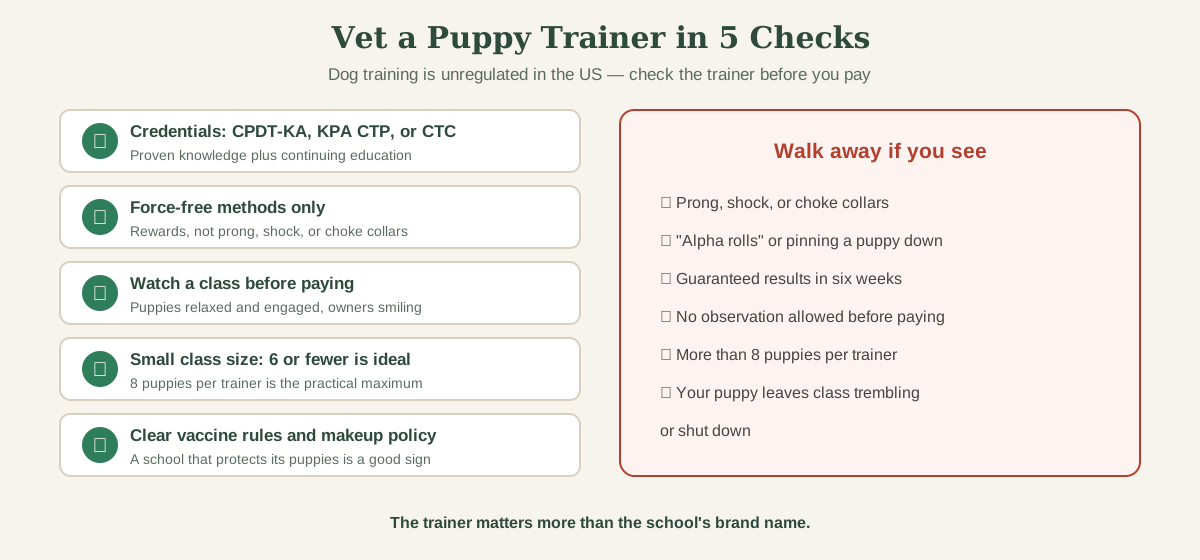
The trainer matters more than the school’s brand name. Dog training is an unregulated industry in the United States: anyone can call themselves a trainer, so credentials and methods are your only real quality filter.
Look for recognized credentials. The Certification Council for Professional Dog Trainers offers the CPDT-KA (Certified Professional Dog Trainer – Knowledge Assessed), which requires at least 300 hours of training experience and a proctored exam. The Karen Pryor Academy certifies KPA CTP (Certified Training Partner) graduates after a hands-on program in clicker training. The Academy for Dog Trainers (CTC) and the International Association of Animal Behavior Consultants (IAABC) are also respected.
Confirm the methods are force-free. A good trainer uses rewards — food, toys, and praise — to build behavior. Ask directly: “Do you use prong collars, shock collars, or leash corrections?” The answer should be no. The American Kennel Club (AKC) recommends positive reinforcement training and advises owners to avoid trainers who rely on punishment or intimidation (AKC choosing a dog trainer). A trainer who says “it depends on the dog” about aversive tools is telling you they use them.
Watch a class before you pay. Any reputable school will let you observe a session. Watch the puppies: are they relaxed and engaged, or cowering and stressed? Watch the trainer: do they explain the “why” behind each exercise, or just bark orders? Fifteen minutes of observation tells you more than any brochure.
Check reviews and references. Look for recent reviews from puppy owners, not just adult-dog clients. Ask the trainer for two references you can contact.
What age should a puppy start training classes?
Most group classes accept puppies from 8 to 16 weeks old, with many schools setting the ideal start at 10 to 12 weeks. That timing is deliberate: the socialization window is widest between 3 and 14 weeks, and the habits a puppy forms then are the hardest to change later.
Vaccination is the usual sticking point. Most schools require at least the first round of core vaccines (distemper/parvo) given at least 7 days before the first class, with a vet’s records to prove it. Some require the second round as well.
If your puppy is older than 16 weeks, you have not missed your chance. Many schools run a “teenage puppy” or adolescent class for dogs up to 6 or 8 months old, and the same principles apply. An older puppy may simply need a class matched to its size and energy level.
A good weekly rhythm helps: pair the class with a consistent at-home routine. A simple puppy training schedule by age shows what to practice each week so the class lessons actually stick between sessions.
What are the red flags in a puppy training class?
Some warning signs should send you straight to the door. The clearest is any use of punishment-based tools: prong collars, choke chains, shock collars, or “alpha rolls” that pin a puppy on its back. These methods suppress behavior through fear and can create aggression in a young dog.
Other red flags are subtler. A class with more than 8 puppies per trainer gives your puppy almost no individual feedback. A trainer who guarantees results — “your puppy will be fully trained in six weeks” — is selling a promise no honest professional makes. A school that refuses to let you observe a class before enrolling is hiding something. And a trainer who dismisses your questions, or tells you that your puppy is “dominant” and needs to be shown who is boss, is working from outdated ideas the science has moved past.
What should you ask before enrolling?
Five questions, asked before you pay, prevent most bad experiences:
- What methods do you use? You want a clear answer: positive reinforcement with food and toy rewards. Vague answers are a warning.
- What are the trainer’s credentials? Look for CPDT-KA, KPA CTP, or equivalent, and ask how long they have taught puppy classes specifically.
- How many puppies are in each class? Six or fewer is ideal; eight is the practical maximum for one trainer.
- What are the vaccination requirements? A school with clear, enforced rules is a school that protects its puppies.
- What happens if we miss a week? Good schools offer a makeup session, a video recap, or a brief catch-up before the next class.
Also ask what the class covers week by week. A transparent curriculum — socialization in week one, recall in week three, loose-leash walking in week five, for example — shows the school has a real plan rather than improvising.
What should you do after the class ends?
Graduation is a beginning, not a finish line. The skills your puppy learned are fresh and fragile: without practice, they fade within weeks.
Keep the daily habit going. Ten to fifteen minutes of practice a day — a few recalls in the yard, a sit-stay before meals, a settle on the mat while you watch TV — is worth more than a long weekend session. Short, frequent practice is how behaviors become permanent.
Keep socializing on purpose. The class gave your puppy a safe introduction to other dogs; regular playdates, calm walks in new places, and brief visits to pet-friendly stores keep that confidence growing. If you want structured ideas between classes, free puppy training apps can guide daily practice with reminders and short video lessons.
Finally, use what you learned at home. The real test of a class is not the graduation certificate — it is a puppy that comes when called at the park and settles calmly when guests arrive. If a behavior slips, go back to the class handouts and rebuild it in small steps. And if your household is adding a second dog, plan the first meetings carefully — our guide on how to introduce a puppy to an older dog covers the slow, supervised approach that avoids early conflict.
Frequently asked questions
Are puppy training classes worth it?
Yes — for most owners, a group puppy class is worth the $100 to $200 it typically costs, because it combines structured teaching with supervised socialization that is hard to reproduce at home. The value depends on the trainer’s skill, so vet the instructor before you judge the format.
When should a puppy start training classes?
Most puppies should start a group class between 10 and 12 weeks of age, after their first round of core vaccines, because the prime socialization window closes around 14 weeks. Older puppies up to 6 or 8 months can join adolescent classes instead.
How long do puppy training classes last?
A standard puppy course runs 6 weeks with one hour-long session per week, and most schools recommend 10 to 15 minutes of daily practice at home between sessions. Some schools offer shorter 4-week courses or drop-in classes for owners who want a lighter commitment.
Can I train my puppy without classes?
Yes, you can train a puppy at home with books, videos, and consistent practice, and many owners do. Classes add two things that are hard to get alone: supervised socialization with other puppies, and a trainer who spots your timing mistakes in real time.
What should I bring to a puppy training class?
Bring small, soft, high-value treats, a standard 6-foot leash (not retractable), your puppy’s vaccination records, and a treat pouch for easy access. Leave choke chains, prong collars, and retractable leashes at home — most force-free schools will not allow them in class.