
Your cat brings you dead animals because hunting is hardwired into its brain, and bringing prey home is part of how cats naturally handle a kill. It is not a gift, a complaint about dinner, or a sign your cat is angry. Your cat is acting on instincts that kept its wild ancestors alive for thousands of years.
That explanation rarely makes the moment easier. You step out the door, or wake up in the morning, and there it is on the doormat: a mouse, a bird, sometimes a lizard, delivered proudly. Understanding why it happens is the fastest way to respond in a way that keeps your cat healthy and your home safe.
Why Do Cats Bring Dead Animals Home?
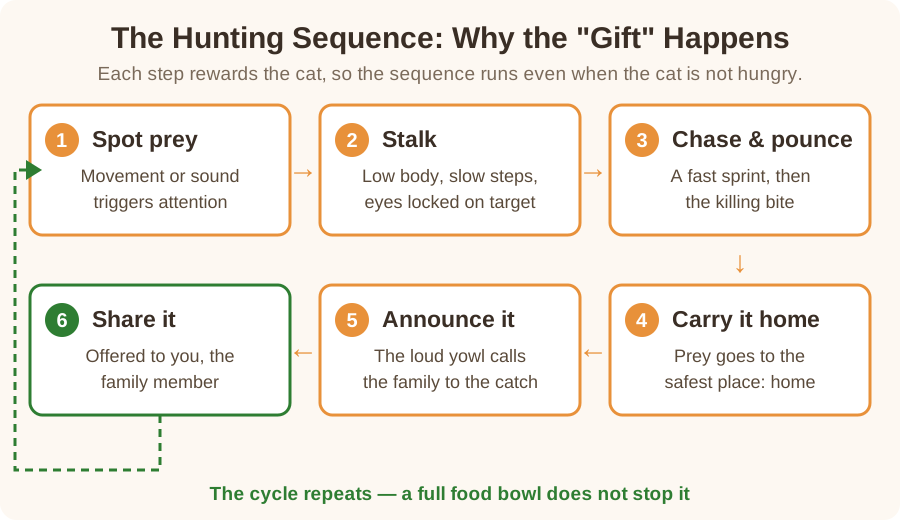
Cats bring dead animals home because the hunt does not end at the kill for them. In the wild, a cat kills prey, then carries it somewhere safe to eat or to share. Your living room, your porch, or your bed is the safe place your cat knows best, so that is where the prey ends up.
Well-fed house cats hunt just as eagerly as hungry ones, because the drive to stalk, chase, and pounce is separate from appetite. A full food bowl does not switch off the hunting sequence.
There is also a social layer: mother cats bring prey to kittens, and a cat that drops a mouse at your feet is treating you as part of its family group, the same bond behind kneading.
Is Your Cat Trying to Teach You to Hunt?
One of the most popular explanations says your cat thinks you are a hopeless hunter and is bringing you lessons. The idea comes from real observations of mother cats. A mother cat first brings dead prey to her kittens, then prey that is still alive, and finally lets the kittens practice the kill themselves.
Some behaviorists believe adult cats extend that same pattern to their owners. From your cat’s point of view, you are a large, clumsy member of the household who never catches anything, so bringing you a dead mouse may be a cat’s version of a teaching moment. The evidence is suggestive: spayed female cats bring home prey more often than males in several owner surveys, which fits the mother-cat pattern.
Other experts are more cautious. Cats also bring prey home when no kittens and no humans are watching, and the simplest explanation is still the strongest: the cat caught something, carried it to its safe territory, and you happened to live there. Either way, your cat is not insulting your cooking, and it is not punishing you.
What Does the Science Say About Cats and Hunting?
Cats are remarkably effective hunters, and the numbers are startling. A widely cited 2013 study published in Nature Communications estimated that free-ranging domestic cats in the United States kill between 1.3 and 4.0 billion birds and between 6.3 and 22.3 billion mammals every year, as of November 2026. Most of that killing is done by unowned and feral cats, but owned outdoor cats contribute a real share.
Those numbers explain why the dead mouse on your doorstep is not a rare event. Owners who recorded what their cats brought home found the average outdoor cat delivers roughly two to three prey items per month during the active hunting season, with mice and other small mammals making up the largest share, followed by birds.
| Prey type | Share of what cats bring home |
|---|---|
| Mice, voles, and shrews | About half of all prey |
| Birds | Roughly one in four prey items |
| Lizards and frogs | Varies by region; common in warm climates |
| Rats and rabbits | A small share; usually larger hunters |
Most of what a cat catches never reaches your doorstep. Studies that fitted cats with small cameras found that cats eat or abandon a large share of their kills outdoors and only bring home a fraction.
The numbers also make this a wildlife issue as well as a household one. In the United States, cats are the leading human-linked cause of bird deaths, ahead of window strikes and cars. That does not make your cat a villain. It makes your cat a predator living in a modern landscape, and it is one more reason to think about how much outdoor access your cat really needs. The trade-offs are covered in our guide to indoor versus outdoor cats.
Are Dead Animals Dangerous to Your Cat and to You?
Dead prey can carry real health risks, and this is the part of the story worth taking seriously. A wild mouse or bird can carry parasites, bacteria, and occasionally poison, and your cat can pick those up by eating or even mouthing the animal.
The best-known risk is toxoplasmosis, caused by the parasite Toxoplasma gondii, which cats can catch by eating infected rodents or birds. The Cornell Feline Health Center explains that most healthy cats show no symptoms, but the parasite can cause illness in kittens and in cats with weakened immune systems. The AVMA notes the risk extends to people: pregnant women and anyone with a weakened immune system should avoid handling dead prey and cat feces, and should wash hands thoroughly after any contact.
Roundworms and tapeworms are also common in wild rodents, so a cat that eats an infected mouse can pick up intestinal worms. Regular deworming matters for any cat with outdoor access, and your veterinarian can advise on a parasite prevention schedule that fits your cat’s lifestyle.
Poison is the hidden danger. A mouse that has eaten rat poison can poison your cat in turn, a process called secondary poisoning. The ASPCA Animal Poison Control Center warns that rodenticides are among the most common cat poisonings it handles, and the signs can take days to appear. Snap traps and sealing entry points are safer alternatives to poison.
Rabies from prey is rare but not impossible, and bats are the main concern: a cat that catches a bat should always be treated as a possible rabies exposure. If your cat brings home a bat, or any animal that looks sick or behaves strangely, keep it away from people and pets, avoid touching it with bare hands, and call your veterinarian the same day.
The rule is simple. Never handle dead prey with bare hands, keep your cat’s vaccinations and parasite prevention current, and call your vet if your cat vomits, has diarrhea, or loses its appetite after eating wild prey.
What Should You Do When Your Cat Brings You a Dead Animal?
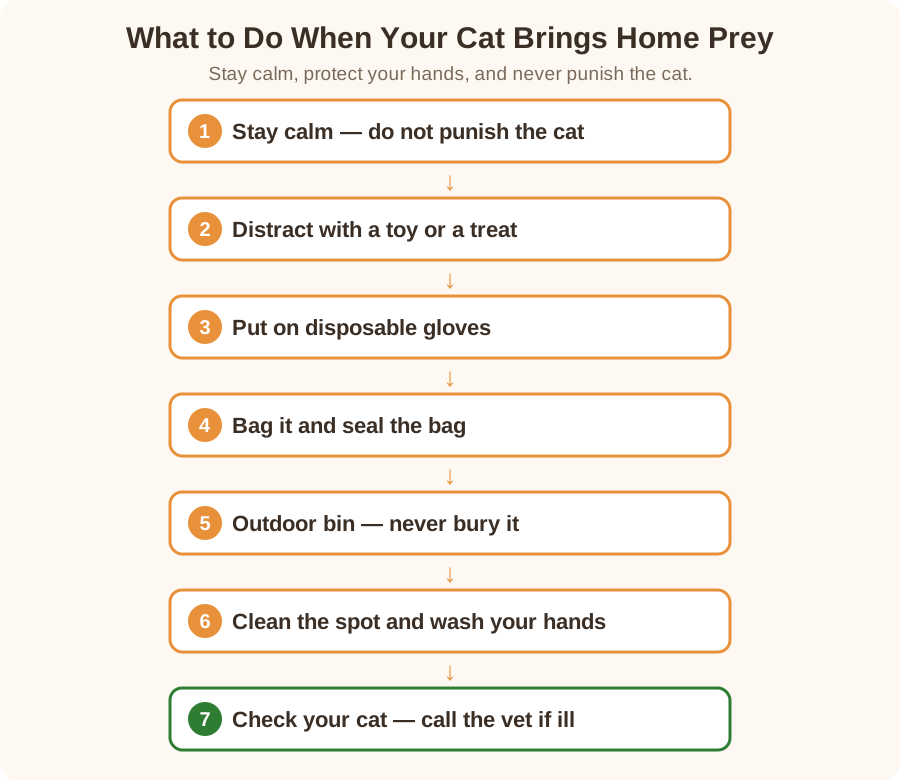
Stay calm. Your cat is not doing anything wrong, and your reaction in the first few seconds matters. Shouting or chasing the cat teaches it to hide the next gift somewhere worse, like under the bed.
- Do not punish the cat. Hunting is instinct, not misbehavior. Punishment will not stop it, and it will damage the trust your cat has in you.
- Distract, do not grab. Toss a favorite toy or a treat a few feet away so the cat drops the prey on its own. Never try to pull a dead animal out of a cat’s mouth.
- Put on disposable gloves. Pick up the animal with a plastic bag turned inside out and seal it. Never touch dead wildlife with bare hands.
- Dispose of it in an outdoor bin. Double-bag the animal and put it in a covered outdoor trash bin. Do not bury it in the garden, where other animals can dig it up.
- Clean the spot. Wipe the floor or doormat with soap and water, then a pet-safe disinfectant. Wash your hands thoroughly afterward, even though you wore gloves.
- Check your cat. Look for bites or scratches. If the cat ate part of the animal, watch for vomiting, diarrhea, or loss of appetite over the next day or two, and call your vet if any of those appear.
- Wash any bedding or fabric. If the prey ended up on a bed or blanket, wash it in hot water before anyone sleeps on it again.
If your cat brings home live prey, the same steps apply, with one change: open a door to the outside and give the animal an escape route before you try to catch it.
Cats learn from your reaction. A calm, boring response teaches the cat that the delivery is unremarkable, which over time can reduce the drama even if it does not stop the hunting.
How Can You Reduce the Hunting Without Punishing Your Cat?
You cannot train the hunting instinct out of a cat, and you should not try. What you can do is give the instinct a safer outlet and reduce the number of successful hunts.
Play is the best substitute. Ten to fifteen minutes of interactive play with a wand toy, twice a day, lets your cat run through the full hunting sequence of stalk, chase, pounce, and catch in your living room. End each session by letting the cat “catch” the toy and offering a small treat. A cat that has hunted a feather wand all evening has less appetite for the garden.
A bell on the collar helps, but only a little. Studies have found that bell collars reduce the number of prey cats bring home by roughly a third, because the bell warns birds and small mammals before the cat is in range. It is not a perfect fix, but it is cheap, harmless, and worth trying.
Brightly colored collar covers work better for birds. A 2015 study by researchers at the University of Exeter and the RSPB found that cats wearing a brightly colored Birdsbesafe collar cover caught 87 percent fewer birds than cats without one, as of November 2026.
Keeping your cat indoors at dawn and dusk also helps. Those are the hours when birds and small mammals are most active, and when cats hunt most successfully. A cat that goes out after breakfast and comes in before sunset will still hunt, but it will catch less.
Feeding does not stop hunting, but a well-fed cat is less likely to eat what it catches, which reduces the parasite and poisoning risk even if the hunting continues. If you are choosing between foods, our comparison of wet food versus dry food for cats explains the trade-offs.
The most effective option of all is also the most obvious: keeping the cat indoors. Indoor cats live longer on average, avoid traffic, fights, and disease, and catch nothing. If full-time indoor life is not realistic, supervised outdoor time on a leash, or a secure catio, gives your cat fresh air without free rein over the local wildlife.
Frequently Asked Questions
Why does my cat bring me dead animals if I feed it well?
Your cat brings you dead animals because hunting is driven by instinct, not hunger. A well-fed cat still stalks, chases, and kills because the hunting sequence itself is rewarding, and it carries prey home to share with its family group.
Do cats bring dead animals as gifts?
Cats do not give gifts the way people do, but the behavior serves a similar social purpose. Mother cats bring prey to kittens, and adult cats share food with their social group, so a cat that brings you prey is treating you as part of its family.
Is it safe to let my cat eat the animals it catches?
No, it is not safe to let your cat eat wild prey. Dead rodents and birds can carry parasites such as Toxoplasma gondii and roundworms, bacteria, and rodenticide poison. Keep your cat’s parasite prevention current and call your vet if it eats prey and then vomits or stops eating.
How do I stop my cat from bringing dead animals into the house?
You cannot stop the instinct, but you can reduce it with daily interactive play, a bell or brightly colored collar cover, keeping your cat in at dawn and dusk, and limiting unsupervised outdoor time. A cat flap with a curfew, or a catio, keeps the hunting outside the house.
Why does my cat meow loudly when it brings prey home?
The loud, yowling meow is an announcement. Your cat is calling attention to the catch, the same way a mother cat calls her kittens to food. It is proud of the hunt and wants you to notice, so a calm acknowledgment and a distraction with a toy is the best response.