
Yes, you can put a small amount of plain, unscented baking soda in cat litter — about 2 to 4 tablespoons per standard litter box — to help neutralize urine odor. Baking soda is alkaline and cat urine is acidic, so it neutralizes the smell instead of covering it up. Use it sparingly, mix it in well, and never let it replace daily scooping.
Baking soda is one of the cheapest odor tricks in cat care, and it works — up to a point. The catch is that the same fine powder that absorbs odor can also be inhaled or licked off paws, and cats groom constantly.
Does baking soda actually help with litter box odor?
Yes, baking soda genuinely reduces litter box odor — but only the urine smell, not the whole problem. Baking soda is sodium bicarbonate, a mild alkali, and cat urine is acidic. Much of urine’s sharp smell comes from acidic compounds and ammonia that builds as urine breaks down; baking soda neutralizes those acids instead of masking them with fragrance.
That beats scented litters and sprays, which layer one smell over another. Baking soda also absorbs some moisture, which slows the bacterial breakdown that makes an old box smell worse.
But it has clear limits. It does nothing about solid waste, which is why scooping still matters most. It does not kill bacteria or disinfect the box. And its effect fades: once the powder has reacted with urine, it is spent, so an unscooped box smells again within a day or two.
In short: baking soda helps a box that is already well maintained; it cannot rescue one that is not. If the box smells strongly even after scooping, the fix is more frequent cleaning, fresher litter, or an extra box — not more powder.
How much baking soda should you put in cat litter?
There is no vet-approved dose for baking soda in cat litter — no veterinary body has tested and endorsed a specific amount for home use. The amounts below come from commonly cited household guidance and should be treated as a ceiling, not a target.
For a standard box holding 3 to 4 inches of litter, sprinkle 2 to 4 tablespoons of plain, unscented baking soda — roughly a quarter cup at most — and mix it through the litter. A light dusting worked into the litter does the job; a thick layer on top just creates dust your cat will breathe in and track around the house.
Why keep it that low? The safety margin is thinner than most people realize. A vet-reviewed guide from Catster notes that baking soda toxicity is estimated at around 2 tablespoons ingested by an average 8.8-pound cat, with vomiting usually the first sign (Catster vet-reviewed guide). Your cat will not eat everything you sprinkle, but cats lick their paws clean after every visit.
A few rules make the amount safer:
- Use plain, unscented baking soda only. Scented varieties contain added fragrances that can irritate a cat’s nose and airways — the ingredients should list only sodium bicarbonate.
- Never use baking powder. It looks similar but contains acids and other additives, and it is not the same product.
- Use less for kittens and small cats. Kittens mouth everything and groom often, and a small body has less room for error — many owners skip loose powder until a kitten is at least 6 months old.
- Use less in a covered box. Enclosed boxes trap dust in the air your cat breathes, so a covered box needs a lighter hand — or none at all.
- Reapply only at full litter changes, not after every scoop. Adding powder daily builds up a dusty layer.
| Situation | How much baking soda | Notes |
|---|---|---|
| Standard open litter box | 2–4 tablespoons, mixed in | A quarter cup at most; mix through, do not leave on top |
| Covered or hooded box | 1–2 tablespoons, or skip it | Dust builds up in enclosed air; keep it minimal |
| Kitten under 6 months | None recommended | Kittens mouth and groom more; use low-dust litter instead |
| Cat with asthma or breathing issues | None | Fine powder can trigger coughing |
| Cat with kidney disease | Ask your vet first | Sodium load matters more with kidney problems |
How do you add baking soda to cat litter step by step?
Adding baking soda takes about two minutes, but the order matters — sprinkling it on a dirty box and letting your cat walk through the dust is the version that causes problems.
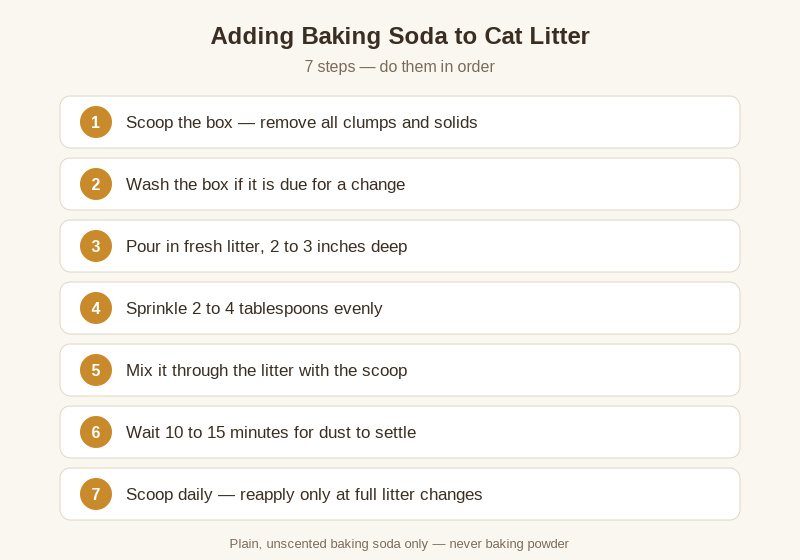
- Scoop the box first. Remove all clumps and solids — baking soda cannot fix a dirty box.
- Empty and wash the box if it is due for a change. If the litter is more than two weeks old or the box smells even when empty, dump it, wash with warm water and unscented soap, and dry fully.
- Pour in fresh litter to the normal depth, about 2 to 3 inches — most cats prefer unscented litter at a shallow depth.
- Sprinkle the baking soda evenly. Scatter 2 to 4 tablespoons across the surface — a light dusting, not a pile in one corner.
- Mix it through the litter. Stir with the scoop until you can barely see the powder — this keeps loose powder off your cat’s paws.
- Wait before letting your cat in. Give the dust 10 to 15 minutes to settle so your cat does not breathe in the fresh powder cloud.
- Scoop daily and reapply only at full changes — add a fresh sprinkle only when you replace all the litter.
If your cat sneezes, coughs, or avoids the box after you add baking soda, stop using it. A cat that avoids the box will go elsewhere in the house, and the powder is never worth a litter box aversion.
What are the risks of baking soda in cat litter?
Baking soda is not classified as toxic to cats in small amounts, but “not toxic” and “safe in any amount” are very different things. The risks are eating it, breathing it, and using it as a substitute for cleaning.
Ingestion is the main risk. Cats groom their paws constantly, so anything on their paws ends up in their stomachs. A small amount is unlikely to cause harm, but a large amount is another story: the ASPCA Animal Poison Control Center warns that eating too much baking soda can raise a pet’s sodium level, causing unsteadiness, muscle tremors, and seizures (ASPCA Animal Poison Control Center). The Catster vet-reviewed guide puts the estimated toxic dose at around 2 tablespoons for an average 8.8-pound cat, with vomiting, drooling, and lethargy as early signs. Young, elderly, and kidney-disease cats face higher risk at lower amounts. The American College of Veterinary Pharmacists lists vomiting as the most common first sign of baking soda toxicity, followed by diarrhea, lethargy, tremors, and seizures (ACVP baking soda guidance).
In practice, a cat would have to eat a lot of litter-box powder to reach that dose — but a kitten that mouths everything, or a box with a thick layer of loose powder on top, moves in the wrong direction.
Dust is the second risk. Every dig and scratch sends fine powder into the air, and cats breathe close to the litter surface. In a covered box, that dust has nowhere to go. Cats with asthma should not be exposed to loose powder at all, and even healthy cats can cough if the box is over-dusted.
The third risk is a false sense of security. Baking soda makes a box smell better, which tempts owners to scoop less often or stretch litter changes further. A box that smells fine but is full of waste is still unhygienic, and a cat that starts avoiding a “fresh-smelling” dirty box will use the rug instead.
Two more cautions: never put baking soda directly on your cat, because grooming turns skin contact into ingestion. And if your cat shows any sign of illness after exposure — vomiting, drooling, lethargy, tremors, or trouble breathing — contact your veterinarian or the ASPCA Animal Poison Control Center at (888) 426-4435 right away.
What are the best alternatives to baking soda for litter box odor?
Baking soda is the cheapest option, but not the only one. The right alternative depends on what is causing the smell.
Scoop more often. This is the single most effective odor fix, and it costs nothing. Scooping once or twice a day removes waste before it breaks down into ammonia. If the box still smells after daily scooping, the problem is usually the litter or the number of boxes. Most multi-cat homes need one box per cat plus one extra — our guide to how many litter boxes per cat explains the rule.
Switch litters. A good clumping litter traps urine in tight clumps you can remove completely. Low-dust formulas cut airborne particles, and unscented litters avoid fragrance. If tracked litter is spreading through the house, a non-tracking cat litter helps too.
Use a litter with baking soda built in. Several commercial litters include it in their formula, with a controlled amount bound into the granules instead of loose dust. For owners who want the benefit without the powder cloud, a pre-mixed litter is safer.
Activated charcoal. Charcoal-based deodorizers absorb odor molecules without adding fine powder to the box, and they last longer than baking soda between changes. They cost more, but they suit cats with sensitive airways.
Enzyme cleaners for the box itself. An enzyme-based cleaner breaks down urine residue that regular soap leaves behind. Wash the empty box at least once a month — more often with several cats.
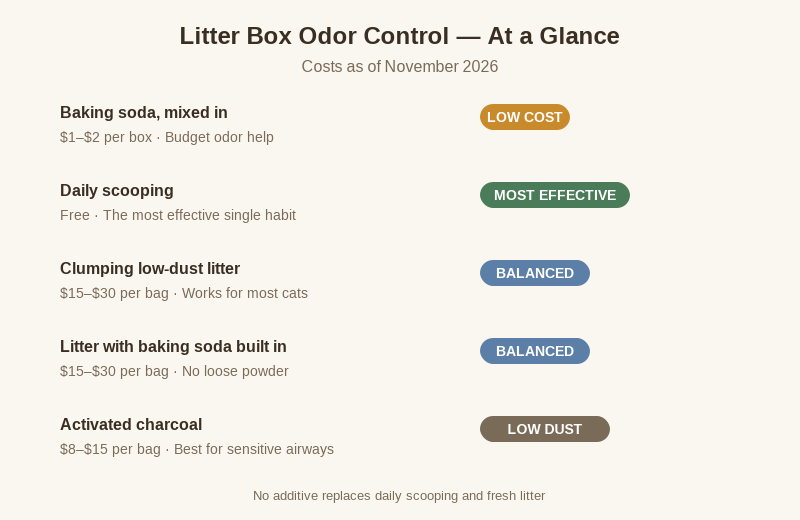
| Odor control method | How it works | Cost (as of November 2026) | Best for | Watch out for |
|---|---|---|---|---|
| Baking soda, mixed in | Neutralizes acidic urine odor | $1–$2 per box | Budget odor help in a well-scooped box | Dust; ingestion if overused |
| Daily scooping | Removes waste before it breaks down | Free | Every household | Needs consistency |
| Clumping low-dust litter | Traps urine in removable clumps | $15–$30 per bag | Most cats | Check dust levels |
| Litter with baking soda built in | Controlled dose bound into granules | $15–$30 per bag | Owners avoiding loose powder | Check for added fragrance |
| Activated charcoal | Absorbs odor molecules | $8–$15 per bag or sachet | Cats with asthma or dust sensitivity | Costs more; replace on schedule |
Should you use baking soda in cat litter?
For most healthy adult cats, a small amount of plain baking soda mixed into the litter is a reasonable, low-cost way to cut urine odor — as long as you treat it as a helper, not a solution. Use 2 to 4 tablespoons per box, mix it in well, and keep scooping every day.
Skip it, or ask your vet first, if your cat is a kitten, has asthma or breathing problems, has kidney disease, or licks litter off its paws. A litter with baking soda built in, or a charcoal deodorizer, gives most of the benefit with less risk.
What controls litter box smell is a clean box, the right number of boxes, and fresh litter. Baking soda can improve a good setup; it cannot rescue a neglected one. If you are setting up a box for the first time, our guide on how to litter train a kitten covers box choice, placement, and the routine that keeps a cat using the box happily for years.
Frequently asked questions
Can you put baking soda in cat litter safely?
Yes — about 2 to 4 tablespoons of plain, unscented baking soda mixed into a standard litter box is generally considered safe for healthy adult cats. Keep the amount low, mix it in well, and skip it for kittens and cats with asthma or kidney disease.
How much baking soda do you put in cat litter?
Use 2 to 4 tablespoons per standard litter box, sprinkled evenly and mixed through the litter — roughly a quarter cup at most. Reapply only when you replace all the litter, not after every scoop.
Is baking soda toxic to cats?
Baking soda is not classified as toxic to cats in small amounts, but it can be dangerous in large quantities. The ASPCA Animal Poison Control Center warns that eating too much can raise a pet’s sodium level and cause unsteadiness, tremors, and seizures — call your vet if your cat eats a large amount.
Can you use scented baking soda in cat litter?
No — only plain, unscented baking soda. Scented varieties contain added fragrances that can irritate your cat’s nose and airways, and some fragrance ingredients are unsafe for cats.
Does baking soda replace cleaning the litter box?
No. It only neutralizes some urine odor and does nothing about solid waste or bacteria, so you still need to scoop at least once a day and replace the litter regularly.
What can I use instead of baking soda for cat litter odor?
The best alternatives are daily scooping, a good clumping low-dust litter, a litter with baking soda built in, or an activated charcoal deodorizer. Daily scooping alone does more for odor than any additive.