
The best dog crate for an anxious dog is a den-like crate sized so your dog can stand, turn, and lie down, and one your dog has been trained to enjoy gradually. For most anxious dogs, the MidWest iCrate with a cover is the best start; escape artists need the heavy-duty Impact High Anxiety crate.
Photo: Pexels.
TL;DR — Our verdict: Start with the MidWest iCrate (budget, easy to make den-like with a cover). If the crate will sit in your living room, upgrade to the Diggs Revol. If your dog has already bent wire or broken out, skip straight to the Impact High Anxiety crate. No crate fixes separation anxiety on its own.
What makes a dog crate good for an anxious dog?
An anxious dog needs a crate that feels like a den, not a cage. Four features matter most. First, escape-proofing: a panicking dog will push, chew, and paw at the door, so look for double latches, reinforced corners, and welds rather than thin wire hooks. Second, den feel: dogs are den animals, and many anxious dogs settle faster in a darker, more enclosed space, which is why crate covers and plastic kennels help. Third, durability: a crate that bends teaches an anxious dog that escape is possible. Fourth, quiet operation: rattling wire panels add stress for a noise-sensitive dog.
A crate is a management tool, not a treatment — it keeps a dog safe, but it does not resolve the fear behind the anxiety.
Which crate type is best for an anxious dog?
Four main crate types suit different kinds of anxious dogs. Wire crates are the most common: airy, foldable, and cheap, but also the easiest to escape from. Plastic kennels feel more den-like and are quieter, though bulkier. Heavy-duty steel or aluminum crates are built for dogs that have already destroyed lighter crates. Furniture-style crates look like home furniture and suit calm dogs needing a cozy den.
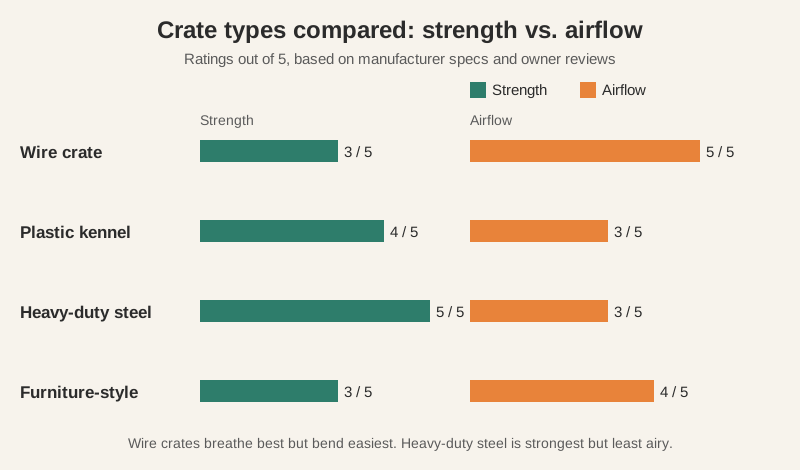
A wire crate with a cover is the best starting point for a mildly anxious dog: airflow and visibility, plus a den feel once covered. A plastic kennel is a better pick for a dog that settles when it cannot see the whole room. Heavy-duty crates are not a first purchase — they are the answer when a dog has already proven it can defeat a standard crate. Avoid soft-sided fabric crates for anxious dogs: a panicking dog can chew through the mesh in minutes, and a dog that escapes once will try again.
How do you measure your dog for the right crate size?
Crate size is the most common mistake owners make. A crate that is too big feels exposed rather than den-like, and a dog may soil one end. A crate that is too small causes discomfort and raises stress.
Measure your dog standing on all fours: length from the tip of the nose to the base of the tail, plus 2 to 4 inches. Measure height from the floor to the top of the head — or the tips of the ears, whichever is higher — then add 2 to 4 inches. The crate should let your dog stand without crouching, turn around freely, and lie down stretched out.
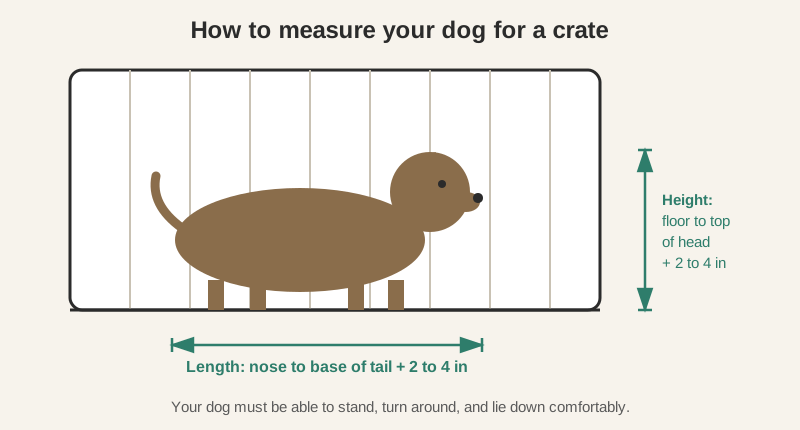
For a puppy, choose a crate with a divider panel so you can shrink the space now and expand it later. If your dog has escaped before, prioritize construction strength over a perfect size match.
What are the best dog crates for anxious dogs in 2026?
We compared specs, prices, and verified owner reviews across the most widely available crates in the US. Prices below were verified against US retailer listings as of November 2026. This is a research comparison, not a hands-on test: we did not test these crates ourselves.
| Crate | Material | Best for | Price tier |
|---|---|---|---|
| MidWest iCrate | Folding wire steel | Most anxious dogs; first crate | Budget |
| Diggs Revol | Reinforced mesh and steel frame | Living-room den; noise-sensitive dogs | Premium |
| Frisco Ultimate Heavy Duty | Welded steel | Dogs that have escaped wire crates | Mid-range to premium |
| Impact High Anxiety | Aircraft-grade aluminum | Confirmed escape artists | Premium |
| Petmate Vari Kennel | Hard plastic | Den-like quiet; travel | Budget to mid-range |
MidWest iCrate — Best overall for most anxious dogs
The MidWest iCrate is the default recommendation from vets, rescues, and trainers: inexpensive, widely available, and it does the fundamental job well. It is a folding wire crate with two doors, a divider panel, and a removable leak-proof tray, in sizes from 18 to 48 inches. For an anxious dog, its strength is flexibility — drape a cover over the top and sides and the open frame becomes a dark, den-like retreat. Its weakness is openness: a determined dog can bend the wire or work the slide-bolt latches, so owner reviews rate it for mild to moderate anxiety, not escape artists. Prices as of November 2026 run from about $31 to about $69 depending on size.
Diggs Revol — Best upgrade for the living room
The Diggs Revol is a collapsible crate with a reinforced mesh body and a steel frame, designed to look like furniture rather than a cage. It comes in Small through X-Large with a divider, a removable tray, and a carrying handle. Its solid panels block more of the room than a wire crate, which helps dogs that settle when they cannot see everything around them. For anxious dogs, its biggest advantage is quiet: no rattling wire panels, and the mesh muffles household noise. The drawback is price — from around $299 direct from Diggs to roughly $395 in larger sizes as of November 2026, five to seven times a basic wire crate — and it is not built for dogs that chew through mesh or have destroyed a metal crate.
Frisco Ultimate Heavy Duty Steel Crate — Best heavy-duty value
The Frisco Ultimate Heavy Duty crate is Chewy’s house-brand answer to dogs that have defeated standard wire crates. It is welded, powder-coated steel with 22-gauge panels and half-inch steel tubing, two door locks placed out of easy reach, and locking caster wheels, in two sizes: Medium (37 inches) and Large (42.1 inches). For a dog that has already escaped, the welded construction is the point: no thin wire to bend, no single latch to nose open. The trade-offs are weight and range — only two sizes, heavy, not foldable, and it looks industrial. The Medium was listed at $309.79 on Chewy as of October 2026.
Impact High Anxiety Crate — Best for confirmed escape artists
The Impact High Anxiety crate is the specialist pick here. It is aircraft-grade aluminum alloy the maker says is 62 percent thicker than its standard crates, with small round ventilation holes a dog cannot get teeth or a snout into, a zinc-steel paddle latch backed by four butterfly latches, and no exposed bolts. It is sold direct from the maker in Hayden, Idaho, and it does not fold. This is the crate for a dog that has already destroyed one or more crates, and it carries a 10-year Dog Damage Guarantee: if the dog damages it into malfunction, Impact replaces the parts or the crate free. At 63 pounds for the 34-inch size, it is not portable and not crash tested. Prices start at $1,099 (30-inch) and run to about $1,265 (40-inch) as of November 2026.
Petmate Vari Kennel — Best den-like plastic kennel
The Petmate Vari Kennel (also sold as the Ultra Vari Kennel) is the classic hard-plastic travel kennel, and its enclosed design is exactly what some anxious dogs prefer. Solid plastic walls block sightlines in every direction except the wire front door, creating a cave-like den many nervous dogs choose voluntarily. It is quiet, easy to hose clean, and accepted by most airlines in the appropriate size. The drawbacks are bulk and airflow: it does not fold, takes up real floor space, and runs warmer than a wire crate in summer. It sits in the budget to mid-range tier.
How much should you expect to pay for a crate for an anxious dog?
A good wire crate costs $30 to $90, a den-style or furniture crate costs $200 to $400, and a true escape-proof crate costs $300 to $1,300. Most owners of anxious dogs spend in the $60 to $350 range and never need the top tier.
Do not buy the most expensive crate first. Start with a wire crate and a cover, train gradually, and only upgrade if your dog proves it can defeat the cheaper option. The money saved can go toward what actually reduces anxiety: training, enrichment toys, and a vet or behaviorist consultation if the anxiety is severe.
How do you crate train an anxious dog without making things worse?
Crate training an anxious dog is a slow process measured in days and weeks, not hours. Rushing it teaches the dog that the crate is a trap.
- Introduce the crate with the door open. Put a soft bed and a few treats inside, and let your dog investigate on its own.
- Feed meals in the crate. Serving meals just inside the door, then gradually further back, builds a strong positive association.
- Close the door for seconds, not minutes. Once your dog walks in willingly, close the door while you sit nearby, then open it before the dog gets worried.
- Add departures gradually. Step out of the room for a few seconds, return calmly, and only lengthen the absence when your dog stays relaxed.
- Use high-value chews. A stuffed Kong or a long-lasting chew gives an anxious dog something to do in the crate. Many dogs love banana as a training reward — read more about whether dogs can eat bananas before offering it.
- Keep the routine predictable. Regular meals, walks, and rest lower a dog’s baseline stress. A tired dog settles more easily — for high-energy breeds, see how much exercise a Labrador needs — and a steady grooming routine, such as how often you should bathe a dog, also helps.
Never use the crate as punishment. Sending a dog to its crate after it does something wrong teaches the dog that the crate predicts trouble. If your dog panics — heavy panting, drooling, frantic escape attempts, or injuring itself — stop, open the door, and step back to an earlier stage.
Can a crate cure separation anxiety?
No. A crate cannot cure separation anxiety, and for some dogs it makes things worse. Confining a dog that is already panicking about your absence can turn anxiety into injury. The ASPCA advises owners to watch a dog’s behavior during crate training and while left in the crate: if the dog shows heavy panting, drooling, frantic escape attempts, or persistent howling, a baby-gated room may be safer. Read the ASPCA’s full guidance on separation anxiety in dogs.
The AVMA likewise advises working with a veterinarian on a structured plan, not just containment. If your dog injures itself trying to escape, destroys crates repeatedly, or panics within minutes of your departure, talk to your vet or a certified behaviorist before buying a stronger crate. The honest rule is this: a crate helps a dog that already likes its crate. It does not help a dog that is terrified of being alone.
Frequently asked questions
What is the best dog crate for an anxious dog?
The MidWest iCrate with a crate cover is the best starting point for most anxious dogs: sturdy, affordable, and easy to make den-like. Dogs that have already escaped a wire crate need a heavy-duty option like the Impact High Anxiety crate instead.
Should I cover my dog’s crate to reduce anxiety?
Yes, covering the top and sides of a wire crate often helps an anxious dog settle, because it blocks visual stimulation and creates a darker, den-like space. Leave the front partly open for airflow.
Is it cruel to crate an anxious dog?
A crate is not cruel when a dog has been trained gradually, chooses to rest in it, and is never left in it for too long. Watch your dog’s behavior and stop if you see distress.
My dog destroyed its crate — what now?
Stop using that crate, check your dog for injuries, and talk to your vet or a certified behaviorist before buying a replacement. A dog that destroys crates needs a behavior plan, not just thicker steel.
Which crate should you buy for your anxious dog?
Buy the crate that matches your dog’s actual behavior, not the worst case you imagine. For a mildly anxious dog, the MidWest iCrate with a cover is the smartest buy. If your dog settles when it cannot see the room, the Diggs Revol or the Petmate Vari Kennel will feel more like a den. For a dog that has already broken out, the Frisco Ultimate Heavy Duty crate is the value pick and the Impact High Anxiety crate is the last resort.