
Most kittens learn to use a litter box within one to two weeks if you start at the right age — around 3 to 4 weeks old, once weaning begins — and set the box up correctly. The secret: kittens are born with the instinct to dig and bury waste in loose material. Your job is a low-sided box, the right litter, and a calm routine.
Photo: Pexels.
TL;DR — the short version:
- Start at 3–4 weeks old, when weaning begins. Before that, kittens cannot eliminate on their own.
- Use a low-sided box and non-clumping litter for kittens under 8–10 weeks — clumping litter can be dangerous if a curious kitten eats it.
- Place the kitten in the box after meals, naps, and play. Praise success, and never punish accidents.
- Most kittens are reliable within 1–2 weeks. Accidents during the first days are normal, not failure.
- Straining, crying in the box, or blood means call the vet — a medical problem, not a training problem.
We compared guidance from the Cornell Feline Health Center and the ASPCA, plus veterinary behavior advice and verified owner feedback, to build this guide.
When can you start litter training a kitten?
Start as soon as a kitten is 3 to 4 weeks old. That is when weaning begins and kittens start eating solid food — and when they gain the motor control to climb into a box and eliminate without their mother’s help. Before 3 weeks, a kitten cannot eliminate on its own: the mother stimulates it by licking, and an orphaned kitten needs a caregiver to do the same with a warm, damp cloth after every feeding.
Age matters more than eagerness. A 4-week-old kitten has the digging instinct but almost no bladder control, so expect several accidents a day. An 8-week-old — the age most kittens go to new homes in the US — usually picks up the routine in a few days, because the mother has already demonstrated it.
| Kitten age | What to expect | Your role |
|---|---|---|
| Under 3 weeks | Cannot eliminate alone | Stimulate with a warm cloth if orphaned |
| 3–4 weeks | Weaning starts; digging instinct appears | Introduce a low-sided box after meals |
| 5–7 weeks | Learning fast, accidents frequent | Keep the box close; watch for sniffing |
| 8–10 weeks | Bladder control improving | Reinforce the habit; keep the box clean |
What do you need before day one?
Get four things right before the first introduction.
1. A low-sided litter box. A standard adult box has walls 6 to 7 inches high — a wall a 4-week-old kitten cannot climb. For a kitten under 10 weeks, use a box with sides 3 to 4 inches high — or a shallow baking tray, or a cardboard box with one side cut low. Big enough to turn around and dig in, low enough to step into without a jump.
2. Non-clumping litter. This is the safety rule that matters most. Kittens explore the world with their mouths, and clumping litter expands when wet — inside a kitten’s stomach, a swallowed clump can cause a dangerous blockage. Until your kitten is at least 8 to 10 weeks old, use fine-grained unscented clay, paper pellets, or wood pellets. Fine, sand-like texture works best — closest to the loose soil a kitten’s instincts expect. Avoid scented litter; most cats dislike strong fragrances.
3. A scoop and a cleaning routine. Scoop solids at least once a day and change the litter completely once a week while training. Kittens are clean animals and will refuse a dirty box.
4. The right location. Put the box somewhere quiet, private, and easy to reach — not next to the food and water bowls, not next to a washing machine, and not in a dark basement. Cats avoid eliminating near where they eat.
| Litter type | Good for kittens? | Why |
|---|---|---|
| Non-clumping clay, fine, unscented | Yes — best starter | Sand-like, safe if tasted |
| Paper pellets | Yes | Very low dust, safe if eaten |
| Wood pellets | Yes | Natural, low dust |
| Clumping clay | No — wait until 8–10 weeks | Blockage risk if swallowed |
| Scented or crystal litter | No | Smell deters kittens |
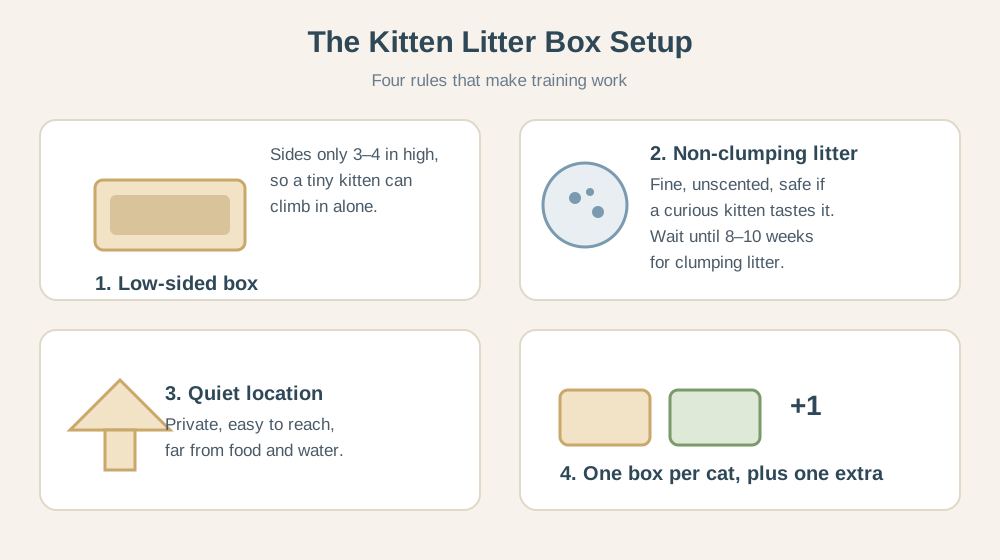
One box per cat, plus one extra, is the rule for life. A single kitten gets one box now; add a second in a different spot when you add a cat. Two boxes side by side count as one location, not two.
How do you litter train a kitten step by step?
Training is a routine, not a lesson. Repeat the same short sequence several times a day until the kitten’s own instinct takes over — usually one to two weeks.
- Show the kitten the box on arrival. Carry them gently to the box and set them inside. Let them sniff and dig for a minute. Do not force their paws to dig — the scratching motion is instinctive, and forcing it teaches fear, not the box.
- Place the kitten in the box after every meal. Kittens usually need to eliminate within 10 to 20 minutes of eating, so set them in the box after meals, after naps, and after play sessions. Timing beats repetition.
- Watch for the signs between trips. A kitten that stops playing, sniffs the floor intently, circles, or squats needs to go. Pick them up gently and carry them to the box — calmly, or a startled kitten will associate the box with the scare.
- Praise the moment it happens. When the kitten eliminates in the box, praise them softly and offer a tiny kitten treat right there — within seconds, while the kitten still connects it to the box.
- Leave a trace of success. After the first success, leave a little used litter in the box when you scoop — the familiar scent marks it as the bathroom.
- Confine the world at first. For the first few days, keep the kitten in one room with the box, food, water, and a bed — the box as far from the food as the room allows. A kitten loose in a whole house will not find the box in time.
- Clean accidents the right way. Clean with an enzymatic pet cleaner, never anything with ammonia, which smells like urine to a cat and draws them back to the same spot. Do not scold or rub the kitten’s nose in it. Punishment teaches a kitten to hide from you when they need to go — the opposite of what you want.
Most kittens click within a week. The Cornell Feline Health Center notes that kittens are naturally attracted to an area where they can scratch, dig, and bury. If your kitten still has an accident or two a day at the end of week one, tighten the routine rather than changing the litter or moving the box.
How long does litter training take?
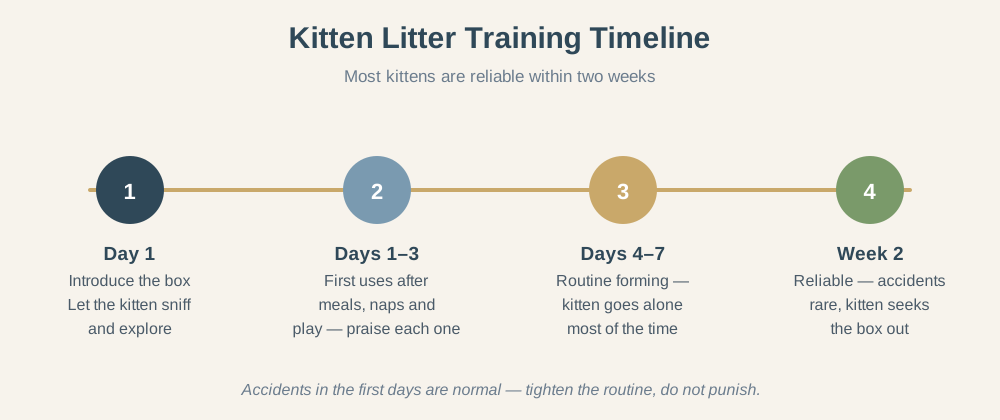
For most kittens, one to two weeks to reliability, with the first three days doing most of the work. A kitten already trained by its mother may need only a day; an orphaned kitten may need the full two weeks.
| Stage | Timing | What success looks like |
|---|---|---|
| Introduction | Day 1 | Kitten sniffs and steps into the box without fear |
| First uses | Days 1–3 | Eliminates in the box after meals, at least sometimes |
| Routine forming | Days 4–7 | Goes to the box on its own most of the time |
| Reliable | Week 2 | Accidents rare; kitten seeks out the box |
Do not move the box during training. A kitten navigates by memory and scent — a box that moved overnight is one the kitten cannot find. If it must move, shift it a few feet a day.
What should you do when accidents happen?
Accidents are part of the process. Clean the spot thoroughly, change nothing about the kitten, and look for a pattern.
Clean with an enzymatic cleaner. Ordinary cleaners mask the smell for humans but leave the scent markers a cat can detect. Enzymatic cleaners break down the urine compounds themselves, removing the signal that tells the kitten “go here again.”
Never punish a kitten for an accident. Scolding or nose-rubbing teaches nothing, because the kitten cannot connect your anger to something that happened minutes ago. What it does teach is that eliminating near you is dangerous — so the kitten starts going behind furniture and under beds.
Look for the pattern, not the incident. Three accidents in the same spot means something: the box is too far away, too dirty, or the kitten likes that spot. Put a second box near the accident spot for a week, then move it a few feet a day toward where you want it.
What if your kitten refuses the litter box?
A kitten that will not use the box at all is usually objecting to one of three things: the box, the litter, or the location. Work through them one at a time, changing one thing and waiting a day before changing another.
| Problem | Likely cause | What to try |
|---|---|---|
| Avoids the box entirely | Sides too high, or box covered | Switch to a low, open tray |
| Steps in, then leaves | Dislikes litter texture or smell | Try fine unscented clay |
| Uses the floor next to the box | Box dirty, or too small | Scoop twice a day; try a bigger box |
| Goes in one room only | Box too far away | Add a second box nearby |
| Used the box, then stopped | Something changed | Undo the last change |
| Goes on soft surfaces | Prefers soft texture | Add a box near the spot |
Try a different litter before you try a different box. Litter preference is the most common cause of refusal, and the cheapest to test: put two small boxes side by side with different litters and see which one the kitten chooses. If your home also has a dog, keep the dog away from the litter box — a dog that raids it will stress a kitten out of its own bathroom. (For the dog side of a multi-pet home, our guide to how often you should bathe a dog covers the grooming routine that keeps shared spaces clean.)
When should you call the vet?
Most litter training problems are setup problems. A few are medical, and those need a vet, not more training. The Cornell Feline Health Center is clear: any medical condition that interferes with normal urination or defecation can cause litter box problems, and a cat that associates the box with pain will avoid it.
Call the vet promptly if you see any of these:
- Straining or crying in the box. A kitten that visits repeatedly, strains, and produces little or nothing may have a urinary blockage — an emergency, especially in male cats.
- Blood in urine or stool. Even a small amount deserves a same-day call.
- Sudden change after reliable use. A kitten trained for weeks that suddenly stops using the box may have a urinary tract infection.
- Diarrhea lasting more than a day, or a kitten that stops eating or drinking alongside litter problems.
Do not wait it out. Urinary blockages can become life-threatening within a day. A vet visit that finds nothing is cheap; a missed blockage is not.
Frequently asked questions
How long does it take to litter train a kitten?
Most kittens are reliable within one to two weeks, though kittens under 6 weeks will still have accidents because their bladder control is not mature yet.
What kind of litter is safest for kittens?
Non-clumping, fine-grained, unscented litter is safest for kittens under 8 to 10 weeks, because clumping litter can block a kitten’s stomach if swallowed.
Why is my kitten not using the litter box?
The most common reasons are a box with sides too high to climb, a litter texture or scent the kitten dislikes, a dirty box, or a location that is too far away or too noisy.
How many litter boxes do I need for one kitten?
One box is enough for a single kitten, but the rule is one box per cat plus one extra.
Should I punish my kitten for accidents outside the litter box?
No — punishment teaches a kitten to hide when it needs to go, so clean the spot with an enzymatic cleaner and look for a pattern.
Sources
- Cornell Feline Health Center, “Feline Behavior Problems: House Soiling” (updated January 2015): vet.cornell.edu/departments-centers-and-institutes/cornell-feline-health-center/health-information/feline-health-topics/feline-behavior-problems-house-soiling
- ASPCA, “Litter Box Problems”: aspca.org/pet-care/cat-care/common-cat-behavior-issues/litter-box-problems
This article is general pet-care information, not veterinary advice. Every kitten is different — talk to your veterinarian if your kitten strains, cries, or shows blood in the litter box, or if litter problems appear suddenly after reliable use.