
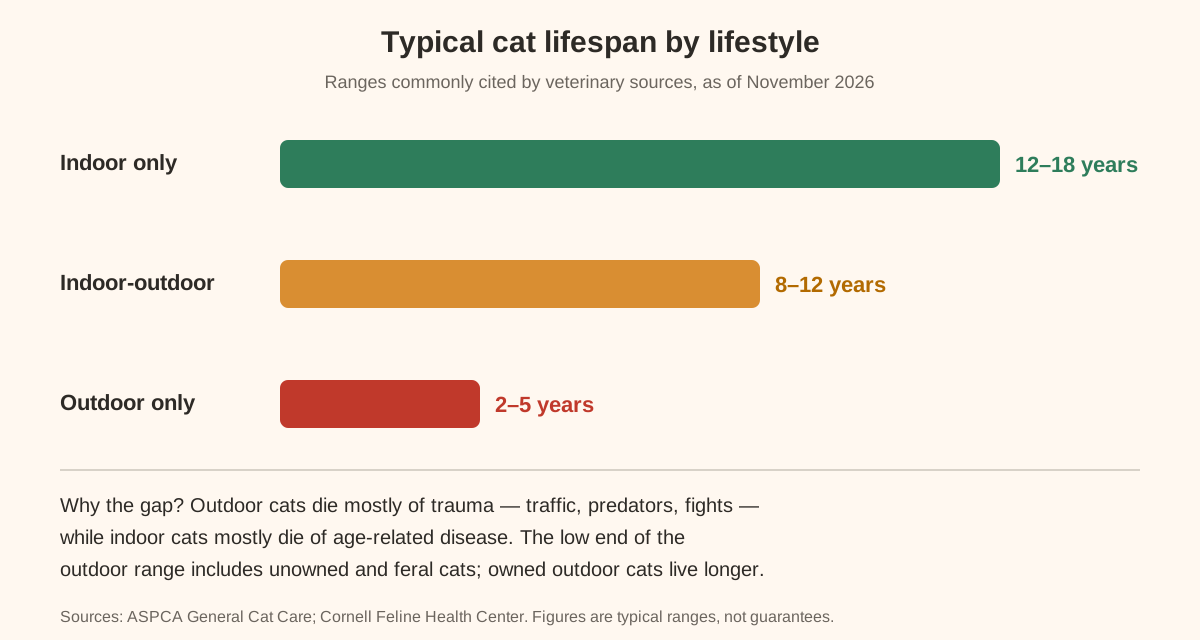
Indoor cats live noticeably longer than outdoor cats, but outdoor cats get more natural exercise and stimulation. Indoor cats typically live 12 to 18 years, while outdoor-only cats are commonly cited at 2 to 5 years. The best choice depends on your home, your neighborhood, and your cat’s personality — and there is a middle ground.
What is the difference between an indoor cat and an outdoor cat?
An indoor cat lives its whole life inside your home, with supervised outings only. An outdoor cat roams freely, coming and going as it pleases. Between them sits the indoor-outdoor cat, which sleeps inside but spends part of each day roaming the neighborhood.
An indoor cat meets almost no traffic, predators, or fights. An outdoor cat meets all of them, plus weather, parasites, and disease. Neither lifestyle is free of trade-offs: indoor cats trade freedom for safety, outdoor cats trade safety for freedom.
Most veterinary organizations recommend keeping cats indoors. The ASPCA advises owners to keep cats indoors, noting that outdoor cats do not live as long as indoor cats and face trauma from cars, fights, predators, fleas, ticks, and disease.
How long do indoor cats live compared to outdoor cats?
Indoor cats typically live 12 to 18 years. The ASPCA cites 13 to 17 years as the typical range, and many well-cared-for indoor cats reach their late teens or early twenties. Outdoor-only cats are commonly cited at 2 to 5 years — a range that mixes owned outdoor cats with unowned and feral cats, so treat the low end as a population average, not a prediction for any single pet.
The gap is large because the causes of death differ. Indoor cats mostly die of age-related disease: kidney disease, cancer, and hyperthyroidism. Outdoor cats mostly die of trauma: cars, dog attacks, falls, and fights.
| Lifestyle | Typical lifespan | Most common causes of death |
|---|---|---|
| Indoor only | 12–18 years | Kidney disease, cancer, hyperthyroidism |
| Indoor-outdoor | 8–12 years | Traffic, fights, disease, plus age-related illness |
| Outdoor only | 2–5 years | Traffic, predators, fights, exposure, disease |
One caveat: the indoor-outdoor row is an estimate, not a measured average.
What are the pros of keeping a cat indoors?
Safety is the biggest advantage, and it is not close. An indoor cat cannot be hit by a car, attacked by a coyote or a loose dog, or poisoned by antifreeze in a neighbor’s driveway. It cannot get lost, stolen, or trapped in someone’s garage.
Disease exposure drops sharply indoors. Outdoor cats pick up feline leukemia virus (FeLV) and feline immunodeficiency virus (FIV) mainly through bites and close contact with infected cats. The Cornell Feline Health Center notes that indoor cats face far less exposure to feline panleukopenia virus, a highly contagious and often fatal disease spread through contact with infected cats and contaminated surfaces.
Indoor cats are also easier to monitor: you notice appetite changes and small injuries the same day they happen, so problems get caught while they are still treatable. Finally, indoor cats protect wildlife — a widely cited study in Nature Communications estimated that free-roaming cats in the United States kill 1.3 to 4.0 billion birds and 6.3 to 22.3 billion small mammals every year.
What are the cons of keeping a cat indoors?
Boredom is the real cost of indoor life. A cat evolved to hunt, climb, and patrol territory, and a flat apartment with one scratching post does not replace that. Bored indoor cats overgroom, overeat, or scratch and spray inappropriately.
Weight gain follows inactivity. The Association for Pet Obesity Prevention’s 2022 survey classified about 59% of cats as overweight or obese, and indoor cats are overrepresented because they move less and eat from a bowl that is always full. Obesity brings diabetes, arthritis, and urinary problems.
Some cats never accept indoor life: an adult adopted after years of roaming may pace, yowl at doors, and try to escape for weeks. An outdoor cat entertains itself; an indoor cat needs you to be its entertainment.
What are the pros of letting a cat go outdoors?
Freedom is the obvious benefit, and cats use it. An outdoor cat climbs trees, stalks insects, patrols territory, and chooses its own schedule. That natural behavior is hard to replicate indoors.
Exercise comes built in: outdoor cats walk, run, climb, and hunt for hours a day, which keeps weight down and joints flexible. Mental stimulation is constant outside too — new smells, sounds, and birds give a cat’s brain work to do, while an indoor cat lives in a static environment that only changes when you change it. Some cats are outdoor cats by temperament: barn cats, former ferals, and confident roamers may never settle indoors.
What are the cons of letting a cat go outdoors?
Traffic is the leading killer of outdoor cats. A cat crossing a road has no sense of car speed, and drivers often cannot see a small animal at dusk, when cats are most active.
Fights are the second major risk. Unneutered males roam farthest and fight most, and bite wounds are how FIV spreads; even a minor bite can turn into an abscess that needs surgery. FeLV spreads through close contact and shared food and water, and according to the Cornell Feline Health Center, cats with progressive FeLV infection have a median survival of about 2.5 years after diagnosis.
Predators and people are real dangers too. Coyotes kill cats in suburbs and rural areas, and cruelty, trapping, and accidental poisoning from antifreeze, pesticides, and rodenticides all happen to roaming cats.
Outdoor cats also cost more in vet bills over time. The American Veterinary Medical Association (AVMA) advises owners to work with their veterinarian on a lifestyle plan, including vaccination and parasite control, for any cat that goes outside. As of November 2026, a single abscess treatment commonly runs $150 to $400 at a US vet clinic, and an emergency visit after a car accident can easily pass $1,000.
Indoor vs outdoor cats at a glance
| Factor | Indoor cat | Outdoor cat |
|---|---|---|
| Typical lifespan | 12–18 years | 2–5 years |
| Traffic risk | None | High — leading cause of outdoor cat deaths |
| Disease exposure | Low | High — FeLV, FIV, panleukopenia, rabies |
| Parasites | Occasional | Frequent — fleas, ticks, worms |
| Weight and fitness | Prone to obesity without play | Naturally active, usually leaner |
| Mental stimulation | Needs owner-provided enrichment | Constant, from the environment |
| Wildlife impact | None | Kills billions of birds and mammals yearly in the US |
| Vet costs | Lower, mostly preventive | Higher, more injuries and infections |
| Escape and loss risk | Low | High — can get lost, stolen, or trapped |
| Owner effort | Daily play and enrichment required | Less daily effort, more worry |
Is there a middle ground between indoor and outdoor?
Yes, and for many owners it is the best answer. A catio — an enclosed patio or window box — is the most popular option, from a screened window enclosure to a full backyard run. Your cat gets fresh air, sun, and bird-watching while staying protected from cars, predators, and other cats.
Leash training is the second option: many cats, especially kittens, learn to walk on a harness in a few weeks, giving supervised outdoor time with full control. Supervised yard time is the third: a fenced yard with cat-proof fencing, or a few minutes outside with you present. These compromises capture much of what cats value outdoors while removing the biggest dangers.
How do I keep an indoor cat happy?
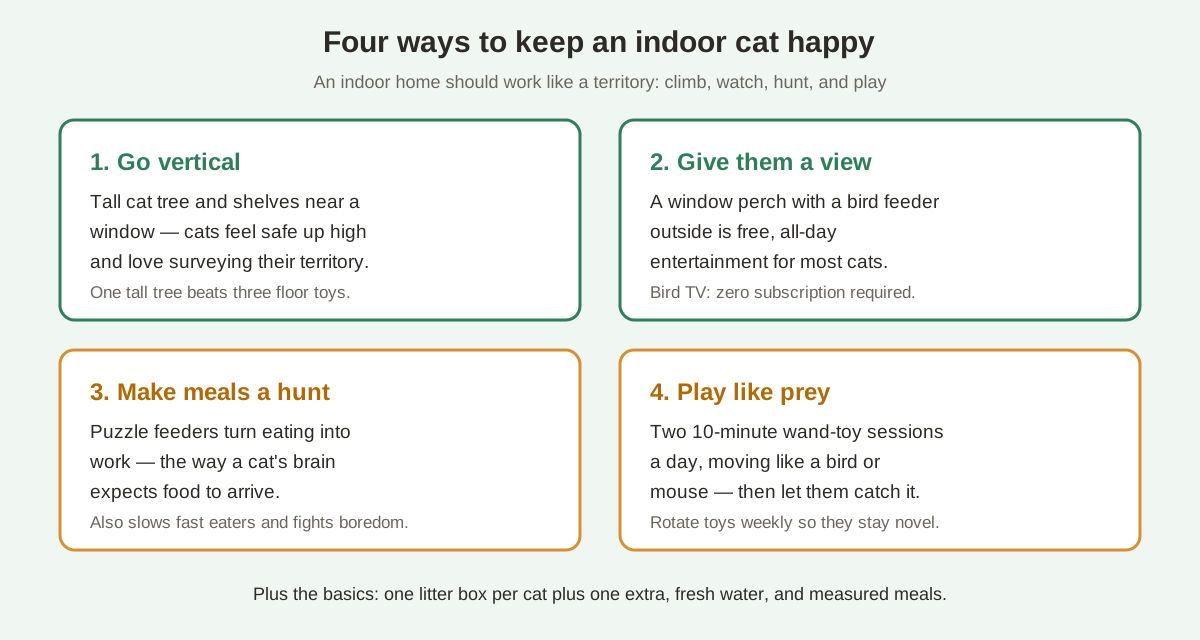
An indoor cat is happy when its home works like a territory: vertical space, hiding places, hunting games, and a view of the world. Start with height — cats feel safe up high, so a tall cat tree near a window does more for happiness than any toy. Add a window perch, and put a bird feeder outside for free, all-day entertainment.
Play like prey: two ten-minute sessions a day with a wand toy that moves like a bird or a mouse. Rotate toys so they stay novel, and use puzzle feeders to make meals a hunt rather than a handout. Our guide to why cats knead explains the comfort behaviors of a content cat at home.
Feed for an indoor lifestyle: indoor cats move less, so they need fewer calories — ask your vet about an indoor-formula food and measured meals. Our comparison of wet food vs dry food for cats covers the hydration trade-offs that matter most for indoor cats. Keep water fresh — many cats drink more from a fountain, and our guide to how to clean a cat water fountain shows how to keep one hygienic. Finally, keep the litter box clean and predictable: one box per cat, plus one extra, scooped daily. Our guide to how to litter train a kitten covers box placement and litter choice.
How do I transition an outdoor cat to indoors?
Transition slowly, over two to four weeks, and expect protest. Start by bringing the cat inside for a few hours a day, with food, water, a litter box, and a comfortable hiding spot ready. Increase indoor time gradually, and make the indoors rewarding: play sessions, treats, and a sunny window spot.
Watch for stress signs: hiding for days, refusing food, overgrooming, or spraying. Some stress in the first week is normal, but stress lasting beyond two weeks — or a cat that stops eating entirely — needs a vet visit. Enrichment is not optional during a transition — a cat that loses the whole outdoors at once needs the indoors to be interesting on day one. A cat still miserable after a month of good enrichment may be a candidate for a catio or leash walks instead of strict indoor life.
Which lifestyle is right for my cat?
Ask four questions, in this order. First, where do you live? A busy road or coyotes push hard toward indoor; a quiet rural property with no nearby roads makes outdoor life far safer. Location is the single biggest factor.
Second, what is your cat’s age and health? Kittens, seniors, and cats with chronic illness should stay indoors, and a cat with FIV or FeLV should never roam. Third, what is your cat’s temperament? A nervous cat that hides from visitors will be happier indoors, while a bold, restless cat that paces at the door may need outdoor access or a catio.
Fourth, how much time can you give? An indoor cat needs daily play and enrichment from you. If you are away twelve hours a day, a safe outdoor option like a catio matters even more. For most owners in most places, the answer is indoor with enrichment, or indoor with a catio or leash walks.
Frequently asked questions
Is it cruel to keep a cat indoors?
No, it is not cruel when the cat gets enrichment, play, and vertical space. Most indoor cats adapt well — but a bored indoor cat with no stimulation is a welfare problem, so enrichment is part of the deal, not an extra.
Do indoor cats live longer than outdoor cats?
Yes, by a wide margin. Indoor cats typically live 12 to 18 years, while outdoor-only cats are commonly cited at 2 to 5 years — a range that includes unowned and feral cats. Owned outdoor cats live longer than the low end, but still far short of indoor cats.
Can an indoor cat go outside on a leash?
Yes, many cats learn to walk on a harness and leash, especially if training starts young. Use a properly fitted cat harness, not a collar, start indoors, and keep sessions short. Some cats never accept a leash — a catio or window perch is an alternative.
Should I let my cat out at night?
No. Night is the most dangerous time for an outdoor cat: traffic is harder to see, coyotes and owls are active, and fights peak after dark. If your cat goes outside at all, bring it in before dusk.
The bottom line
Indoor cats live longer and safer lives; outdoor cats live freer and more stimulating ones. The evidence points toward indoor living for most cats in most places — the ASPCA and most veterinary groups recommend it, and the lifespan gap is too large to ignore. But indoor living only works if you do the work: play daily, provide vertical space, and keep the litter box clean.
If your cat is miserable indoors despite good enrichment, do not give up on safety — add a catio, try leash training, or give supervised yard time. The best lifestyle is rarely all indoors or all outdoors; it is the one that keeps your cat safe and lets it be a cat. This article was reviewed against current guidance from the ASPCA, the Cornell Feline Health Center, and the AVMA as of November 2026.