
Socializing a shy rescue dog means letting the dog choose the pace: a quiet safe space, a predictable routine, and small, rewarded exposures to new people, sounds, and places over about four weeks. Never force greetings or flood the dog with strangers. Most shy rescue dogs grow noticeably braver within three months.
The dog that seemed sweet at the shelter may hide under the bed, refuse food, or freeze on the leash during its first week home. That is normal. About 3.3 million dogs enter US shelters and rescue groups each year, according to ASPCA estimates, and many arrive stressed or unsure of people. Shyness is usually a confidence problem — and confidence can be built, one small win at a time.
What is the 3-3-3 rule for rescue dogs?
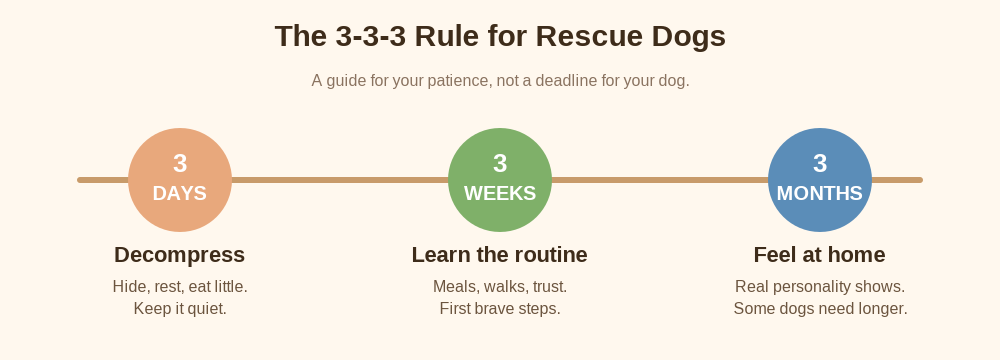
The 3-3-3 rule is a timeline rescue groups use to set expectations: three days to decompress, three weeks to learn your routine, three months to feel at home.
In the first three days, your dog is overwhelmed. Expect hiding, little appetite, and no interest in play. The kindest thing you can do is almost nothing: feed quietly, keep visitors away, and let the dog watch the house from its safe spot.
By three weeks, most dogs know the shape of your days — meals, walks, who lives here. Appetite returns, and the dog starts testing small brave choices, like sniffing a new room.
By three months, the dog usually knows it is home, and the real personality shows up. Deeply fearful dogs may need six months or more. The 3-3-3 rule guides your patience; it is not a deadline for your dog.
How can you tell if a shy dog is stressed or relaxed?
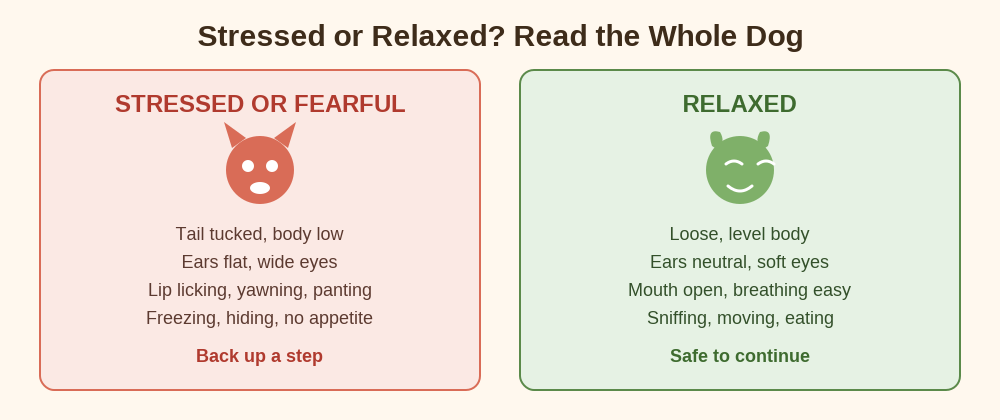
Reading body language is the most important skill in this plan. The ASPCA’s guide to adopting a fearful dog lists the signals trainers watch for: tucked tail, lowered body, flattened ears, and avoidance mean fear; a loose body and soft eyes mean safety.
| Signal | Stressed or fearful dog | Relaxed dog |
|---|---|---|
| Body posture | Crouched low, looking small | Loose, level body |
| Tail | Tucked tightly between the legs | Neutral height, loose wag or still |
| Ears | Flattened back against the head | Neutral or slightly forward |
| Eyes | Wide, whites visible (“whale eye”) | Soft, squinty, blinking |
| Mouth | Lip licking, yawning, panting | Slightly open, tongue relaxed |
| Movement | Freezing, hiding, retreating, pacing | Moving freely, sniffing, approaching |
| Appetite | Refuses even favorite treats | Takes treats gently, eats normally |
One signal alone is rarely the whole story — a yawn might just be a yawn. But three together, such as a tucked tail, lip licking, and refusal to eat, mean your dog is over its limit: back up to the last step that felt easy. Appetite is the most reliable stress signal. A dog that will not take a treat it normally loves is too stressed to learn.
What should you set up before your rescue dog comes home?
Pick one quiet corner as the dog’s safe zone, with a crate or bed, a water bowl, and a worn T-shirt that smells like you. Leave the crate door open — a crate is a den, not a cage, and the dog should never be locked in as punishment. If you are still deciding on a crate, our guide to the best dog crate for anxious dogs explains what to look for in size, material, and placement.
Keep the house calm for the first few days: no welcome party, no neighbors popping in, no loud music. A baby gate lets the dog watch the household from a safe distance. Stock up on small, soft, high-value treats — pea-sized pieces of boiled chicken, cheese, or hot dog. The ASPCA recommends real food over dry biscuits for fearful dogs, because the smell carries further and the value is higher.
Buy a well-fitting harness and a six-foot leash — skip retractable leashes, since a shy dog that bolts needs a leash you can hold firmly. Agree on house rules first: nobody chases, corners, or forces affection on the dog.
Week 1: How do you help a shy rescue dog decompress at home?
Week 1 has one job: let the dog learn that your home is safe. No training sessions, no visitors, no pet-store trips.
Let the dog stay in its safe zone. Sit nearby on the floor, sideways to the dog. Do not stare, reach out, or coax. The ASPCA advises exactly this: when meeting a fearful dog, the best way to approach is not to approach at all. Let the dog choose to come to you, and reward every brave step with a treat tossed gently underhand toward its feet — never overhand, which can feel threatening.
Keep a strict routine from day one: same feeding times, same walk times, quiet evenings. Predictability turns a scary new place into a known place, and the ASPCA’s tips for a new dog stress the same point: dogs, especially shy ones, learn to trust people they can predict.
Take the dog out only for short toilet breaks near the door, on leash, and come straight back in. Some shy dogs eat only when you leave the room. That is fine — leave food down for 20 minutes, then try again at the next meal.
Week 2: How do you build trust and a routine?
In Week 2, you become predictable and rewarding.
Start with two or three short “treat and retreat” sessions a day, five minutes each. Sit on the floor, toss a treat a few feet away, and wait. When the dog eats it, toss the next one slightly closer. Never lure the dog all the way to you — the dog must choose each step. If the dog stops coming closer, that is its comfort line for today. Respect it.
Teach the dog its name first: say it, and the instant the dog glances at you, say “yes” and give a treat. Then teach “touch” — reward the dog for bumping its nose against your open palm. “Touch” gives a shy dog a job to do when it meets something new.
Start a real walking routine now, but keep it boring: the same quiet route, the same time of day, 15 to 20 minutes. Let the dog sniff as much as it wants — sniffing is how dogs gather information, and a sniffing walk tires a dog out more than a fast march. If the dog freezes, stop and wait — never drag a frightened dog forward.
Week 3: How do you introduce new sights, sounds, and people?
Week 3 is where socialization actually starts — carefully, at a distance, and always with an escape route. For every new thing: distance first, duration second, closeness last.
Start with sounds at home. Play recordings of traffic, doorbells, and thunder at a very low volume while the dog eats or chews a stuffed Kong, and raise the volume a little each day — the same gradual approach in our guide on how to stop dog barking at the doorbell. If the dog stops eating or leaves the room, the volume was too high — turn it down and try again tomorrow.
Then add sights: sit with your dog in the car or on a quiet bench at the edge of a park and let it watch people and other dogs from a distance where it can still eat treats. The AKC recommends exactly this: train near people at a distance where the dog feels safe, and pair strangers with high-value treats. This is desensitization and counterconditioning, and it works because the dog learns that strangers predict chicken, not danger.
Introduce one calm person this week, on the dog’s terms: ask your visitor to ignore the dog completely — no eye contact, no reaching out — sit down, toss treats to the side, and wait. The ASPCA’s fearful-dog guide is blunt about this: everything humans do naturally when greeting each other — holding eye contact, leaning forward, reaching out — is threatening in dog language. Let the dog sniff the visitor in its own time. If the dog approaches and then walks away, that is a win, not a failure.
If you have another dog at home, introduce them with a parallel walk on neutral ground, not a face-to-face meeting indoors — our guide on how to introduce a puppy to an older dog covers the same gradual method.
Week 4: How do you plan short outings and first visitors?
Week 4 takes the show on the road, in short, boring doses. The goal is not adventure; it is proof that the world outside is survivable.
Pick one quiet outing: a slow walk around a calm block, a visit to a friend’s fenced yard, or a drive to a pet store parking lot where the dog can watch from the car. Keep it to 15 to 20 minutes and end while the dog is still coping well — always leave on a good note. Bring treats, water, and a blanket the dog can sit on; familiar smells are calming.
Invite a second visitor for a slightly longer stay. Have them arrive calmly, ignore the dog, and sit down with a book, with a few treats near their chair so the dog earns rewards just for being in the same room. Over several visits, most shy dogs progress from hiding, to watching, to sniffing, to leaning.
What should you never do when socializing a shy rescue dog?
One bad experience can undo weeks of progress.
Never flood the dog. Flooding means throwing the dog into a scary situation and hoping it “gets used to it” — the crowded dog park on day three, the family reunion with twelve strangers. A flooded dog learns it cannot escape, and its fear gets worse.
Never force greetings. Do not push the dog toward a stranger, do not hold it while someone pets it, and do not let visitors chase it for a cuddle. A dog that cannot walk away will eventually growl, snap, or bite.
Never punish fear. Growling is communication, not disobedience. The AKC is clear on this point: punishing a fearful dog teaches it to stop warning you, which makes a bite more likely, not less. If your dog growls, calmly increase the distance.
Never take a shy dog to the dog park too early. Dog parks are loud, chaotic, and full of off-leash dogs with unknown manners. Wait until your dog is relaxed around calm dogs on leash, often several months in. If you need daytime care later, read our guide on how to choose a doggy day care first, and ask how they handle shy dogs.
Never rush the timeline. The 3-3-3 rule is a minimum, not a promise. A dog that was under-socialized for years will not be “fixed” in four weeks, and that is fine. Slow progress that sticks beats fast progress that falls apart.
When does fear become a vet or behaviorist matter?
Some shy dogs need more than patience. Call your veterinarian if your dog refuses food for more than 48 hours, has diarrhea or vomiting that lasts more than a day, or shows signs of pain — pain makes any dog more fearful. Your vet can also check whether anxiety medication would help.
Seek a certified professional — a Certified Applied Animal Behaviorist (CAAB) or veterinary behaviorist (DACVB) — if your dog has bitten someone, freezes and cannot be moved, or shows aggression that is getting worse. The ASPCA recommends working with a certified behavior professional for dogs with severe fear. Severe fear is common in rescue dogs, and it is treatable.
Frequently asked questions
How long does it take to socialize a shy rescue dog?
Most improve clearly within 3 to 4 weeks and feel at home within about 3 months. Deeply fearful dogs may need 6 months or longer.
Should I take my shy rescue dog to the dog park?
No, not in the first few months. Start with quiet walks and one calm dog at a time instead.
Why does my rescue dog hide from me?
Hiding is a normal stress response in the first days. It usually fades as the dog learns your routine — give it space, stay predictable, and let it come to you.
Is it okay to comfort a scared dog, or does that reward the fear?
Yes, it is okay to comfort a scared dog. Calm, quiet comfort does not reward fear — fear is an emotion, not a behavior. Speak softly and let the dog move closer to you if it wants to.
Socializing a shy rescue dog is not about turning a timid dog into a social butterfly. It is about giving a dog that had a rough start enough confidence to enjoy its life: to walk without panic, greet a friend without hiding, and trust the people in its home. Four weeks of calm, patient work will not finish the job — but as of November 2026, trainers and rescue groups agree it is the right start.
Sources: ASPCA (Adopting a Fearful Dog; Tips for a New Dog; Fear of the Outdoors); American Kennel Club (Fear of Strangers).