
Quick answer: Male vs female cat temperament differs less than most people expect. The real differences are hormone-driven: unneutered males roam, fight, and spray more, while unspayed females call loudly and try to escape during heat. Once cats are spayed or neutered, those gaps shrink fast, and breed, early socialisation, and individual personality matter far more than sex.
This guide is for anyone choosing between a boy and a girl cat, or wondering why their cat acts the way it does. We compared guidance from the Cornell Feline Health Center and the Merck Veterinary Manual, so every claim below traces back to a source we opened and read.
Photo: Orange Tabby Cat sitting on a couch by LauraDelga, CC BY 4.0, via Wikimedia Commons.
Are male cats really more affectionate than females?
Male cats have a reputation for being the cuddly ones, and there is a grain of truth in it. Neutered males often seek out people, greet visitors at the door, and settle on laps.
Female cats tend to be more selective. They often bond deeply with one or two people and take longer to warm up to strangers. That does not make them cold. A female cat that trusts you may be just as affectionate as any male, on her own terms. She may show it with slow blinks and head bumps instead. Our guide to why cats knead explains one of the ways cats of both sexes show contentment.
The honest answer is that affection varies more between individual cats than between the sexes. If you want a cuddly cat, meet the individual cat first. Sit with it, see whether it approaches you, and ask the shelter how it behaves with strangers. That tells you far more than its sex does.
How do male and female cats differ day to day?
Most real differences come from reproductive hormones, so they show up most in unspayed and unneutered cats.
Territory and spraying. Unneutered males spray urine to mark territory, inside and outside the home. The smell is strong, and the habit can be hard to break once it starts. Females spray far less, though an unspayed female in heat may spray too. If your cat starts urinating outside the box, first rule out a litter problem with our guide on why your cat is peeing outside the litter box.
Roaming. Intact males wander furthest from home looking for mates, sometimes for days, which raises the risk of fights, injuries, and getting lost. Females stay closer to home, except in heat, when they may try hard to escape. Keeping cats indoors removes most of this risk either way, as our guide to indoor vs outdoor cats explains.
Playfulness. Neutered males often stay playful into adulthood and enjoy wand toys and fetch. Females play too, but often in shorter bursts and may lose interest sooner.
Getting along with other cats. Females can be more territorial about their core space, especially with another female. Indoors, neutered males often accept a second cat more easily. In a multi-cat home, resources matter more than sex: enough litter boxes, food bowls, and resting spots prevent most conflicts. Our guide on how many litter boxes you need per cat covers the rule that keeps the peace.
How should you choose between a male and a female cat?
Follow these steps at the shelter or breeder instead of deciding by sex alone.
- Meet several cats. Spend at least 15 minutes with each one. Note which cats approach you and which stay relaxed when handled.
- Ask about the cat’s history. A kitten handled gently by many people in its first weeks usually grows into a confident adult, male or female.
- Match energy to your home. A busy household with children and visitors often suits a confident, social cat. A quiet home suits a cat that prefers one person.
- Check the spay or neuter status. Ask whether the cat is already fixed, and if not, when the surgery is planned. Behaviour changes a lot after the procedure.
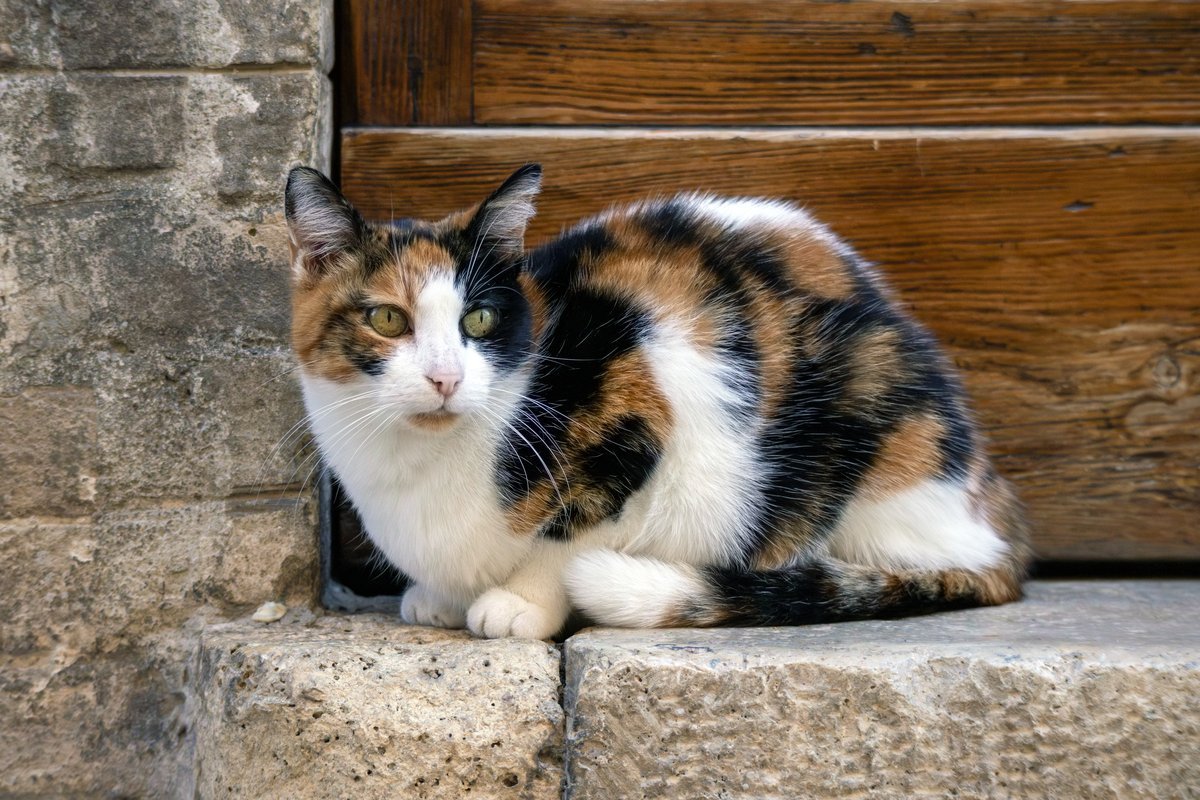
Photo: Calico cat, – Assisi, Italy by Terragio67, CC BY-SA 4.0, via Wikimedia Commons.
What does coat colour tell you about a cat’s sex?
Coat colour is one of the few places where sex is written on the outside of the cat. Calico and tortoiseshell cats are almost always female, because the gene for orange fur sits on the X chromosome. A female has two X chromosomes, so she can carry one orange and one black version. A male has only one X chromosome, so he can carry one or the other, but not both.
The Merck Veterinary Manual explains that a male calico is very rare: he is born with two X chromosomes and one Y chromosome, and the extra X usually leaves him sterile. Britannica puts the figure at about 1 in every 3,000 calico cats. The same genetics explain why most orange tabbies are male: a female needs the orange gene on both X chromosomes to be fully orange, while a male needs it on just one.
None of this says anything about personality. The old idea that calico cats are feisty or that orange tabbies are friendly is folklore, not science.
How does spaying or neutering change a cat’s behaviour?
Spaying or neutering changes the hormone-driven behaviours, and leaves the rest of the cat alone. That is the single most useful fact in this whole comparison.
For males, neutering removes the testosterone that drives roaming, fighting, and spraying. Cornell states that neutering eliminates the hormones that cause an uncastrated male to roam, be aggressive to other cats, and spray urine for marking territory. Cornell also notes that within about two weeks of the operation, a neutered cat is likely to be exactly the same cat as before. The surgery does not rewrite personality; it removes the urges that made him restless.
For females, spaying ends heat cycles. An unspayed female in heat yowls loudly, rolls on the floor, and tries to escape the house. Spaying removes that cycle entirely, and Cornell recommends spaying a female kitten at three to six months old, before her first heat.
Expect a slower metabolism in both sexes after surgery. Neutered and spayed cats gain weight more easily, so measure food rather than free-feeding and keep up daily play.
What not to do when choosing a cat by sex
- Do not pick a male expecting a lap cat. Plenty of males are aloof, and plenty of females are lap cats. Meet the cat first.
- Do not pick a female expecting a quieter cat. An unspayed female in heat is one of the loudest cats you will ever meet.
- Do not skip spaying or neutering to preserve personality. The surgery removes hormone-driven behaviours, not the traits that make your cat yours.
- Do not assume two females will get along. Female cats can be the most territorial about their space, so introduce any new cat slowly.
- Do not judge a cat by its coat colour. Calico and orange patterns tell you about genetics, not temperament.
- Do not adopt on looks alone. A cat that hides from you at the shelter may need weeks to settle, male or female. Ask staff how the cat behaves once it feels safe.
Male vs female cats at a glance
| Trait | Male cats | Female cats |
|---|---|---|
| Affection | Often seek people out and greet visitors | Often bond deeply with one or two people |
| Territory and spraying | Unneutered males spray and mark often | Spray far less; unspayed females in heat may spray |
| Roaming | Intact males roam furthest looking for mates | Stay closer to home, except when in heat |
| Playfulness | Often stay playful into adulthood | Play in shorter bursts |
| With other cats | Neutered males often accept a second cat | Can be territorial, especially with another female |
| Effect of fixing | Neutering removes roaming, fighting, and spraying urges | Spaying ends heat cycles and the yowling that comes with them |
| Coat colour clue | Most orange tabbies are male | Almost all calico and tortoiseshell cats are female |
FAQ
Are male cats more affectionate than female cats?
On average, neutered males seek people out more readily, while females bond with one or two people. The gap is small and individual cats vary far more, so meet the cat first.
Do male cats spray more than female cats?
Yes, unneutered males spray far more, because testosterone drives territory marking. Neutering removes most of that urge. Females spray much less often, though unspayed females in heat and stressed cats of either sex can spray too.
Are calico cats always female?
Almost always. The calico pattern needs two X chromosomes, one carrying orange and one carrying black, so about 1 in 3,000 calico cats is male. Those rare males usually carry an extra X chromosome and are sterile, according to Britannica and the Merck Veterinary Manual.
Should I get a male or female cat if I already have a cat?
Either can work if both cats are spayed or neutered and introductions go slowly. A neutered male often accepts a new cat more easily, while two females can be more territorial with each other. Give each cat its own food, water, litter box, and resting spot, and let them meet over days, not hours.