
Photo: Calico kitten on the litter box by MiNe, CC BY 2.0, via Wikimedia Commons.
Quick answer: PrettyLitter cat litter is a silica-crystal litter that changes color when your cat urinates, giving you an early hint of possible urinary problems. A subscription for one cat costs about $24 a month for the original formula and $29.99 a month for the clumping formula, as of November 2026. It controls odor well and needs little scooping, but it is not a medical test, and a color change alone never replaces a vet visit.
This review is for cat owners who keep seeing PrettyLitter ads and wonder whether the color-changing crystals are a real tool or a gimmick. We compared the company’s published specs and pricing, independent reviews, and owner feedback to answer that question. We did not run hands-on lab tests, so the notes below reflect published information and what owners consistently report, not measurements from our own testing.
This post contains affiliate links. If you buy through them, we may earn a commission at no extra cost to you.
As an Amazon Associate I earn from qualifying purchases.
What is PrettyLitter cat litter?
PrettyLitter is a subscription cat litter made from silica gel crystals. The founder started the company after losing a cat to a sudden illness, and developed the litter with veterinarians and scientists. The idea is simple: the crystals change color based on the pH of your cat’s urine, so a glance at the litter box can flag a change worth checking with a vet.
The original formula is non-clumping. PrettyLitter now also sells a clumping formula and a lightly scented lotus version, both at the same subscription model. You buy it mainly through a subscription on the company’s website, with bags delivered monthly. It is also stocked at some Walmart, Target, Costco, PetSmart, and Petco stores, though availability and pricing vary by retailer.
How does PrettyLitter work?
The crystals are made of silica gel, a highly porous mineral that absorbs moisture and traps urine odor inside the crystals as the water evaporates. Because the litter is non-clumping, there are no wet clumps to scoop out. You scoop out solid waste daily, stir the crystals so urine spreads evenly, and replace the whole box about once a month. One bag is designed to last one cat for about a month when you follow that routine.
Two practical benefits stand out. First, the litter is virtually dust-free, which Vetstreet’s review notes makes it a better fit for cats with asthma or other breathing problems than dusty clay litter. Second, it is light: the company says it is up to 80% lighter than most litters, so a monthly bag is easy to carry upstairs. The trade-off is that the light crystals track easily. One reviewer found crystals up to three feet outside the litter box, and a litter mat helps.
One honest limit: PrettyLitter controls urine odor well, but it does not remove the smell of poop. The smell stays until you scoop, which is actually a useful reminder to scoop daily.
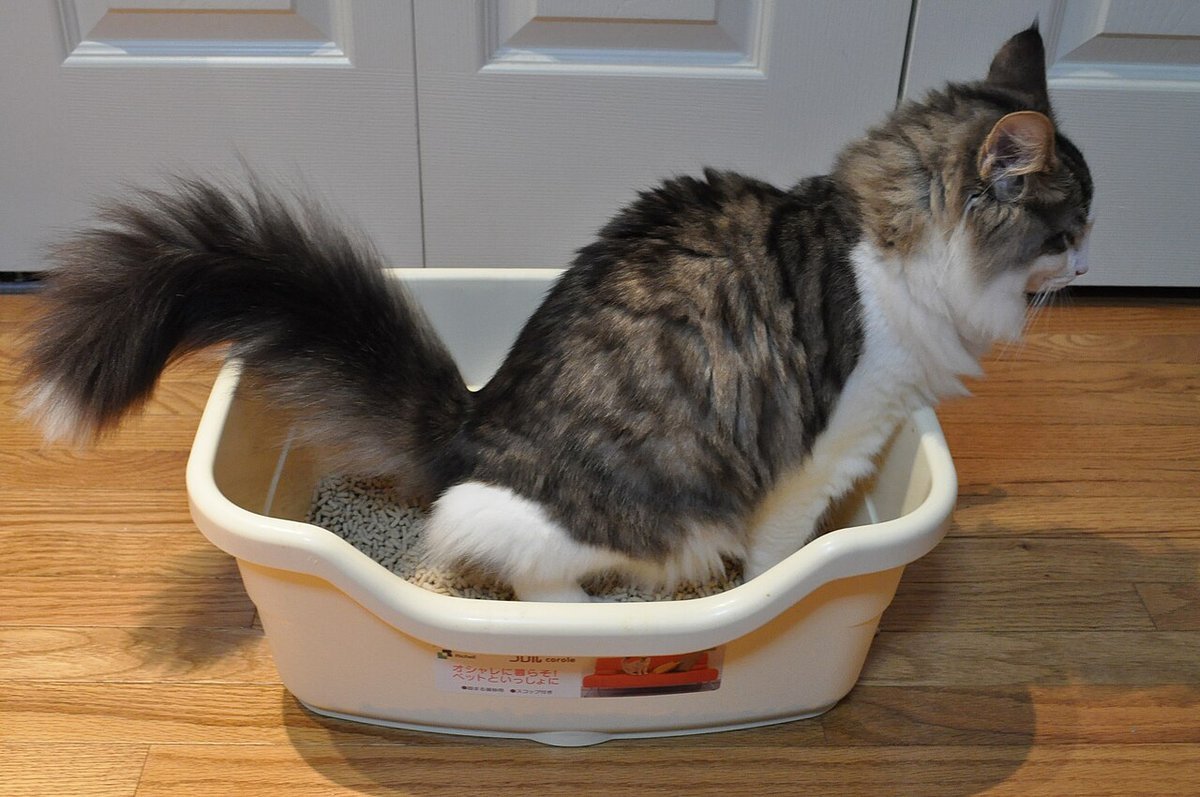
Photo: Japanese litter box in use by Ocdp, CC BY-SA 3.0, via Wikimedia Commons.
What do the PrettyLitter colors mean?
The crystals are infused with a formula that reacts to urine pH and the possible presence of blood. Dark yellow to olive green is the normal range. Any other color is a prompt to watch your cat and call your vet if it persists, not a diagnosis on its own.
| Color | What it may mean | What to do |
|---|---|---|
| Dark yellow to olive green | Urine pH in the typical range | Nothing — this is normal |
| Blue | Alkaline urine, possibly linked to a urinary tract infection or struvite stone risk | Watch for a day; call your vet if the blue color persists |
| Orange | Acidic urine, possibly linked to metabolic acidosis, kidney tubular acidosis, or calcium oxalate crystals | Call your vet if the orange color persists |
| Red | Blood in the urine, possibly linked to bladder inflammation, bladder or kidney stones, or kidney disease | Call your vet promptly |
Two warnings matter here. First, owners have reported both false positives and false negatives, so a normal color does not guarantee a healthy cat, and an odd color does not guarantee a sick one. Second, in a multi-cat home the litter cannot tell you which cat produced a color change, so you may need to watch the box to work out who used it. If your cat stops using the box altogether, read our guide on why your cat is peeing outside the litter box — that change alone deserves a vet visit.
How much does PrettyLitter cost?
PrettyLitter sells by subscription, priced by the number of cats in your home. Prices below come from PrettyLitter’s own 2026 pricing page, as of November 2026.
| Household | Original (non-clumping) | Clumping formula |
|---|---|---|
| 1 cat | About $24 per month | About $29.99 per month |
| 2 cats | 2 bags per month | 2 bags per month |
| 1 cat, per year | About $288 | About $360 |
A one-cat household uses about one bag a month, and multi-cat homes need roughly one bag per cat per month. Traditional clay litter usually costs less upfront, so PrettyLitter is a premium price for the health-monitoring feature, the odor control, and the delivery. Introductory offers for new subscribers change through the year, so check the official site before your first order. You can pause, skip, or cancel the subscription from your account before the next shipment. The original formula is also sold on Amazon: a single 6 lb bag is $27.99 (list price $33.98), and the 2-pack is $48.98, about $24.49 a bag, as of November 24, 2026: Check the price of PrettyLitter Health Monitoring Cat Litter (2-Pack) on Amazon.
Who should try PrettyLitter — and who should skip it?
PrettyLitter fits best if your cat is older or has a history of urinary problems, since an early color change can prompt a vet visit before other symptoms show. It also suits homes where dust is a problem, people who struggle with heavy litter bags, and owners who like automatic delivery. If you already follow the one-box-per-cat-plus-one rule, adding a health-monitoring litter is a small extra step, not a new routine.
Skip it if your budget is tight and you only want the cheapest litter that works. Multi-cat homes should also think twice, because attributing a color change to one cat takes extra watching. And if your cat is fussy about litter texture, give them a transition period with both the old and new litter available rather than swapping overnight — a cat that refuses the box is worse than a cat on plain clay. For other low-dust options, see our roundup of the best non-tracking cat litter.
What not to do with PrettyLitter
- Do not treat a color change as a diagnosis. Only a vet, with an exam and tests, can say what is wrong.
- Do not switch cold turkey. Offer the new litter beside the old box for a few days and let your cat choose.
- Do not overfill the box. Filling above the recommended depth makes the litter work less well and wastes money.
- Do not flush used litter unless your local rules allow it. Check the bag and your local guidance first.
- Do not expect it to hide poop odor. Scoop solids daily; the smell is your reminder. If your cat starts avoiding the box, see why cats poop outside the litter box.
When to call your vet
Call your vet if a blue, orange, or red color lasts more than a day, or if your cat strains to pee, cries in the box, passes blood, pees outside the box, or seems lethargic. The Cornell Feline Health Center notes that urinary tract inflammation can make urination painful and more frequent, and a cat may start avoiding the box because it links the box with pain. A male cat that strains but passes little or no urine is an emergency — go to a vet or emergency clinic now, do not wait until morning.
FAQ
Is PrettyLitter safe for cats?
Yes, for most cats. PrettyLitter is made of silica gel, a non-toxic mineral, and it is virtually dust-free, which helps cats with asthma or breathing problems. If your cat eats litter, or if you have a very young kitten, ask your own vet before switching.
How often do you change PrettyLitter?
About once a month for one cat on one bag. Scoop out solid waste daily and stir the crystals regularly so urine spreads and dries evenly. At the end of the month, throw the whole bag out and start fresh.
Does PrettyLitter really detect health problems?
No, not in the medical sense. It flags possible changes in urine pH or the presence of blood, which may deserve a vet visit sooner. False positives and false negatives both happen, so treat any color change as a prompt to watch your cat and call your vet, not as a diagnosis.
Can you use PrettyLitter with more than one cat?
Yes. Plan on about one bag per cat per month, and keep enough boxes for the household. The hard part is attribution: with several cats sharing a box, you cannot tell from the color alone which cat needs attention, so watch who uses the box when a color changes.
We are not veterinarians. This article is general information; talk to your vet about your own pet.