
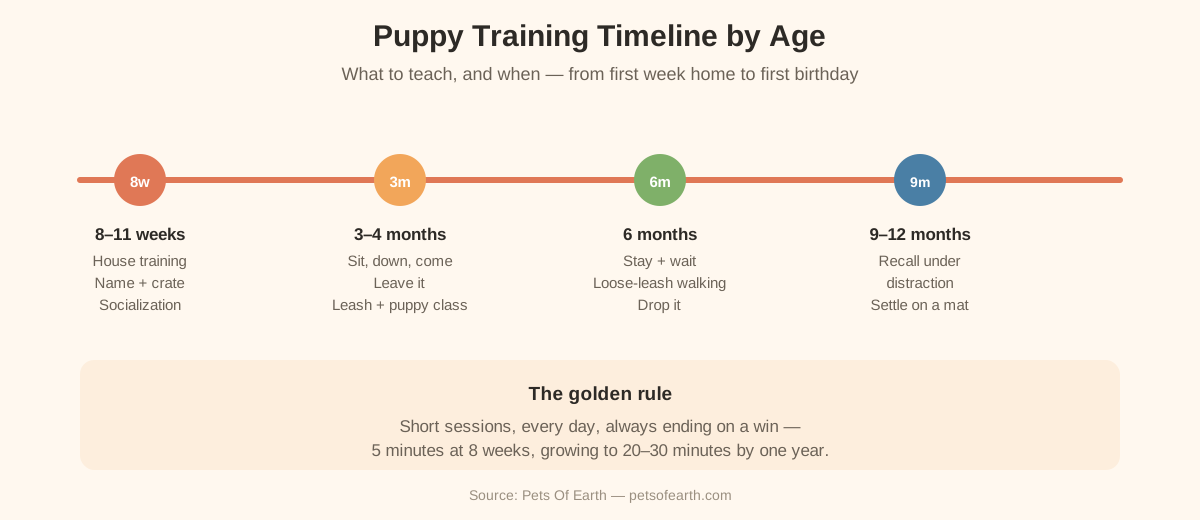
A puppy training schedule by age starts at 8 weeks with house training, name recognition, and gentle socialization, adds basic cues and leash skills at 3 to 4 months, builds impulse control at 6 months, and polishes reliability at 9 to 12 months. Keep sessions to 5 minutes at 8 weeks and 20 to 30 minutes by one year.
Photo: Pexels.
What is a puppy training schedule by age?
A puppy training schedule by age matches what you teach to what your puppy’s brain can handle. The first four months are rapid, almost sponge-like learning, the middle months bring a stubborn adolescent phase, and the first birthday brings a dog that can hold a skill under distraction. Train the skill the age demands.
| Age | Main focus | Key skills | Session length |
|---|---|---|---|
| 8–11 weeks | Settling in, house training, socialization | Name, potty routine, crate comfort, gentle handling | 3–5 minutes, several times a day |
| 12 weeks (3 months) | First cues and manners | Sit, down, come, leave it, first leash walks | 5–10 minutes, 3–4 times a day |
| 3–4 months | Socialization peak and routine | Polite greetings, handling, car rides, alone time | 5–10 minutes, 3–4 times a day |
| 5–6 months | Impulse control and leash skills | Stay, wait, loose-leash walking, drop it | 10–15 minutes, 2–3 times a day |
| 7–9 months | Adolescent reliability | Recall under distraction, settle, polite leash manners | 15–20 minutes, 2 times a day |
| 9–12 months | Real-world proofing | Off-leash recall in safe areas, café manners, advanced cues | 20–30 minutes, 1–2 times a day |
Every age below assumes positive reinforcement — treats, praise, and play. Harsh corrections slow a schedule down by teaching a puppy to fear training itself.
What should you teach a puppy at 8 weeks?
Eight weeks is when most puppies come home, and the first week is about safety and routine, not obedience. Most veterinarians and breeders put the ideal age to bring a puppy home at 8 to 10 weeks, and the American Kennel Club notes that the socialization period typically runs from 6 to 12-to-14 weeks of age.
Start house training on day one: take the puppy out first thing in the morning, after every meal, nap, and play session, and every one to two hours in between. Puppies this young can only hold their bladder for about one hour per month of age, so an 8-week-old puppy needs a break roughly every two hours. For the numbers behind that rule, see our guide on how long a dog can hold its bladder.
Teach the name first: say it once in a happy tone, and the instant the puppy looks at you, mark it with a “yes!” and a treat. Repeat five times, then stop. Name recognition is the foundation of recall.
Introduce the crate as a bedroom, not a punishment: feed meals inside it with the door open and let the puppy nap there. Handle your puppy gently every day — ears, paws, mouth — pairing each touch with a treat.
Socialization starts at home, not at the dog park. The AKC explains that the most sensitive socialization period runs from roughly 3 weeks to 12–14 weeks, and early experiences can permanently shape a puppy’s temperament. At 8 weeks, that means safe, controlled novelty: the vacuum cleaner in the next room, a visitor sitting quietly on the floor, different floor surfaces. Keep every new experience short, positive, and at the puppy’s pace.
One warning: the fear imprint period typically falls between 8 and 11 weeks, according to the AKC. If something scares your puppy, do not push through it — increase the distance, let the puppy watch from safety, and try again another day.
What changes at 12 weeks (3 months)?
At 12 weeks, your puppy has been home for a month, the potty routine is starting to click, and the brain is ready for its first real cues: sit, down, come, and leave it — one cue at a time, in sessions of 5 to 10 minutes.
Teach sit by luring: hold a treat just above the puppy’s nose and move it slowly back over the head; the rear end drops naturally as the nose follows. Mark and reward the instant the bottom touches the floor, then add the word “sit” only after the puppy is doing the motion reliably. Saying the word too early just teaches the puppy to ignore it.
Teach come as a game, never as a chore. Crouch down, open your arms, say “come” in a happy voice, and reward with a jackpot of three or four treats when the puppy arrives. Never call your puppy for something unpleasant, like a bath — every recall should end in something good, or the word loses its power.
Start leash training indoors: clip the leash on, let the puppy drag it around the house, then pick up the end and walk a few steps, rewarding the puppy for staying near your leg. Outdoor walks depend on vaccinations — ask your veterinarian which outings are safe now.
Start alone-time training too: leave the puppy alone for five minutes with a stuffed Kong, come back calmly before it gets upset, and build up gradually. If your household already has an older dog, our guide on how to introduce a puppy to an older dog covers the process: neutral ground, parallel walks, and separate feeding spots.
What should a puppy learn at 3 to 4 months?
Three to four months is the peak of the socialization window, and your puppy’s vaccination series is usually wrapping up, opening the door to the wider world. The priority now is breadth: as many safe, positive new experiences as possible before the window starts closing around 14 weeks.
Aim for a simple weekly target: five new people, three new places, and two new sounds — children, older adults, someone in a hat; the pet store, a quiet park bench, a friend’s kitchen; traffic, a blender, a bicycle bell.
Enroll in a puppy class once your puppy has started vaccinations. The AKC notes that puppies can attend classes once they have started their vaccination series, and a well-run class teaches your puppy to work around other dogs while staying focused on you. Choose a class that uses treats and play.
Add the next layer of cues: down, leave it, and a release word such as “okay.” Leave it is the most valuable cue you will ever teach — it is the difference between a puppy that drops a chicken bone and a puppy that swallows one. Practice with a boring treat on the floor, cover it with your hand if the puppy lunges, and reward from your other hand the moment the puppy looks away.
What should you teach at 6 months?
Six months is where training shifts from teaching new behaviors to teaching self-control. Your puppy knows sit, down, and come in the kitchen — the question is whether it can do them when a squirrel runs past or a guest arrives.
Teach stay and wait as separate skills. Wait means “pause until I release you” — for doorways, car doors, and food bowls; stay means “hold this position until I come back to you.” Practice wait first: ask for a sit at the door, wait two seconds, then release with “okay.” Build duration in two-second increments.
Loose-leash walking becomes the daily project. The rule is simple: a tight leash stops the walk, a loose leash moves it forward. The moment the leash tightens, stop; wait for the puppy to slacken it, then move forward again. It is slow and boring for the first two weeks, and it works — because pulling stops paying off.
Add drop it and trade games: offer a boring toy, say “drop it,” then present a high-value treat; when the puppy drops the toy, reward and give the toy back.
Teething peaks around 5 to 6 months as adult teeth come in, and chewing explodes with it. This is not disobedience — it is pain relief, so rotate chew toys and puppy-proof relentlessly. Six months is also when adolescence arrives: the recall that was perfect at 4 months suddenly stops working. Answer it with more practice, higher-value rewards, and lower expectations in distracting places.
What should training look like at 9 to 12 months?
By 9 months, your puppy is a teenager in a nearly adult body, and training becomes proofing: taking skills the puppy knows at home and making them work in the real world.
Proof a skill in three dimensions, one at a time: distance, duration, and distraction. Ask for a sit from two steps away before ten, a 10-second stay before a 60-second one, and a recall in an empty field before a busy park. Changing all three at once is how dogs fail, and a failed repetition teaches the puppy that the cue is optional.
Off-leash recall can start in safe, enclosed areas around 10 to 12 months, once the on-leash recall is reliable. Use a long line first — a 10-metre training lead gives the puppy freedom while keeping you in control. Reward every recall for the first month of off-leash work, even the slow ones: a recall rewarded every time becomes a habit; one rewarded sometimes becomes a gamble.
Settle training pays off now: teach a “place” cue and practice it during dinner and when guests arrive. At 12 months, most puppies graduate to adult status — small breeds sooner, large and giant breeds later, sometimes not until 18 to 24 months.
How long should puppy training sessions be?
Shorter than you think, and more often than you expect. A session that ends while the puppy is still engaged beats a long session that ends in frustration.
The rule of thumb is simple: a puppy’s focused training time in minutes roughly matches its age in months, up to about 30 minutes. An 8-week-old puppy gets 3 to 5 minutes, a 4-month-old gets 5 to 10, a 6-month-old gets 10 to 15, and by one year, 20 to 30 minutes of focused work is realistic.
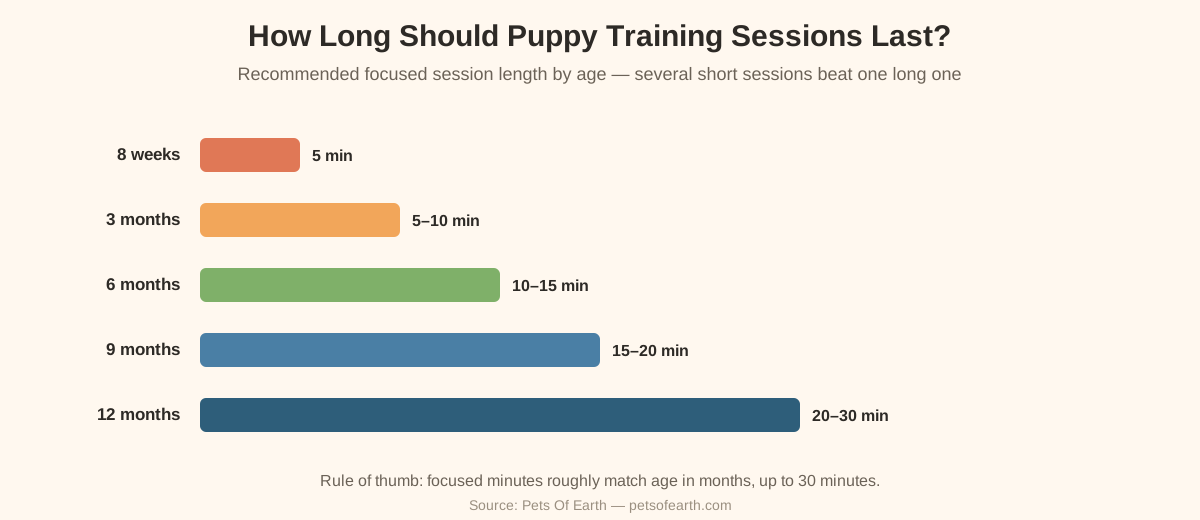
Three short sessions a day beat one long session every time, as of November 2026 — puppies learn in the gaps between sessions as much as during them. End every session on a success: ask for one easy cue your puppy already knows, reward it generously, and stop.
If you want structure without guesswork, our roundup of free puppy training apps turns this schedule into daily reminders and step-by-step lessons.
What are the most common puppy training mistakes?
The most common mistake is training too long. A 10-week-old puppy asked to train for 20 minutes is not being stubborn when it wanders off — it is exhausted. Quit while the puppy is still winning.
The second mistake is repeating cues. Saying “sit, sit, SIT, sit!” teaches a puppy that the first three sits do not count. Say a cue once, wait three seconds, and if nothing happens, lure the behavior and try again later.
The third mistake is training only in the kitchen. A cue learned in one room does not automatically transfer to another. Practice every skill in at least three places — the kitchen, the garden, and the front sidewalk — before you call it learned.
The fourth mistake is rewarding inconsistently. If jumping up earns attention on Monday and a scolding on Tuesday, the puppy learns that jumping sometimes works — and “sometimes” is the most addictive reward schedule there is. The fifth mistake is waiting for the puppy to “grow out of it”: puppies grow into whatever behavior gets rewarded.
Frequently asked questions
When should I start training my puppy?
Start on the day your puppy comes home, usually at 8 weeks, with house training, name recognition, and gentle handling. Formal cues such as sit and come can begin at 12 weeks.
How long does it take to train a puppy?
Basic house training usually takes 4 to 6 months of consistent routine, and reliable obedience takes until 12 months or longer, as of November 2026.
Is 6 months too late to start training a puppy?
No — 6 months is an excellent age to start, and it is never too late to train a dog of any age. A 6-month-old puppy learns faster than an 8-week-old one, so you can catch up on basic cues within weeks.
How many hours a day should I train my puppy?
Train in short sessions totalling 15 to 30 minutes a day, split across 2 to 4 sessions. Every potty trip, meal, and greeting is also a training opportunity.
A puppy training schedule by age is not a race — it is a map: 8 weeks for the foundations, 3 to 4 months for the first cues and the socialization peak, 6 months for self-control, and 9 to 12 months for the real world. Follow the map, keep sessions short, and reward generously.