
Photo: Cat into the box by Broc, public domain, via Wikimedia Commons.
Quick answer: Cats love cardboard boxes because a box gives them three things at once: a hiding spot where nothing can sneak up behind them, a warm insulated nest, and a perfect ambush spot for play. A 2014 Utrecht University study found shelter cats given a hiding box settled in much faster than cats without one, reaching the same low stress level in about 3 days instead of 14.
This guide is for cat owners who have watched their cat ignore an expensive bed and climb straight into the delivery box it came in. We compared what the research actually found with guidance from Cornell’s shelter medicine team, so you can see which claims hold up — and how to turn a free box into real enrichment.
What did the Utrecht study actually find?
In 2014, researchers at Utrecht University’s Faculty of Veterinary Medicine set out to test whether a hiding box helps newly arrived shelter cats cope with stress. Shelters are stressful places for cats, and the researchers noted that raised cortisol can suppress a cat’s immune system and lead to more infectious disease.
The study was small but well designed: 19 newly arrived cats at a Dutch animal shelter were randomly split into two groups, 10 with a hiding box and 9 without. Researchers scored each cat’s stress over 14 days on the Kessler and Turner Cat-Stress-Score, a standard scale based on observed behavior.
On days 3 and 4, the cats with a box had significantly lower average stress scores than the cats without one (p < 0.01), and the scores were consistent across nearly all the cats in the box group. By day 14, both groups had reached the same low stress level — but the cats with a box had already reached that level around day 3. Claudia Vinke summed it up in one line: “Hiding is a behavioral strategy of the species to cope with environmental changes and stressors.”
A 2019 follow-up in PLOS ONE confirmed the pattern: of 23 shelter cats aged 1 to 10, the box group of 12 reached a lower steady stress level seven days earlier than the control group of 11.
Both studies also set a limit on what a box can do. In the 2019 trial, nearly all cats in both groups lost significant body weight during the first two weeks, and the boxes did nothing to prevent that. There was also no difference in adoption rates or length of stay. So the honest reading: a box speeds up settling in, but it is not a cure for stress. You can read the original 2014 paper in full here (PDF).
Why do cats love boxes so much?
Hiding is how cats cope. Cats are both predator and prey, so their first response to something new or scary is to withdraw somewhere enclosed. With walls on three sides and a single entrance, nothing can approach unseen. Cornell’s College of Veterinary Medicine puts it plainly: cats benefit greatly from the ability to hide when stressed, and a hiding box can be as simple as a cardboard box.
Boxes are warm. A cat’s thermoneutral zone — the range where it stays comfortable without burning extra energy — is 86 to 97 degrees Fahrenheit, per a 2006 National Research Council study. Most homes sit well below that, so a snug cardboard box traps body heat and forces the cat to curl into a ball, which preserves heat.
Boxes are ambush blinds. Cats hunt by waiting unseen, then pouncing. A box is a perfect hideout: walls to stay hidden behind, a clear view of the approach, and one direction to watch. That is why a cat in a box stares at a toy, a passing foot, or another pet. The same hunting instinct is behind other odd cat habits, like why cats bring dead animals home.
Cardboard feels good to shred. Cats need to scratch and chew, and cardboard gives them a safe outlet for both. Cornell lists cardboard boxes among the cheapest enrichment items for indoor cats, alongside paper bags and ping pong balls. A box your cat can dig its claws into is doing real work.
How to use a cardboard box for enrichment
You need nothing but a plain shipping box and five minutes.
- Pick a box your cat can turn around in and lie down curled up in — snug is the point, not so big that it feels open.
- Cut one entrance hole in the side, about as wide as your cat’s shoulders, and fold the flaps back.
- Put a soft blanket or old towel inside so it is warm and smells familiar.
- Place the box in a quiet corner against a wall, away from the litter box and food bowls.
- Drop a toy or a few treats inside so your cat discovers it on its own — never pick your cat up and put it in.
- Keep a second box in another room, and swap in a fresh box every week or two.
If your cat ignores the box for a few days, leave it out anyway — cats often claim a box on their own schedule. For more ideas on keeping an indoor cat busy, see our guide to indoor vs outdoor cats.
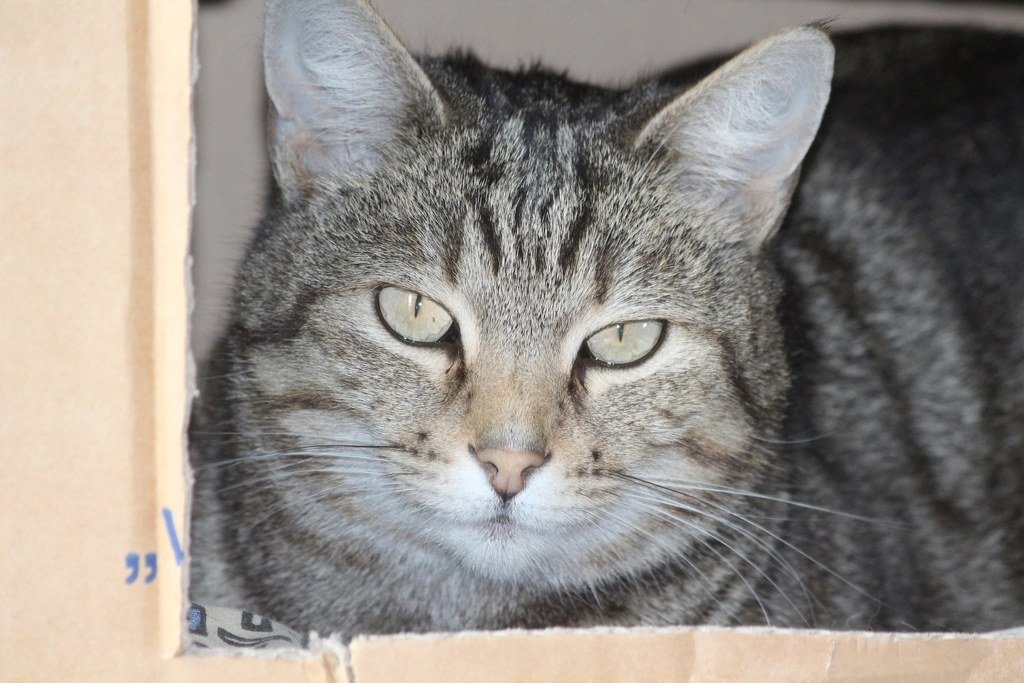
Photo: Cat cardboard box by Rawpixel, CC0, via Openverse.
What size box should you pick — and where should it go?
Size matters more than most owners expect. A box that is too big loses the two things cats want most: warmth and the feeling of being hidden. A box that is too small will simply be ignored. The right size lets your cat lie down fully curled and turn around — a shoe box for a kitten, a standard shipping box for a large adult.
Put the box where your cat already feels safe: a quiet corner, a spare room, or beside the sofa — not in a hallway, and not near the litter box, since cats do not rest where they toilet. If your cat hides in the litter box itself, that is a different signal, and our guide on why your cat sleeps in the litter box explains what it usually means.
Check safety first: pull off tape, stickers, and staples, and check cut edges for sharp points. Never use a box that held chemicals, cleaning products, or anything damp or moldy. Cardboard cannot be cleaned, so Cornell’s shelter medicine team notes a box should be used for one cat only, then discarded or recycled. Replace it once it gets soggy, torn, or chewed through.
What not to do with a cardboard box
- Do not force your cat into the box. A box works because the cat chooses it.
- Do not use a box that held chemicals or food with a strong smell.
- Do not leave tape, staples, or loose flaps on the box. Cats chew and swallow small pieces.
- Do not put the box next to the litter box or food bowls. Resting, eating, and toileting need separate spots.
- Do not treat the box as a fix for a sick or frightened cat. If your cat suddenly hides much more than usual, stops eating, or changes behavior overnight, talk to your vet — hiding is often the first visible sign that something is wrong.
FAQ
Do cats prefer cardboard boxes over cat beds?
Usually, yes — the reason is the shape, not the price. A typical cat bed is open on all sides, while a box is enclosed, warm, and hidden. If your cat ignores an expensive bed, try putting it inside a large box with an entrance cut out. Like kneading, box-sitting is a comfort behavior, not a rejection of you.
Why does my cat sit in a box that is too small?
Because snug is the point. A tight box traps body heat and presses gently on all sides, which feels safe to an animal that hides to cope with stress. If the cat can curl up and turn around, the box fits, even if it looks too small to you. Worry only if the cat seems stuck or cannot get out on its own.
Is it safe for my cat to chew cardboard?
Most cats shred cardboard rather than swallowing it, and small amounts are usually harmless. Take the box away if your cat eats chunks of it, vomits after chewing, or goes after tape and glue. Stick to plain brown cardboard, not glossy or heavily printed boxes.
Will a box help my new cat settle in?
Yes — this is the one claim the research backs directly. In the Utrecht study, shelter cats with a box reached a calm stress level around day 3, while cats without one took until day 14. Set up a box in your new cat’s safe room on day one, before you open the carrier.