
Photo: A Beagle sitting next to dog food by Slyronit, CC BY-SA 4.0, via Wikimedia Commons.
Quick answer: How to choose the best dog food for your dog: pick a complete and balanced food that matches your dog’s life stage, made by a company that can answer questions about how it formulates and tests its food. Start with the AAFCO adequacy statement on the back of the bag, then check the life stage and the feeding directions.
This guide is for dog owners facing fifty bags in the pet food aisle that all claim to be the best. We compared label rules from the FDA and AAFCO with WSAVA’s guidance, so you can judge any bag yourself.
What does “best dog food” actually mean?
There is no single best dog food: the right food depends on your dog’s age, size, activity level, and health. “Best” means a food that gives your dog every nutrient it needs, in the right amounts, at its current life stage.
The baseline is the AAFCO nutritional adequacy statement. AAFCO sets nutrient profiles for dog food, and the FDA explains that a food can only call itself “complete and balanced” if it meets one of those profiles or passes an AAFCO feeding trial. A bag without that statement is not meant to be your dog’s whole diet, and seals from other groups are not proof of nutritional adequacy.
How do you read a dog food label?
Flip the bag over: the front is advertising, and the back is where the decisions live.
- Find the nutritional adequacy statement, usually in small print on the back or side. It should say “complete and balanced” and name a life stage: growth, adult maintenance, or all life stages.
- Check how adequacy was shown: “formulated to meet” the AAFCO nutrient profiles, or proven by AAFCO feeding tests — the stronger proof, since the food was actually fed to dogs under a standard protocol.
- Read the ingredient list, in descending order by weight. Weight includes water, so fresh meat listed first is not automatically more nutritious than a meat meal listed second.
- Read the product name with care: under AAFCO’s naming rules, “beef dog food” must be mostly beef, while “with beef” only needs a small amount and “beef flavor” only a detectable amount of flavor.
- Check the guaranteed analysis and the feeding directions. The numbers are “as fed,” so wet and dry food cannot be compared straight across: canned food is typically 75 to 78 percent moisture, dry food typically 10 to 12 percent.
- Find the maker’s contact details. The World Small Animal Veterinary Association (WSAVA) advises choosing companies that employ a qualified nutritionist, explain who formulates their diets, run quality checks, and answer questions. If a company will not share this information, be cautious about feeding that brand.
How do life stages change the choice?
A dog’s needs shift as it grows, and the label’s life stage is the simplest way to match the food to the dog. There is no AAFCO profile for senior dogs, so “senior” is a marketing term, not a regulated category.
| Life stage | What the food is built for | When to switch |
|---|---|---|
| Puppy | Higher calories, protein, and minerals for fast growth | About 12 months for most breeds, 18 to 24 months for large and giant breeds |
| Adult | Steady weight, lean muscle, and daily energy | From about 1 year old |
| Senior (7+) | Muscle maintenance and healthy aging, usually fewer calories | Most healthy seniors do well on adult food with portion control |
| All life stages | Formulated for growth, so it covers puppies too | Safe in a multi-dog home, but watch adult portions |
Large-breed puppies need special care: a food made for large-breed growth controls calcium and calories so a big puppy grows steadily instead of too fast, which protects developing joints. If your puppy is expected to weigh more than about 70 pounds as an adult, pick a food made for large-breed growth. Bringing a puppy home? Our puppy training schedule by age covers the first months, and our guide on how to introduce a puppy to an older dog helps the first meeting go well.
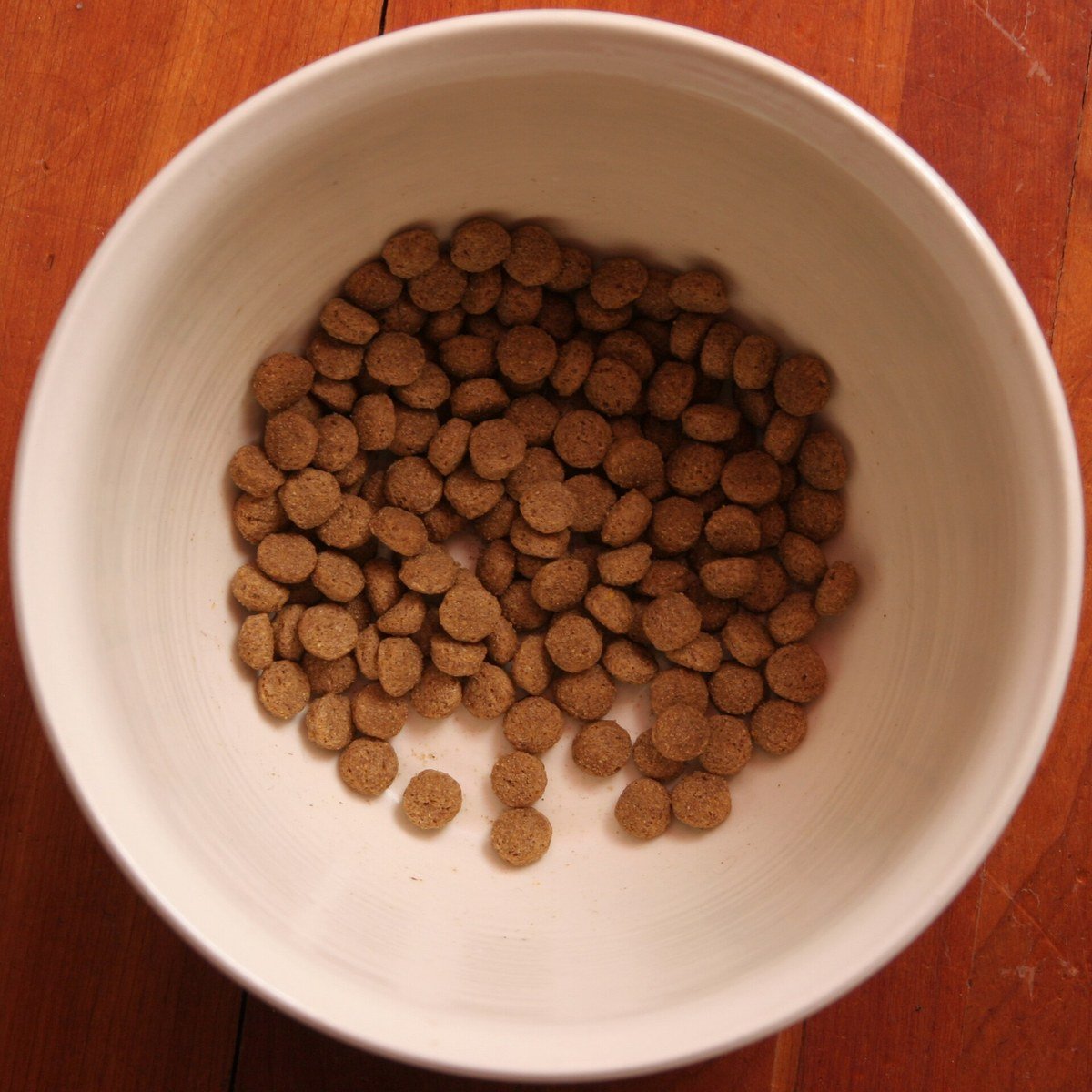
Photo: Dog food in a bowl by James Redekop, CC BY-SA 2.0, via Wikimedia Commons.
Wet food vs dry food: which is better?
Neither is better in general: both can be complete and balanced. The real difference is water — wet food is mostly water, so it looks low in protein on the label even when it is not. To compare fairly, convert to a dry-matter basis: divide the nutrient percentage by the dry-matter percentage and multiply by 100.
| Dry food (kibble) | Wet food (canned) | |
|---|---|---|
| Typical moisture | 10 to 12 percent | 75 to 78 percent |
| Cost per calorie | Usually lower | Usually higher |
| Best for | Most healthy dogs and tight budgets | Picky eaters, dogs that need more water, dogs with few teeth |
Some owners mix the two, which is fine as long as the total stays within the feeding directions. Toppers, treats, and table scraps should stay small: WSAVA puts foods for intermittent or supplemental feeding at about 10 percent or less of the diet. Check human foods first: can dogs eat bananas and can dogs eat apples cover two common choices, and our roundup of the best puppy training treats explains what to look for.
How to choose the best dog food on a budget
Sometimes, but price is a weak guide on its own. A higher price can pay for better quality control, published feeding research, and a staff nutritionist — the things WSAVA tells owners to ask about. It can also pay for a prettier bag.
Words like “premium,” “holistic,” and “natural” do not help either: WSAVA states plainly that these terms are unregulated and of little practical value. “Grain-free” is the same kind of claim — grains are not fillers, and grain-free is not automatically healthier. Judge the food by its adequacy statement, its life stage, and the company behind it, and think about budget as cost per day, not cost per bag. WSAVA’s guidelines on selecting pet foods list the questions to ask any maker.
What not to do when choosing dog food
- Do not pick a food from the front of the bag: words like “premium” and “holistic” are unregulated. Turn the bag over and read the adequacy statement first.
- Do not feed a treat or topper as a main meal: products labeled “for intermittent or supplemental feeding only” are not complete and balanced, and feeding one as a whole diet leaves gaps.
- Do not feed adult food to a puppy. Adult maintenance food does not have the nutrient levels a growing puppy needs, and large-breed puppies need a growth food made for their size.
- Do not switch foods overnight. Mix the new food with the old one over about a week.
- Do not cook a homemade diet from an internet recipe. Most are not complete and balanced, and balancing one properly needs a veterinary nutritionist. Our article on the veterinarian warning about homemade dog food explains why.
When to call your vet
Most healthy dogs do fine on a complete and balanced food matched to their life stage, but some signs mean the question needs a vet, not a new bag. Call your vet if your dog is losing or gaining weight without a clear reason, has ongoing diarrhea or vomiting, refuses food for more than a day, or shows itchy skin, ear infections, or a dull coat. The same applies with a diagnosed condition such as kidney disease, diabetes, or a serious food allergy: those dogs often need a diet chosen with a vet or a board-certified veterinary nutritionist.
We are not veterinarians. This article is general information; talk to your vet about your own pet.
FAQ
How do I know if a dog food is good quality?
Check the AAFCO nutritional adequacy statement first: it should say the food is complete and balanced for your dog’s life stage. Then look at the company — WSAVA advises picking makers that employ a qualified nutritionist and answer questions about their food.
Is grain-free dog food better for my dog?
Not as a rule. Grains are not fillers, and most healthy dogs digest properly cooked grains well. Grain-free is useful only if your vet has found a specific grain problem.
How much should I feed my dog each day?
Start with the feeding directions on the bag, then adjust to your dog’s body condition. Weigh the food, keep treats under about 10 percent of daily calories, and ask your vet if your dog’s weight keeps drifting.
Can I mix wet and dry dog food?
Yes, as long as the main food is complete and balanced and the total stays within the feeding directions. Wet food adds water and flavor, which helps picky eaters. Measure both parts so the mix does not quietly add extra calories.